Families packing an occasional bean lunch
A tin can wait in the cupboard until needed, but a plan to serve the beans hot depends on the school’s arrangements. Check how prepared food will be kept until lunchtime.


Choose a reduced-sugar-and-salt or no-added-sugar tin if its label shows the difference you want for the portion being packed; a smaller can may be more practical if one lunch would leave much of a larger tin unused. Check the school’s arrangements before planning hot beans, and include other foods alongside the beans rather than making them the whole lunch.
Can size, preparation and the rest of the lunch matter as much as the variety of beans.
A tin can wait in the cupboard until needed, but a plan to serve the beans hot depends on the school’s arrangements. Check how prepared food will be kept until lunchtime.
Compare the exact standard and reduced varieties by sugars and salt per 100g, then consider how much will go into the lunch. A reduction claim has its own stated comparator.
Beans can provide the bean component of a packed lunch. The Department for Education’s school-food guidance also describes fruit, vegetables and starchy foods as parts of a varied diet.
Start with the intended portion and how the beans will be served, then compare nutrition labels on the exact tins under consideration.
| Priority | What to check | Your needs |
|---|---|---|
| Sugars and salt | Compare both figures per 100g and for the portion you intend to pack. Check which regular recipe a reduction claim refers to: Waitrose & Partners lists 2.0g sugars and 0.30g salt per 100g for Essential Reduced Salt & Sugar, against 3.4g and 0.49g for regular Essential beans. | I’m looking for a difference in the amount my child will eat, not just reduced wording on the front of a tin. |
| Can size | Read the net weight and any declared servings. A 220g can and a 415g can call for different portion and leftover plans; check the opened-can storage instruction if choosing the larger size. | For one lunch, I would rather choose a suitable amount or know when the remainder will be used. |
| Serving at school | Ask whether the school permits hot food and provides reheating. If packing prepared beans, check how the lunch will be kept until it is eaten; GOV.UK advises keeping a fridge between 0 and 5°C. | A hot lunch only works for us if there is an agreed way to prepare and carry it for lunchtime. |
| The rest of lunch | Plan what will accompany the beans. The Department for Education’s school-food guidance includes beans among non-dairy protein foods and also describes starchy foods, fruit and vegetables. | I want the beans to be one part of lunch, with other foods my child will eat alongside them. |
A reduction claim refers to a specified regular recipe, not necessarily to other brands. Waitrose & Partners, for example, compares its Essential Reduced Salt & Sugar beans with its regular Essential beans.
Read sugars and salt per 100g on both tins you are considering, then compare the figures for the portion you plan to serve.
If one lunch uses only part of a can, the rest needs appropriate storage. Waitrose & Partners instructs shoppers to transfer its regular Essential beans to a covered, non-metallic container, refrigerate them and use them within two days.
Check the instructions on your chosen can before opening it, or consider a smaller size when that better matches the lunch portion.
Reheating arrangements differ by setting. Tower Hamlets Council’s holiday-childcare packed-lunch guidance says that its scheme does not reheat food; that does not establish a rule for other schools.
Ask the individual school about hot food, food flasks and lunchtime storage before relying on a hot-bean lunch.
Beans cover one part of the meal, while the Department for Education’s school-food guidance also describes starchy foods, fruit and vegetables.
Choose accompaniments such as bread or a wrap and fruit or vegetables that suit the pupil and the school’s packed-lunch arrangements.
These examples show why the exact variety matters; the figures describe the named products, not everything sold under each brand.
Heinz offers standard baked beans and a No Added Sugar variety. The named variety’s label is the relevant comparison if sugars and salt are priorities.
The regular and Reduced Salt & Sugar varieties provide a within-range comparison, including a 220g reduced-variety can.
M&S baked beans provide a standard 400g-can example for comparing nutrition figures and portion size.
These tins offer different can sizes and standard or reduced-sugar-and-salt wording for a packed-lunch plan. Compare the current label and the portion you intend to serve.
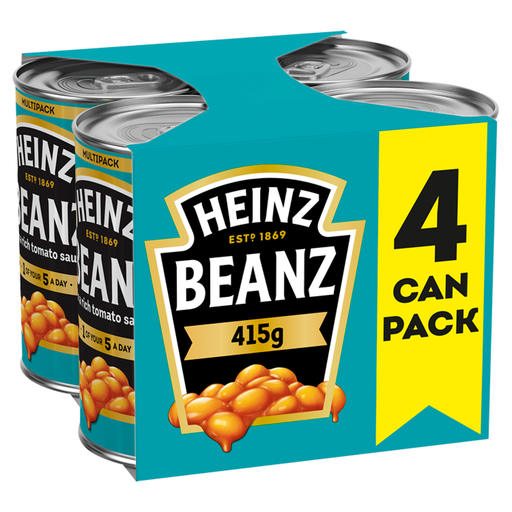 Image unavailable
This four-pack is an option when beans are planned for more than one lunch. Each can is 415g, so decide on the lunch portion and how you will store any opened remainder; check the school’s arrangements before planning to serve the beans hot.
 Image unavailable
Consider this reduced-sugar-and-salt variety if those label figures matter to your choice. The pack contains four 410g cans; compare the current nutrition panel with the alternative you are considering, and plan for any beans left after serving one lunch.
 Image unavailable
The 220g can is worth considering when a smaller tin better matches one packed-lunch portion. Check its nutrition and serving instructions on the can, and confirm the school’s arrangements if the lunch is intended to be hot.
Check the individual school’s packed-lunch and reheating arrangements before deciding how to serve them. Tower Hamlets Council says its holiday-childcare scheme does not reheat lunches, which illustrates why access to reheating should not be assumed at another setting. If the beans are prepared in advance, plan how they will be kept until lunchtime.
Choose by the figures on the exact tins and the amount you intend to pack. Waitrose & Partners lists 2.0g sugars and 0.30g salt per 100g for Essential Reduced Salt & Sugar, versus 3.4g and 0.49g for regular Essential beans; its reduction claim compares those two varieties, not every brand.
Follow the storage and use-after-opening instructions on that can. Waitrose & Partners instructs shoppers to transfer its regular Essential beans to a covered, non-metallic container, refrigerate them and use them within two days. GOV.UK advises keeping a fridge between 0 and 5°C.