Regular second-home visitors
If you use the property often, several unopened tins may be practical cupboard stock. Check the best-before marking on each tin and bring older stock forward before adding more.


For a second home used regularly, a multipack makes sense if you can use and rotate its tins between visits. For shorter stays, consider whether a smaller tin would prevent leftovers; if you prefer a reduced-sugar-and-salt recipe, compare the per-100g label and ingredients rather than assuming it is the same as standard beans.
If you use the property often, several unopened tins may be practical cupboard stock. Check the best-before marking on each tin and bring older stock forward before adding more.
If baked beans are a regular meal, compare salt and sugars per 100g and read the ingredients. Reduced-sugar-and-salt versions can contain different ingredients from standard recipes.
A smaller tin may be easier to finish during a short stay. Once a tin is opened, follow its instructions for transferring, refrigerating and using any leftovers.
Start with how many tins you will use between visits, then compare recipes and the storage instructions for the formats that suit your stay.
| Priority | What to check | Your needs |
|---|---|---|
| Stock quantity | Check the number and size of tins. Read the best-before marking on each tin and rotate older stock forward. | I visit often enough to use a multipack without leaving tins forgotten at the back of the cupboard. |
| Recipe | Compare salt and sugars on the same per-100g basis. Read the ingredients when switching between standard and reduced-sugar-and-salt beans. | A different recipe might suit my preferences, but I do not want to assume it will taste or contain the same ingredients as standard beans. |
| Unopened storage | Check the tin’s storage directions and best-before marking. Tesco and Joybuy Branston product information specifies cool, dry storage for unopened tins. | The cupboard needs to accommodate tins while the property is empty between visits. |
| Leftovers | Choose a tin size you can use during the stay. Check the individual product’s directions for transferring and refrigerating opened contents. | On a brief visit, I would rather plan around a whole tin than leave part of one behind. |
ASDA’s Reduced Salt & No Added Sugar beans list steviol glycosides. A change in the salt or sugars figures does not describe every difference in the recipe.
Compare the per-100g nutrition panel and ingredient list with the standard tin before choosing.
Opened contents need different handling from unopened cupboard stock. Marks & Spencer says to transfer unused beans to a non-metallic container, refrigerate them and eat them within 3 days; Joybuy’s Branston 4 x 410g directions specify use within 2 days.
Follow the directions on your tin and plan a short stay around an amount you can finish.
GOV.UK explains that a best-before date concerns quality; how long a canned food remains acceptable after that date depends on the product and its storage conditions.
Check each tin’s date and condition when you arrive, and move older tins forward before adding new ones.
These product-line details can help you compare recipes and storage directions; they do not describe every tin sold under each name.
Tesco’s standard baked beans come in a 4 x 420g multipack, a format to consider if visits are frequent enough to use several tins.
ASDA’s Reduced Salt & No Added Sugar baked beans are listed as a 4 x 410g pack.
Sainsbury’s lists standard baked beans in a 4 x 400g multipack.
Tesco lists standard Heinz and Heinz No Added Sugar baked beans in 4 x 415g packs for shoppers choosing between those recipes.
Branston has standard and Reduced Sugar & Salt baked-bean variants.
M&S baked beans are a 400g option to consider when that tin size suits a visit.
Waitrose lists Essential standard baked beans in a 420g tin.
These Branston options include standard multipacks, a Reduced Sugar & Salt multipack and a smaller single tin. Choose the quantity and recipe for your visits, and check each product’s current label before use.
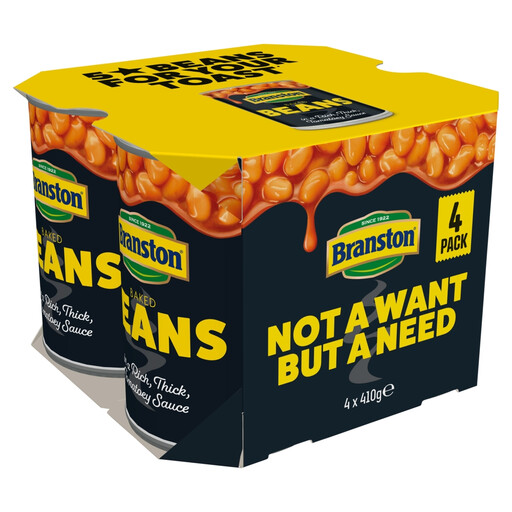 Image unavailable
Four 410g tins may suit repeat visits. Joybuy specifies cool, dry storage while unopened; after opening, transfer leftovers to a container, refrigerate and use within 2 days.
 Image unavailable
This four-tin pack offers a different recipe from standard Branston beans. Branston lists 0.39g salt per 100g for the reduced variant; compare its full nutrition panel and ingredients with the standard tin.
 Image unavailable
Six 410g tins provide stock for several visits if you will use them. Check each tin’s best-before marking and rotate older tins forward.
 Image unavailable
This single 220g tin is an option when a short stay calls for less than a standard-sized tin. Check the can’s directions for storage and any unused contents.
Unopened tins can be kept between visits when you follow their storage directions and check their best-before markings. Tesco’s baked-bean listing specifies cool, dry storage; check the instructions on the tins you buy.
Do not treat opened beans as cupboard stock. Transfer and refrigerate leftovers as directed on the particular tin: Marks & Spencer specifies eating its beans within 3 days of opening, while Joybuy’s Branston 4 x 410g directions specify 2 days.
Read the salt and sugars figures per 100g, then compare the ingredients. For example, ASDA lists 0.34g salt and 1.5g sugars per 100g for its Reduced Salt & No Added Sugar beans, whose ingredients include steviol glycosides.
A best-before date concerns quality, not a use-by safety deadline. GOV.UK gives baked beans as an example of a tinned food carrying a best-before date in its guidance for England, Northern Ireland and Wales; storage conditions and the condition of the tin still matter.