Households using beans regularly
If baked beans feature in several breakfasts or quick meals, a pack of full-size tins may match your weekly routine. Check how many tins you normally open before choosing a four-, six- or eight-pack.


Choose a multipack when your household regularly uses that number of tins and has room to store them; individual tins give you more flexibility when use varies from week to week. Decide on the tin size and recipe as well as the pack count, and compare the nutrition panels of the exact standard, no-added-sugar or reduced-sugar-and-salt products you are considering.
If baked beans feature in several breakfasts or quick meals, a pack of full-size tins may match your weekly routine. Check how many tins you normally open before choosing a four-, six- or eight-pack.
Individual tins let you adjust the quantity or combine different recipes. A fixed multipack is simpler to put away when you expect to use every tin.
Standard, no-added-sugar and reduced-sugar-and-salt beans are distinct products. Compare the nutrition panel and serving information on the exact tins you would buy, rather than relying on the variant name alone.
Start with the amount your household will use, then check the recipe and whether the tins fit your cupboard routine.
| Priority | What to check | Your needs |
|---|---|---|
| Pack quantity | Count the tins in the pack and compare that number with the meals you expect to make. Check the weight of each tin; packs containing 400g, 410g and 415g tins are represented in the retailer listings. | I use beans several times a week, so I can choose a pack size that fits that routine without filling the cupboard with unwanted tins. |
| Tin size | Look at the weight of each tin, not just the number of tins. Consider whether an opened full-size tin matches the quantity you use for one meal. | For a smaller meal, I would rather choose a tin size that fits than open more beans than I plan to use. |
| Sugar and salt | Compare sugars and salt per 100g on the exact products; use per-portion figures where shown. The NHS explains that pre-packed food nutrition labels give a common per-100g basis for comparison. | I want to compare a standard recipe with a no-added-sugar or reduced-sugar-and-salt version without assuming those names describe every value on the label. |
| Ingredients | Read the ingredients and any dietary statements for the chosen variety. Check the can when buying a different formulation from your usual one. | A change of recipe matters to my household, even if the tins have a familiar brand name or the same pack count. |
| Storage and dates | Check the best-before date and storage instructions, then make room for the number of tins you intend to keep. GOV.UK identifies tinned baked beans as a product commonly carrying a best-before date, which concerns quality. | My cupboard has limited space, so I want a quantity I can store and work through comfortably. |
Standard, no-added-sugar and reduced-sugar-and-salt labels describe different variants. The wording on one pack does not establish the ingredients or nutrition of another.
Compare the ingredients and the per-100g sugars and salt values on the exact products before stocking up.
A larger pack takes more cupboard space, and its best-before date is relevant to the quality of beans kept for later.
Estimate how many tins you will open, check the dates and storage instructions, and put older tins at the front of the cupboard.
Extra tins also mean more to store and keep track of between shops.
These ranges illustrate different pack formats and recipes; a brand’s inclusion here does not establish which specific product suits your shop.
Heinz standard baked beans appear in 4 × 415g, 6 × 415g and 8 × 415g listings from Tesco and Sainsbury’s; a No Added Sugar 4 × 415g variant is also listed by Waitrose.
Tesco lists own-label baked beans in 420g individual tins.
Sainsbury’s lists own-label standard and Reduced Sugar & Salt baked beans in 4 × 400g packs.
Waitrose lists Essential standard and Reduced Salt & Sugar baked beans as 420g individual tins.
M&S lists 400g standard baked beans alongside No Added Sugar and Only 7 Ingredients variants in its tinned-beans range.
These four- and six-tin baked-bean multipacks suit a weekly shop built around full-size tins. Choose the pack count and recipe that fit your household, and check the current product listing before ordering.
 No image available
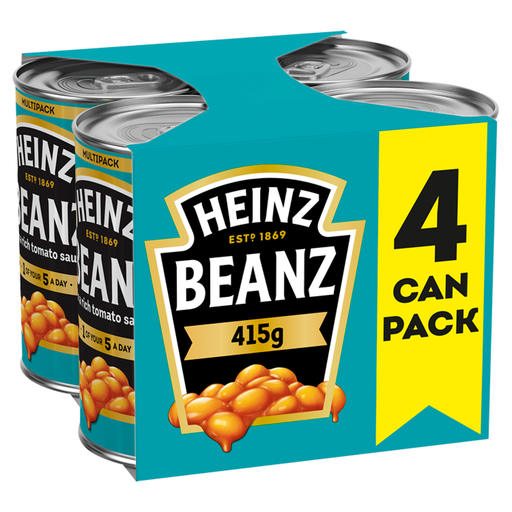
Four full-size tins are an option when you expect to use beans regularly but do not need a six-tin pack. Compare the ingredients and per-100g nutrition of this standard tomato-sauce variety with any alternative recipe you are considering.
 No image available
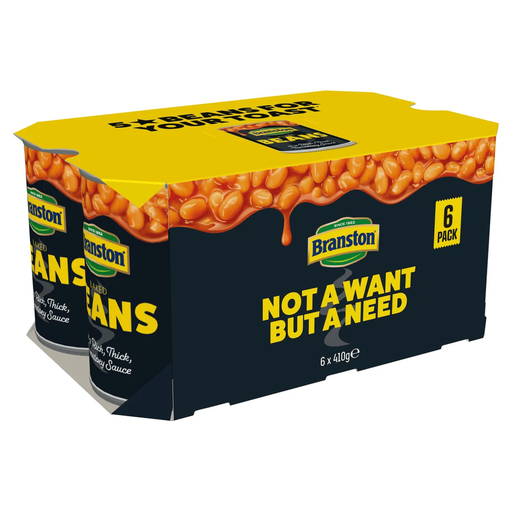
Six 410g tins fit a household that expects to use that quantity and has cupboard space for it. Check this variety’s ingredients and per-100g nutrition if you are comparing it with another Branston recipe.
 No image available
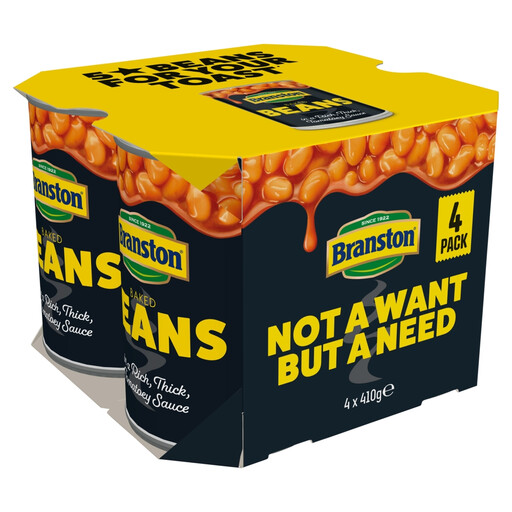
This four-tin pack keeps the 410g tin size while reducing the number of tins to store compared with the six-pack above. Check its nutrition panel and storage instructions for the exact product.
 No image available
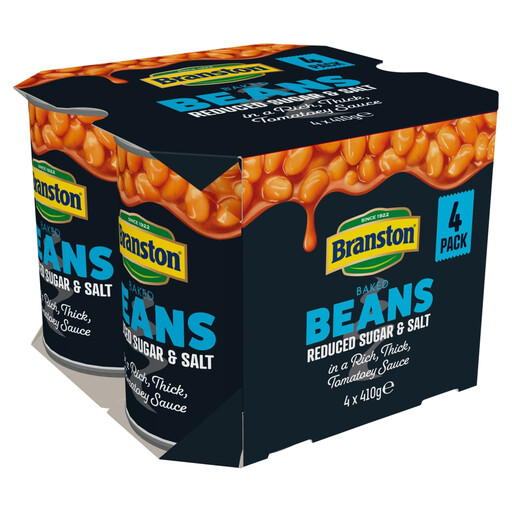
This four-tin pack is the stated reduced-sugar-and-salt variant. The reduction is relative to standard Branston beans; compare sugars and salt per 100g on the exact cans when considering other brands or variants.
Choose individual tins when your household’s use varies, you have limited cupboard space or you want to combine recipes. A multipack makes more sense when you expect to use its full quantity. Tesco also describes an arrangement involving selected individual tins while removing plastic from certain multipacks; check which products qualify.
Match the tin to the amount you normally use at one meal. Full-size baked-bean tins in the supplied retailer listings range from 400g to 420g; a smaller tin may be more convenient when opening a full-size one would leave unwanted beans.
No. Waitrose’s listing for Heinz No Added Sugar 4 × 415g says that product contains naturally occurring sugars and lists 1.9g sugars per 100g. Read the nutrition panel of the exact product, because the label wording alone does not give its full composition.
Tinned baked beans commonly carry a best-before date. GOV.UK explains that this date concerns quality: food may still be safe to eat afterwards, although its quality may have declined. Follow the storage instructions on the tin as well.
Compare salt per 100g on the nutrition panels of the exact products, and check per-portion information where it is shown. The NHS explains that the per-100g format allows pre-packed foods to be compared on the same basis.