Students sharing a kitchen
Four full-size tins can make sense when housemates expect to use beans for toast, jacket potatoes or shared meals. Check the weight of each tin as well as the number in the pack.


For a shared student kitchen or regular meals, start by considering four full-size tins of around 400–420g each. If you usually eat alone and would leave much of a tin unfinished, a smaller tin may be more practical; if sugar or salt is a consideration, compare the nutrition panels of the exact variants rather than relying on their names. Whichever size you choose, check how long the pack says to keep leftovers after opening.
The useful size depends on how many people will open the tins and whether anyone can use the remainder within the pack’s stated storage period.
Four full-size tins can make sense when housemates expect to use beans for toast, jacket potatoes or shared meals. Check the weight of each tin as well as the number in the pack.
A smaller tin may leave less to refrigerate after one meal. If you choose a full-size tin instead, plan how you will store and use the remainder according to its label.
Reduced Sugar & Salt and No Added Sugar identify particular variants, not their complete nutritional profile. Compare the current panels per 100g and for the portion you expect to serve.
Work out how quickly your household will use an opened tin, then compare pack quantities, labels and storage instructions.
| Priority | What to check | Your needs |
|---|---|---|
| Pack quantity | Check both tin count and weight: four 400g tins provide 1.6kg, while four 420g tins provide 1.68kg. A six-tin pack needs more cupboard space. | We share a kitchen and expect to use beans regularly, so several full-size tins could be useful. If meals are less predictable, I would choose a quantity I can realistically use. |
| Portion size | Compare a smaller 200–220g tin with a 400–420g tin. Check the opened-storage directions if one tin is more than you plan to serve. | Cooking for one, I would rather open a tin close to the amount I need than routinely store a large remainder. |
| Sugar and salt | Identify the exact standard or reduced variant, then compare its sugar and salt declarations per 100g and per intended serving. No Added Sugar does not mean sugar-free. | If I am choosing between variants on this basis, I want the figures for the beans I will actually buy, not just a claim on the front of the pack. |
| Ingredients and allergens | Read the current tin’s ingredients, highlighted allergens and dietary statements. Check the specific variant rather than applying one product’s label to a whole brand. | For an allergy or dietary requirement in our household, I need to check every variant we plan to share. |
| Leftovers | Check whether the label requires transfer to another container, refrigeration and a particular use period. Sainsbury’s specifies two days for its 4x400g beans; the M&S Only 7 Ingredients pack specifies three days. | I need a tin size and storage routine that fit the fridge space available after moving in. |
Four-packs can contain different amounts per tin, and a six-pack commits you to more cupboard stock than a four-pack.
Read the tin weight and pack total, then choose an amount your household expects to use.
A small tin can reduce leftovers at a solo meal, but it provides less cupboard supply when several people regularly eat beans.
Choose the portion format around how many people will share each opened tin, not the move-in shop alone.
Opened-storage instructions differ between the reviewed Sainsbury’s and M&S four-packs, so one pack’s use period should not be applied to another.
Transfer leftovers as directed, refrigerate them and follow the period on the exact pack.
No Added Sugar and Reduced Sugar & Salt distinguish products, but they do not give the sugar and salt amounts in your serving.
Use the name to identify a variant, then read its nutrition panel and serving information.
These ranges illustrate different pack and variant choices; a brand name alone does not establish the ingredients or storage instructions of every tin it sells.
Tesco’s own-label range includes a standard baked-bean 4x420g pack and a Reduced Sugar & Salt four-pack.
Sainsbury’s lists standard and Reduced Sugar & Salt own-label packs of four 400g tins.
Heinz has standard and No Added Sugar 4x415g packs, alongside a smaller 4x200g format.
Branston offers a standard baked-bean pack of four 410g tins.
M&S lists a 1.6kg four-pack of Only 7 Ingredients Baked Beans.
Waitrose lists Essential baked beans in individual 420g tins, including a Reduced Salt & Sugar option.
These options include full-size four- and six-tin packs for shared or frequent use, plus one smaller single tin for a solo portion. Match the quantity to your likely meals and check the chosen product’s label before use.
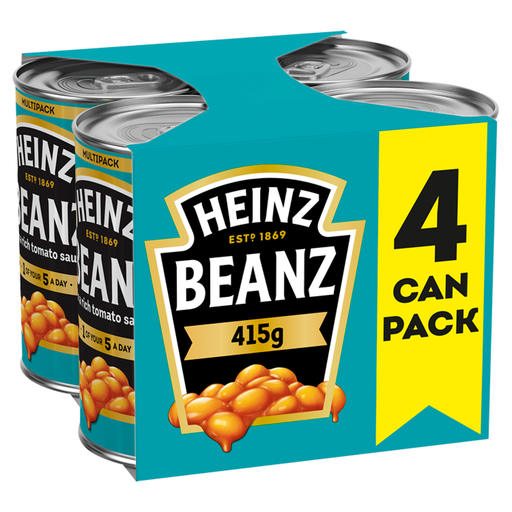 No image available
Four full-size tins suit a household expecting shared meals or regular use. After opening, transfer leftovers to a non-metallic airtight container, refrigerate and use within two days.
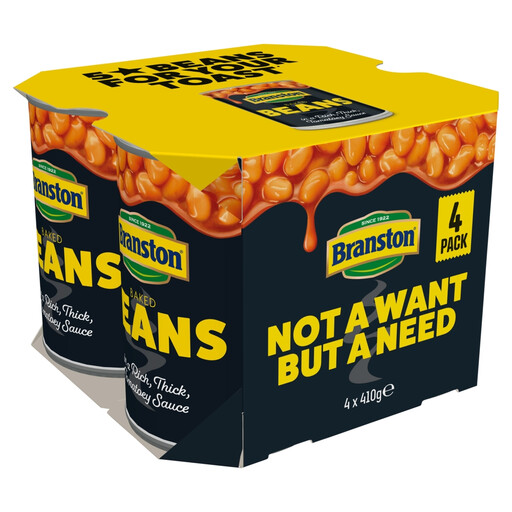 No image available
Four 410g tins offer a full-size pack for regular cupboard use. Transfer opened leftovers to a suitable container, refrigerate and use within two days.
 No image available
This four-tin variant is an option when you want to compare reduced-sugar-and-salt beans with standard packs; read its current nutrition panel for the figures relevant to your serving. Refrigerate opened contents in a suitable container and use within two days.
 No image available
Six full-size tins provide more cupboard stock than a four-pack, so consider how often the household expects to use them. Refrigerate opened contents in a covered container and use within two days.
 No image available
This single 220g tin is a smaller-portion alternative, not a family multipack. If any beans remain after opening, transfer them to a separate container, refrigerate and use within two days.
Four 400–420g tins provide 1.6–1.68kg and are worth considering if housemates expect to use beans regularly. If you normally cook for one, compare that quantity with smaller tins and plan for any leftovers.
No. Transfer the beans to a microwave-safe dish and follow the heating directions on the product; check that they are piping hot before serving.
Follow the exact pack’s instructions. Sainsbury’s 4x400g beans specify transfer to a non-metallic container, refrigeration and use within two days; the M&S Only 7 Ingredients four-pack specifies refrigeration and use within three days.
Not necessarily: GOV.UK explains that best-before dates concern quality and that tinned foods such as baked beans are usually safe after that date, though their quality may change. Store the tin as directed, and do not treat a best-before date as interchangeable with a use-by date.
Read the ingredients, emphasised allergens and dietary statements on the current pack of the exact variant. GOV.UK guidance explains the labelling requirements for allergens in prepacked foods; do not assume that every product from one brand has the same ingredients or warnings.