What should you check?
Start with how much you expect to serve, then compare the exact recipes and labels of tins in a suitable format.
| Priority |
What to check |
Your needs |
| Tin size |
Check the number of tins, the weight per tin and the total pack weight. Retailer listings include 400–420g full-size tins and 200g Heinz tins. |
I’m serving several plates, so a multipack of full-size tins may make sense. For a smaller breakfast, I’d rather open only the amount I expect to use. |
| Recipe |
Compare standard own-label and branded beans by their exact ingredients and nutrition panels; do not assume recipes are the same across ranges. |
A particular recipe matters to me more than the brand name alone, so I’ll check the tin I’m buying. |
| Sugars and salt |
Read both figures per 100g on the exact variant. NHS food-label guidance uses 0.3g of salt or less per 100g as its low-salt threshold; a no-added-sugar label does not establish the salt content. |
If I’m comparing altered recipes, I want to see what each label says about sugars and salt separately. |
| Ingredients |
Check the ingredient list, allergen statement and any vegetarian or vegan declaration on the exact product, particularly for beans with added ingredients. |
For a breakfast with dietary requirements, I need the declaration on this tin rather than an assumption about baked beans generally. |
| Leftovers |
Read the opened-tin storage instructions before choosing a larger tin. The Joybuy page for Heinz Baked Beans in Tomato Sauce 415g says to transfer leftovers to a covered container, refrigerate and use within two days. |
If I won’t finish a full-size tin at breakfast, I need a plan for the rest or a smaller format. |
Which brand ranges are relevant?
These retailer listings illustrate different tin sizes and recipes; check the exact product rather than applying one range’s details to another.
Heinz
Retailer listings include standard 4 x 415g tins, a 4 x 200g format and a separate No Added Sugar 415g tin.
- The Waitrose listing describes the standard 4 x 415g product as suitable for vegetarians and vegans.
- The No Added Sugar tin is a different variant; check its own nutrition panel rather than applying the standard tin’s details to it.
Tesco
Tesco lists own-label standard and reduced-sugar-and-salt baked beans in 4 x 420g packs.
- Both listed variants use the same tin size and pack count, making the exact recipes straightforward to compare.
- Check each variant’s label; a shared pack format does not mean identical nutrition.
Sainsbury’s
Sainsbury’s lists own-label standard and reduced-sugar-and-salt baked beans in 4 x 400g packs.
- The listed four-packs provide a full-size-tin option for planning several servings.
- Compare the exact variant’s ingredients and nutrition rather than treating the two recipes as equivalent.
M&S
The M&S baked-beans product page describes a 400g tin; it is a single-tin reference rather than a multipack example.
- Its product page lists haricot beans at 49% and tomatoes at 33%, with 0.53g salt per 100g.
- Use those details for that product, not for every bean recipe in the M&S range.
Waitrose
Waitrose lists Essential baked beans in 420g tins alongside branded four-packs of different tin sizes.
- The listings let you compare full-size 415–420g tins with the smaller Heinz 200g format.
- Check whether you are choosing individual tins or a pre-packed multipack; the formats are not the same.
Joybuy multipacks to consider
These four- and six-tin baked-bean packs are options for planning a weekend breakfast. Compare their pack sizes and exact recipes against the number of servings you expect.
 No image available
Branston Reduced Sugar & Salt Baked Beans, 4 x 410g
Four 410g tins offer a full-size multipack for a breakfast where several servings are planned. This is the reduced-sugar-and-salt variant; compare both per-100g entries on its label if those differences matter to you.
View on Joybuy
 No image available
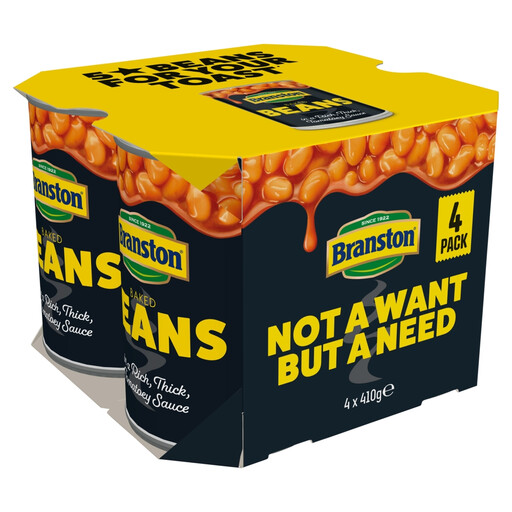
Branston Baked Beans, 4 x 410g
This standard four-tin pack suits a plan that calls for several full-size tins. The Joybuy product page states 4 x 410g, totalling 1,640g, and instructs you to transfer opened leftovers to a container, refrigerate and use within two days.
View on Joybuy
 No image available
Branston Beans in Tomato Sauce, 6 x 410g
Six 410g tins give you more unopened tins to draw on when planning several breakfasts or a larger gathering. Check how many tins you expect to open and follow the pack’s instructions for any leftovers.
View on Joybuy
 No image available
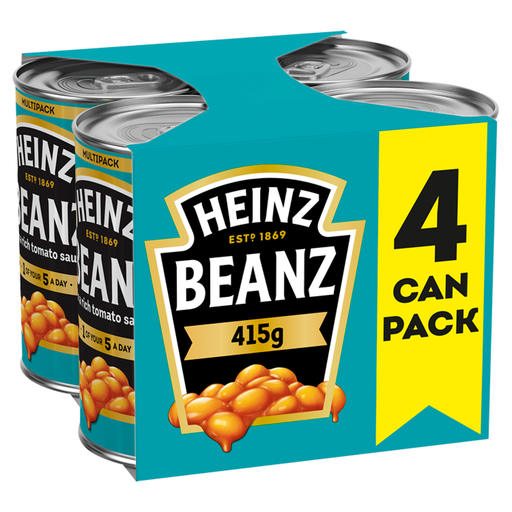
Heinz Baked Beans in Tomato Sauce, 4 x 415g
Four 415g tins are an option when you want the standard Heinz recipe for several breakfast servings. The Waitrose listing for the standard 4 x 415g product describes it as suitable for vegetarians and vegans; check the declaration on the pack you receive.
View on Joybuy
Questions about buying and using baked beans
How many tins should I choose for a weekend breakfast?
Choose by the number of servings you expect and the weight of each tin, not the tin count alone. Retailer listings include multipacks of 400–420g tins and smaller 200g Heinz tins; the smaller format may be more practical when you do not expect to finish a full-size tin.
Does “no added sugar” mean baked beans are low in salt?
No. The Joybuy page for Heinz Beanz No Sugar Added 415g lists 0.4g salt per 100g, while NHS food-label guidance defines low salt as 0.3g or less per 100g. Check both nutrients on the exact product.
What should I do with beans left from an opened tin?
Follow that tin’s storage instructions. For Heinz Baked Beans in Tomato Sauce 415g, the Joybuy product page says to transfer leftovers to a covered container, refrigerate them and consume them within two days.
Are baked beans suitable for a vegetarian or vegan breakfast?
Check the exact recipe. Waitrose describes its listed standard Heinz 4 x 415g baked beans as suitable for vegetarians and vegans, but that declaration should not be extended to beans with added ingredients or to other variants.
Should I compare nutrition per serving or per 100g?
Use the per-100g figures to compare tins of different sizes, then consider the amount you expect to serve. NHS food-label guidance notes that nutrition information is given per 100g or 100ml and sometimes per portion; a stated portion may differ from the amount on your plate.


