School-term cupboard stockers
If beans regularly feature in breakfasts, lunches or evening meals, match the number of tins to expected use and the space available to store them.


For regular school-term meals, choose a tin count that fits your cupboard space and how often you expect to serve beans. If sugar or salt matters to your choice, compare the exact recipes per 100g rather than relying on the words “reduced” or “no added sugar”; check the tin’s ingredients, allergens and storage instructions too.
If beans regularly feature in breakfasts, lunches or evening meals, match the number of tins to expected use and the space available to store them.
If declared sugar and salt matter to you, compare figures per 100g for the specific standard, reduced-sugar-and-salt or no-added-sugar tin.
If someone in the household has an allergy or dietary restriction, check the ingredients and allergen information on the exact product received before serving it.
Start with the number and size of tins you will use, then compare recipes and the instructions that apply once a tin is opened.
| Priority | What to check | Your needs |
|---|---|---|
| Pack size | Compare tin count and net weight. Consider how many tins you expect to open during the school term and where the unopened pack will fit. | Four tins would cover my usual meals; a six-pack makes sense only if I expect to use the extra tins and have room for them. |
| Sugar and salt | Read sugars and salt per 100g on the exact variant. Tesco states that its Reduced Sugar & Salt 4 x 420g recipe has 30% less sugar and 25% less salt than its own standard beans; that comparison does not cover other brands. | I want to compare the recipes I would actually serve, rather than assume every tin labelled “reduced” has the same figures. |
| Leftovers | Check the opened-tin instructions and whether the tin size suits likely portions. Tesco and Sainsbury’s checked four-pack listings instruct refrigeration and use within 2 days of opening. | If a meal uses only part of a tin, I need a way to store the rest and use it within that tin’s stated period. |
| Ingredients and allergens | Read the current ingredients, allergen information and any dietary-suitability statement for the exact product. GOV.UK says regulated allergens present as ingredients in prepacked food must be clearly labelled in the ingredients list. | Someone in my household needs the particular tin checked; a different size or recipe may have different labelling. |
A larger pack takes more cupboard space, even when each tin is a familiar size.
Check the tin count and net weight against your likely school-term meals before choosing a four- or six-pack.
Standard, reduced-sugar-and-salt and no-added-sugar recipes can have different declared sugars and salt per 100g. “No added sugar” does not mean sugar-free.
Compare the nutrition panels and ingredients lists on the exact variants you are considering.
Instructions for unopened tins do not apply to leftover beans after opening. The checked Tesco and Sainsbury’s listings specify refrigeration and use within 2 days.
Follow your tin’s directions for transferring and storing leftovers, and check its stated use-within period.
An ingredient or allergen statement for a previous recipe may not describe the tin delivered to your household.
For an allergy or dietary restriction, read the physical label before serving and ask the retailer or manufacturer if anything is unclear.
These examples show how pack formats and recipe labels differ; check the exact product rather than extending one variant’s details across a brand.
Tesco lists standard and Reduced Sugar & Salt baked beans in 4 x 420g packs.
Sainsbury’s lists a standard baked-bean multipack containing 4 x 400g tins.
The checked Heinz range includes standard and No Added Sugar 4 x 415g multipacks.
Waitrose & Partners lists an essential Waitrose baked-bean tin in a 420g size.
The checked M&S baked-bean product is a 400g tin.
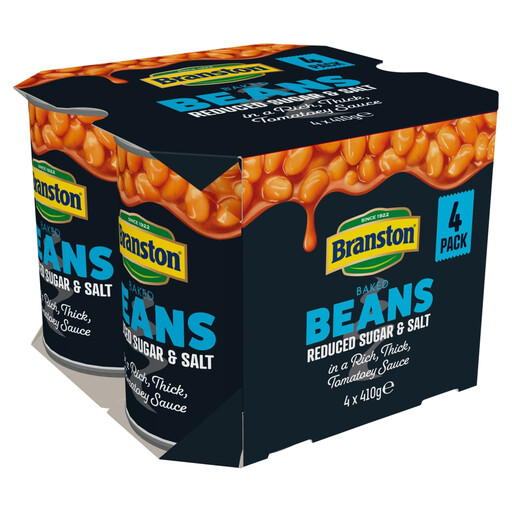
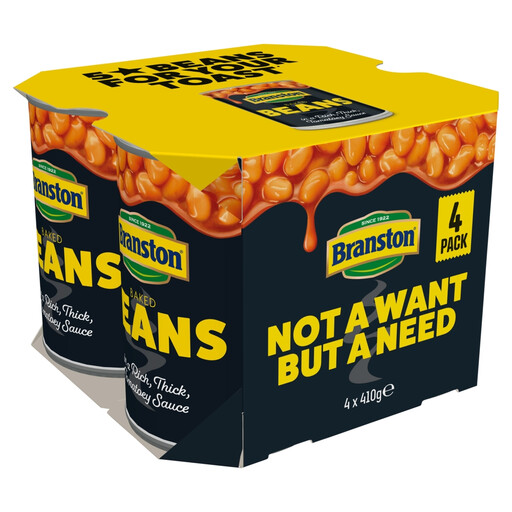
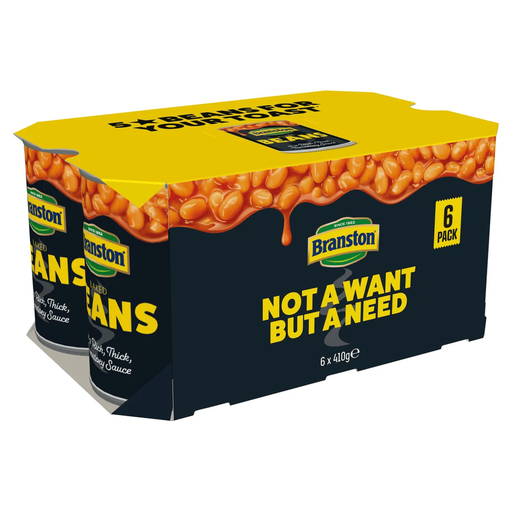
These Branston four- and six-tin packs offer different cupboard quantities for school-term meals, including a reduced-sugar-and-salt four-pack. Compare the exact labels and choose a quantity you expect to use.
 No image available
A four-tin option for households comparing reduced-sugar-and-salt recipes. Check the current tin’s per-100g figures, ingredients and opened-tin instructions before choosing it.
 No image available
A standard four-tin pack for regular cupboard use. Compare its nutrition panel with any reduced recipe you are considering, and follow the label when storing leftovers.
 No image available
Six tins suit a household expecting to use the larger quantity and able to store it. Check the exact tin’s ingredients, nutrition panel and directions for opened leftovers.
Compare sugars and salt per 100g on the specific tins you would buy. Tesco lists 3.0g sugars and 0.29g salt per 100g for its Reduced Sugar & Salt 4 x 420g pack; Waitrose & Partners lists 1.9g sugars and 0.4g salt per 100g for the checked Heinz No Added Sugar 4 x 415g pack. The recipes and ingredients differ, so check the current labels rather than choosing by the front-of-pack wording alone.
Follow the instructions on that tin and refrigerate leftovers as directed. The checked Tesco and Sainsbury’s four-pack listings specify use within 2 days of opening, while Marks & Spencer gives 3 days for its checked 400g tin.
Read the ingredients and any precautionary allergen statement on the exact tin received. GOV.UK says that any of the 14 regulated allergens present as ingredients in prepacked food must be clearly labelled in the ingredients list; do not assume another recipe or an older listing has identical information.
Baked beans in tomato sauce can count, but NHS guidance says beans and pulses count only once towards 5 A Day even if you eat more than one serving. The NHS also advises choosing versions lower in salt and sugar; compare labels if you are deciding between recipes.