First-time cupboard stockers
If you want one cupboard tin rather than a multipack, compare its weight and stated servings with the meals you have planned. The ASDA 410g and Sainsbury's 400g standard tins each state two servings.


A standard 400–420g tin suits a first shop if you plan to use two portions; a 220g tin is worth considering if you want beans for one meal without leftovers. If the listed sugar or salt matters to your choice, compare standard and reduced versions on the same serving basis, then check the ingredients and storage instructions on the tin you buy.
If you want one cupboard tin rather than a multipack, compare its weight and stated servings with the meals you have planned. The ASDA 410g and Sainsbury's 400g standard tins each state two servings.
A smaller tin may fit a single planned meal. Waitrose & Partners lists its Essential reduced-salt-and-sugar 220g tin as one serving, whereas its Essential standard 420g tin states two.
Use the nutrition panel and keep serving sizes consistent. ASDA lists 3.1g sugars and 0.70g salt per half-can for its reduced 410g tin, compared with 8.6g sugars and 0.96g salt per half-can for its standard 410g tin.
Start with the number of meals you expect from the tin, then compare the label details that matter to you.
| Priority | What to check | Your needs |
|---|---|---|
| Portions | Check the tin weight and stated servings. Waitrose & Partners lists its reduced 220g tin as one serving; its standard 420g tin states two. | I'm planning one meal and would rather not store a second portion—or I know I'll use a larger tin across two meals. |
| Sugars and salt | Compare figures on the same per-serving or per-100g basis. ASDA lists 3.1g sugars and 0.70g salt per half-can for its reduced 410g tin, against 8.6g and 0.96g for its standard 410g tin. | If these figures affect my choice, I want to compare the actual panels rather than rely on a front-of-pack description. |
| Leftover storage | Read the opened-tin instructions and have a covered, non-metallic container ready. Waitrose & Partners instructs shoppers to refrigerate its Essential standard beans and use them within two days of opening. | A two-serving tin works for me only if I can store and use the remainder as directed. |
| Ingredients and allergens | Check the ingredients, emphasised allergens and dietary statements on the physical tin. Marks & Spencer states that its researched organic and no-added-sugar beans are not suitable for people with milk or egg allergy. | I need the particular tin I buy to fit my ingredient or allergy requirements, not just the general type of beans. |
Figures can differ even when tins have similar weights. ASDA lists 0.96g salt per half-can for its standard 410g beans, while Tesco Groceries lists 1.24g per half-can for Branston's standard 410g tin.
Compare the current labels on the same serving basis if salt or sugars influence your choice.
A larger tin may leave beans to store after the first meal. Waitrose & Partners instructs shoppers to move unused beans from its Essential tin to a covered, non-metallic container and refrigerate them.
Read your tin's opened-storage period before using it. GOV.UK advises refrigerating leftovers within one to two hours and eating them within 48 hours or freezing them.
Ingredients and allergen information on a product you buy may differ from an earlier listing. That matters particularly when an ingredient must be avoided.
Check the physical tin's ingredients, allergen statement, nutrition panel and storage instructions before buying or eating it.
These examples show formats and label details worth comparing; a brand name alone does not tell you the portion size or ingredients of a particular tin.
ASDA Groceries lists both standard and reduced-salt, no-added-sugar baked beans in 410g tins.
Sainsbury's lists a standard 400g baked-bean tin as two servings.
Waitrose & Partners lists Essential beans in a standard 420g tin and a reduced-salt-and-sugar 220g tin.
Tesco Groceries describes the researched Heinz Beanz in Tomato Sauce 415g tin as suitable for vegans.
Tesco Groceries lists the researched Branston Baked Beans in Tomato Sauce 410g tin as two servings.
Marks & Spencer lists a 400g organic tin and a 390g no-added-sugar tin.
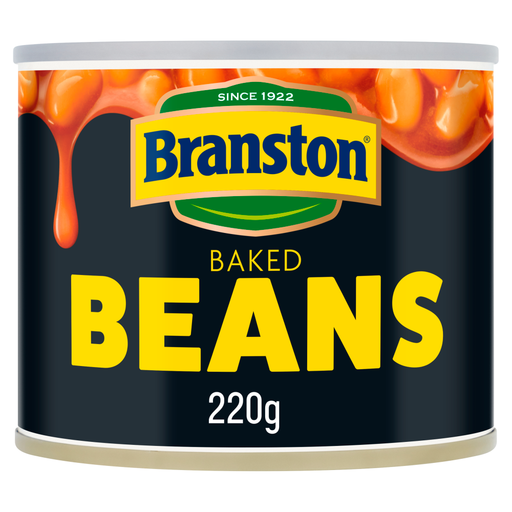
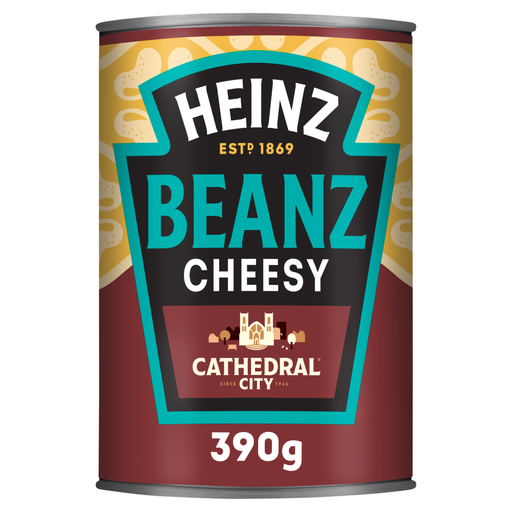
These are two single-tin options for a first food shop: a smaller Branston tomato-sauce tin and a Heinz Cheezy variation. Check each tin's stated servings and ingredients against the meal you have planned.
 No image available
The 220g tin is an option if you are planning a smaller quantity. Check its stated servings for your meal; if any beans remain, follow the tin's instructions for transferring and refrigerating them.
 No image available
This 390g Cheezy variation is not a plain tomato-sauce tin. Check its stated servings against your plans and read the current milk allergen information if dietary restrictions matter.
Check its stated servings rather than judging by weight alone. ASDA's 410g, Sainsbury's 400g and Waitrose Essential's 420g researched tins state two servings; Waitrose Essential's reduced 220g tin states one.
Not if your tin gives microwave instructions. The researched ASDA and Sainsbury's standard tins give hob and microwave directions; for microwave heating, transfer the beans to a suitable container and follow the instructions on your exact tin.
Transfer unused beans to a covered, non-metallic container and refrigerate them, following the period on the tin. Waitrose & Partners specifies two days for its researched Essential standard tin; GOV.UK advises refrigerating leftovers within one to two hours and eating them within 48 hours or freezing them.
No. Check the ingredients and allergen information on the physical tin. Marks & Spencer states that its researched organic and no-added-sugar beans are not suitable for people with milk or egg allergy; GOV.UK says required allergens must be emphasised in prepacked-food ingredient lists.
No. ASDA's reduced-salt, no-added-sugar 410g beans list a stevia-derived sweetener. Read the ingredients on the particular tin if you want to avoid a specific sweetener.