Households making several cooked breakfasts
Standard-size tins in a four- or six-pack let you keep separate tins for repeated full Scottish breakfasts. Choose the count around how often you expect to serve them.


For repeated full Scottish breakfasts, a multipack of roughly 400–420g tins makes sense if you expect to use several full-size tins; choose the tin count around your plans and cupboard space. If you prefer a reduced-sugar-and-salt recipe, compare the exact nutrition, ingredient and allergen labels with the standard tin rather than assuming the recipes are otherwise alike.
A multi-tin pack is most useful when beans are a regular part of the breakfast, rather than an occasional addition.
Standard-size tins in a four- or six-pack let you keep separate tins for repeated full Scottish breakfasts. Choose the count around how often you expect to serve them.
Compare the number and size of tins you will store and use. A larger stock-up pack is worthwhile only if its contents fit your breakfast plans.
A standard tin and a no-added-sugar or reduced-sugar-and-salt variant are different products. Check the exact pack’s ingredients, nutrition panel and allergen statement before switching.
Start with how many breakfasts you are stocking for, then check the tin size and the recipe on the exact pack.
| Priority | What to check | Your needs |
|---|---|---|
| Pack size | Compare the tin count with the breakfasts you have planned. Check that you have room to store the pack. | I serve beans at several full Scottish breakfasts and want enough tins ready without keeping more than I expect to use. |
| Tin size | Check the net weight of each tin, not just the multipack total. The listings include 400g, 410g and 420g tins; use the individual pack’s serving information to plan portions. | Will one tin cover what I intend to put on the table, or am I likely to have leftovers? |
| Sugar and salt | Compare the per-100g nutrition panels of the exact variants. Branston describes its Reduced Sugar & Salt beans as having 30% less sugar and 30% less salt than standard Branston beans; that comparison does not apply to other brands. | I’m considering a different recipe, so I want to see how its stated sugar and salt figures compare with my usual tin. |
| Ingredients and allergens | Read the ingredients and allergen statement on the exact product. Do not carry a dietary statement across brands or variants. | If an ingredient or allergen matters in my household, I need to check each recipe before serving it. |
| Leftovers | Check the opened-pack storage directions before choosing a tin size. The Branston multipacks shown below instruct you to transfer leftovers to a container, refrigerate them and use them within two days. | When breakfast uses only part of a tin, I need a plan for the remainder that follows that product’s label. |
Sugar and salt claims belong to specific variants. The Marks & Spencer product information for its cited baked beans also carries milk- and egg-allergy suitability warnings, so tin size alone cannot establish dietary suitability.
Compare the ingredients, per-100g nutrition and allergen statement on each exact pack, especially when replacing a familiar product.
The Branston multipacks shown below give opened-tin instructions that matter if a breakfast uses less than the whole tin.
For those Branston products, transfer leftovers to a container, refrigerate and use within two days. Follow the directions on any other product’s own label.
These brand references show different tin formats and recipe labels; they do not mean that every product line is interchangeable.
Heinz lists a No Added Sugar four-pack alongside its standard baked beans.
Branston’s standard baked beans are listed in a 4 × 410g format; the Joybuy selection below also includes a six-tin pack and a separate Reduced Sugar & Salt four-pack.
Tesco Groceries lists its own-label baked beans in a 4 × 420g format.
Sainsbury's lists its own-label baked beans as a 4 × 400g pack.
Waitrose & Partners lists Essential baked beans as a 420g single tin, rather than a fixed multi-tin pack in this comparison.
The M&S tinned-bean range includes an Only 7 Ingredients Baked Beans 1.6kg product, a different format from separate breakfast-size tins.
These Branston four- and six-tin packs are options for stocking up for repeated full Scottish breakfasts; the four-tin selection includes a Reduced Sugar & Salt variant.
 No image available
Six separate 410g tins suit a cupboard stocked for repeated cooked breakfasts, if you expect to use them. After opening a tin, transfer leftovers to a covered container, refrigerate and use within two days, following this product’s instructions.
 No image available
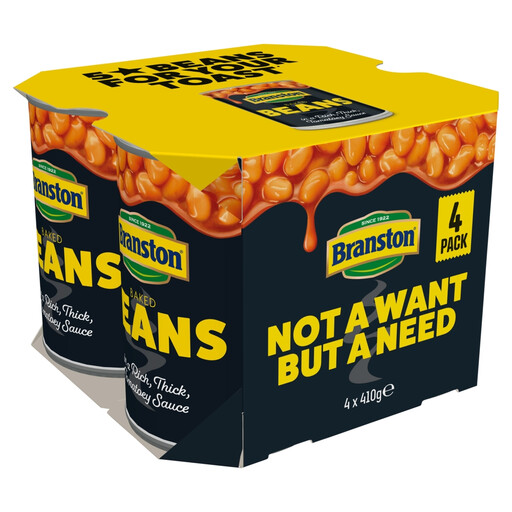
Four 410g tins provide a smaller stock-up format than the six-tin Branston pack for repeated breakfasts. For leftovers from this product, transfer the beans to a container, refrigerate and use within two days.
 No image available
Four 410g tins offer a reduced-sugar-and-salt Branston recipe for repeated breakfasts. Branston states that it contains 30% less sugar and 30% less salt than standard Branston Baked Beans; compare the current nutrition and ingredient labels if that distinction affects your choice.
Check the serving information on the exact tin rather than assuming every 420g product defines a serving in the same way. Also consider how much of the full Scottish breakfast will be on the plate alongside the beans.
No. Sainsbury's cooking instructions say to transfer its baked beans to a microwaveable dish and cover it; follow the heating directions on the pack you are using.
Follow the opened-pack directions for your exact product. The Branston multipacks shown here instruct you to transfer leftovers to a container, refrigerate and use within two days; do not assume another product gives the same period.
No. GOV.UK explains that a best-before date concerns quality rather than safety. Read the date and storage instructions on the tin instead of treating different date labels as interchangeable.