People serving beans for one
A compact tin or pot may avoid an opened portion to store when beans are usually part of a one-person meal. Check the pack size against the amount you normally serve.


Choose a compact tin or pot when one person usually eats the beans and leftovers from a larger tin would be difficult to use within its storage instructions. A 400g–420g tin or multipack makes more sense for shared meals or predictable repeat use; whichever format you choose, compare salt and sugars per 100g and per portion rather than assuming reduced-recipe labels mean the same thing across brands.
A compact tin or pot may avoid an opened portion to store when beans are usually part of a one-person meal. Check the pack size against the amount you normally serve.
A 400g–420g tin is worth considering when two people will share it or the remainder has a planned use within the pack’s opened-storage instructions. A multipack calls for a realistic plan to use the unopened tins, too.
Standard, reduced-sugar-and-salt and no-added-sugar recipes are not interchangeable. Compare the current labels per 100g and per portion, and check the ingredients if sweeteners matter to your choice.
Start with the amount you will eat, then check the opened-storage directions and recipe label. In WRAP’s Household Food Management Survey 2025, conducted online from 30 June to 14 July among 5,509 UK adults responsible for food shopping or preparation at home, 62% reported choosing smaller packs to fit their household size; that finding concerns household shopping generally, not baked beans specifically.
| Priority | What to check | Your needs |
|---|---|---|
| Pack size | Compare the net weight with your usual serving. For a larger tin, check its stated servings and whether you can use any remainder within its opened-storage period. | I usually serve beans for one and would rather not open more than I can use. WRAP found that 62% of the UK adults in its 2025 household-shopping survey reported choosing smaller packs to fit household size. |
| Opened storage | Read the product’s transfer, refrigeration and use-within instructions before opening it. Tesco’s 220g No Added Sugar beans and the Branston example listed by Waitrose both specify refrigeration and use within two days after opening. | If we share a tin, there may be no remainder. Otherwise, I need a definite plan for the opened portion and space to refrigerate it as directed. |
| Salt and sugars | Compare both values per 100g and for the portion you intend to eat. Check what a reduced claim compares with and read the ingredients for sweeteners. | I want to compare recipes on the same basis, rather than assuming a no-added-sugar or reduced-salt label settles the choice. |
| Cupboard use | Check the date on the pack and its unopened-storage directions. Consider whether a multipack fits how often you prepare beans, not just how many tins it contains. | Beans are an occasional meal component in my cupboard, so I want a pack quantity I expect to use. |
A larger supply does not help with one- or two-person meals if opened portions cannot be used within their pack instructions or the unopened tins are unlikely to be used.
Choose the quantity around your normal meals. Before opening a large tin, plan whether it will be shared or used again within the stated period.
A reduction is relative to the named product’s comparator; it does not establish that recipes from different brands contain the same amount of salt or sugars.
Compare current labels per 100g and per intended portion, and check the ingredients if you wish to avoid sweeteners.
The Tesco 220g No Added Sugar product and the Branston product listed by Waitrose instruct shoppers to transfer opened contents, refrigerate them and use them within two days.
Follow the directions on the specific pack you open, including its container and covering instructions.
The pack in hand is where you can check its ingredients, allergens, nutrition, date and storage directions for the product you will actually use.
Read those details when selecting a tin and again before preparing it, particularly if a recipe or storage instruction matters to your household.
These range examples show different pack and recipe choices; check the current product label for the particular tin or pot you select.
Heinz appears in UK listings with standard baked beans and compact No Added Sugar Snap Pots.
Tesco lists a compact 220g No Added Sugar own-label baked-bean product.
Sainsbury’s category listing includes 215g own-label baked beans and a reduced-sugar-and-salt version in that size, alongside branded compact products.
M&S describes its tinned-beans range as including small and large tins and no-added-sugar beans.
Waitrose lists Essential baked beans in 220g and 420g tins, including reduced-salt-and-sugar options.
These Joybuy options include baked-bean multipacks for households expecting shared meals or regular use, plus a Branston listing whose pack quantity should be confirmed before choosing it for a particular serving size.
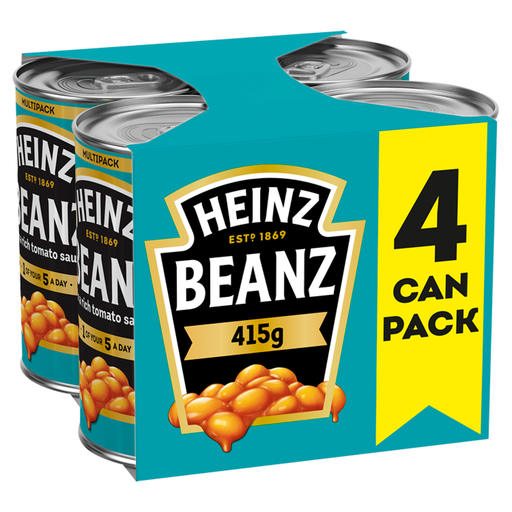 No image available
Four 415g tins suit planned repeat use or meals where a tin can be shared. For any opened remainder, follow the product’s directions to transfer it to a non-metallic container, refrigerate it and use it within two days.
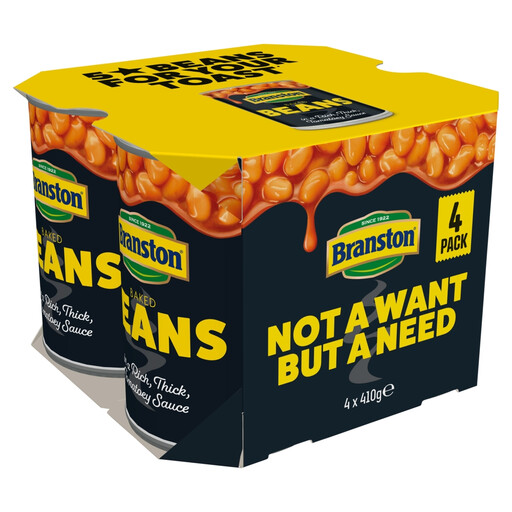 No image available
Four 410g tins are a choice for sharing or planned repeat meals. The product information gives nutrition per 100g and per half-can; transfer and refrigerate opened contents and use them within two days as directed.
 No image available
Six 410g tins fit a cupboard where beans will be used regularly or shared. Check that the quantity fits your plans; the product directions call for opened contents to be refrigerated and used within two days.
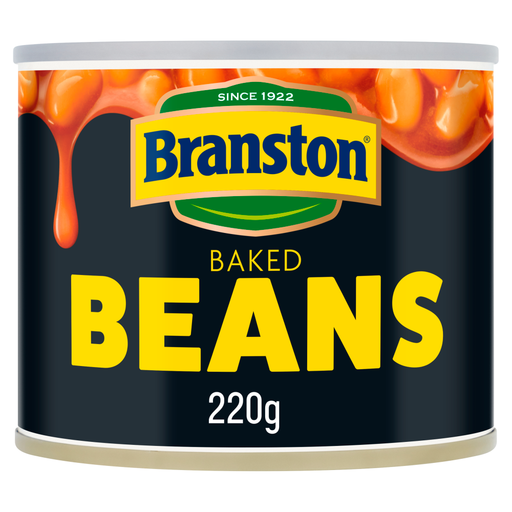 No image available
A Branston tomato-sauce option for the cupboard, but confirm the net quantity and pack configuration on the product you intend to buy before treating it as a single serving or a multipack. Check its label for nutrition and opened-storage directions.
Choose a compact format if you normally eat one serving and have no plan for leftovers. A larger tin can work when you will share it or use the remainder within that product’s opened-storage instructions.
Follow the directions on the specific pack. Tesco’s 220g No Added Sugar beans and the Branston product listed by Waitrose instruct shoppers to transfer unused contents to a suitable container, cover and refrigerate them, and use them within two days.
A best-before date concerns quality rather than being the same as a use-by date. GOV.UK lists tinned foods such as baked beans among products that carry best-before dates; store the tin as directed and do not disregard damage to the package or other product-specific instructions.
No single recipe suits every preference. Compare salt and sugars per 100g and per intended portion, then read the ingredients for sweeteners; a reduced claim describes a comparison with the named standard recipe, not with every other brand.