Families making repeat quick dinners
If beans regularly accompany toast, jacket potatoes or a cooked meal, check how many tins your household uses before choosing a four- or six-tin pack.


Choose a four-tin pack for repeat weeknight dinners if your household will use every tin; consider six tins when you have room to store them and expect to use them. Individual tins let you mix recipes instead. Check the weight of each tin, the nutrition information for your usual portion and the ingredients on the exact pack before choosing between branded, own-label and reduced-sugar or reduced-salt beans.
If beans regularly accompany toast, jacket potatoes or a cooked meal, check how many tins your household uses before choosing a four- or six-tin pack.
Reduced-sugar and reduced-salt wording is a starting point. The nutrition panel and its stated portion size show what is in the recipe you are considering.
Check the ingredients and allergen information on the exact tin, particularly when changing recipe, pack or retailer.
Start with the number of tins you will use, then compare the recipes and instructions that matter for your dinners.
| Priority | What to check | Your needs |
|---|---|---|
| Pack size | Compare tin count and net weight: the options discussed here include four 400–420g tins and six 410g tins. Use your household’s usual portion to judge how many dinners a pack covers. | Beans appear in several of our weeknight meals, but I only want as many tins as we are likely to use. |
| Recipe choice | Compare branded and own-label ingredients on the exact product. Individual tins allow a mix of recipes; a multipack supplies several tins of one recipe. | One recipe suits everyone, or I would rather pick different tins for different household preferences. |
| Salt and sugar | Read the amount per stated serving and the serving size before comparing standard and reduced variants. Check ingredients if sweeteners matter to you. | I want to choose using the nutrition panel, not assume that a reduced-salt or no-added-sugar label answers every question. |
| Preparation and storage | Check the heating directions for your intended method and follow the opened-can storage instructions on the product you buy. | On a busy evening, I need to know how to heat the beans and what to do with any leftovers. |
The cited retailer listings include four-packs with different tin weights, so the same tin count does not mean the same total quantity.
Read both the weight per tin and the total pack weight, then compare them with the portions your household usually serves.
ASDA’s reduced-salt and no-added-sugar 4 x 410g pack lists 0.7g salt per half can in its product information. That figure needs to be read alongside the portion size and ingredients.
Compare the current nutrition and ingredient labels on the exact recipes you are choosing between.
Recipes can differ. Opened-can instructions can also be product-specific: Marks & Spencer directs buyers of its 400g baked beans to move unused contents to a non-metallic container, refrigerate them and eat them within three days.
Check the current tin for ingredients, allergens and directions for any leftovers rather than applying one product’s instructions to another.
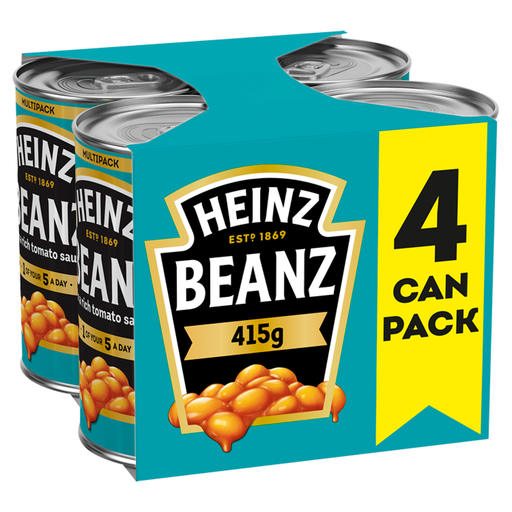
Tesco Groceries lists Heinz baked beans in tomato sauce as a 4 x 415g multipack.
Tesco Groceries lists an own-label baked-bean multipack of 4 x 420g.
Sainsbury's lists reduced sugar and salt baked beans in a 4 x 400g pack.
ASDA Groceries lists a reduced-salt, no-added-sugar baked-bean pack of 4 x 410g.
Marks & Spencer provides product information for an individual 400g tin of baked beans.
Waitrose & Partners lists Essential baked beans in individual 420g tins.
These four- and six-tin baked-bean packs are options for households planning repeat weeknight meals. Compare the recipe and tin count with the individual-tin route discussed above.
 No image available
Four 415g tins give households that prefer the Heinz recipe a pack for repeat meals. Check the current can label for ingredients, nutrition and heating directions.
 No image available
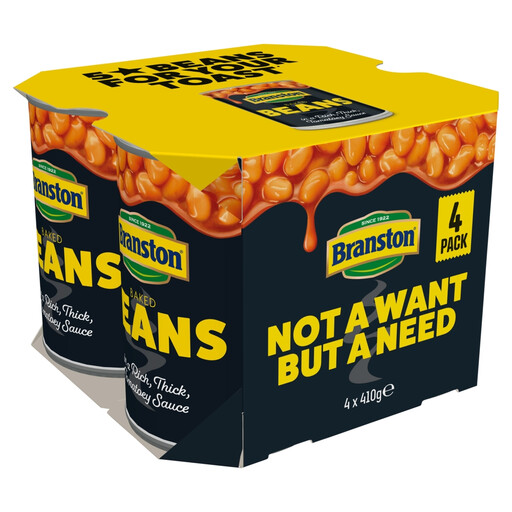
Four 410g tins offer another single-recipe pack for recurring dinners. Check the current can for ingredients, dietary suitability and heating directions.
 No image available
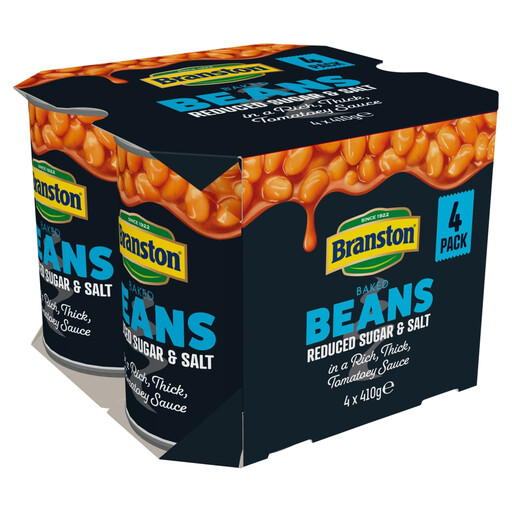
This four-tin option is for households considering a reduced-sugar-and-salt recipe. Compare the current label’s serving size, nutrition and ingredients with those of the standard recipe; check the ingredients if you prefer to avoid sweeteners.
 No image available
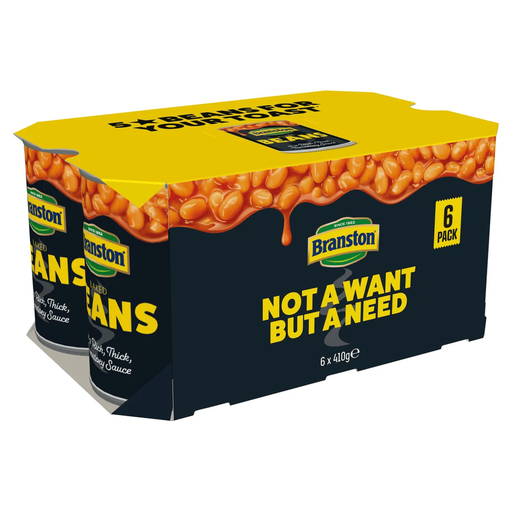
Six 410g tins suit a household that expects to use more of the same recipe and has space to store them. Check the can for heating and opened-tin storage instructions before preparing a meal.
Start with the amount your household normally serves and how often beans are on the menu. Some product nutrition panels use half a can as their portion basis, but your meal portions may differ; use those portions to decide whether four tins, six tins or individual tins make sense.
No. Read the nutrition panel’s serving size and the ingredient list on the exact pack. ASDA Groceries lists 0.7g salt per half can for its reduced-salt, no-added-sugar 4 x 410g beans; that figure describes this product and stated portion, not every reduced variant.
No. Check the current ingredients and allergen information for the exact recipe you buy, especially when changing packs or retailers. A product name or another brand’s label cannot establish suitability for a different tin.
Follow that product’s opened-can instructions. For its 400g baked beans, Marks & Spencer says to transfer unused contents to a non-metallic container, refrigerate and eat within three days; do not assume those exact directions apply to every brand.