Parents planning quick household meals
A four-tin pack can keep baked beans in the cupboard for recurring meals for adults or older children. Check the weight of each tin as well as the pack count.


For regular adult or older-child meals, choose a four- or six-tin pack if you have cupboard space and expect to use it; smaller pots suit occasions when opening a full tin would leave unwanted leftovers. Compare the exact label if a reduced-sugar-and-salt formulation matters. A family multipack is not a shortcut for feeding a baby: NHS guidance says babies should not eat much salt and recommends a varied diet from around six months alongside their usual milk.
A four-tin pack can keep baked beans in the cupboard for recurring meals for adults or older children. Check the weight of each tin as well as the pack count.
If one person eats beans at a time, a 200g pot may be closer to the amount needed than opening a standard-sized tin.
Separate plans for adult cupboard meals from decisions about feeding a baby. NHS guidance says babies should not eat much salt and that a varied diet is introduced from around six months alongside usual milk feeds.
Start with how often the household eats beans and how much it uses at once. Then check the formulation and label for whoever will eat them.
| Priority | What to check | Your needs |
|---|---|---|
| Pack size | Check both tin count and weight: the cited Tesco and Sainsbury’s four-packs contain 420g and 400g tins respectively. Consider cupboard space and how often you use them. | Beans are a regular part of our household meals, so a four-tin pack is likely to get used. |
| Portion size | Compare a standard-sized tin with 200g pots. Think about how much will be eaten after each container is opened. | When only one of us wants beans, a smaller portion could mean fewer leftovers. |
| Formulation | Read the exact tin’s ingredients and nutrition label rather than relying on a range name. Check salt, sugar and any dietary information relevant to the household. | I’m choosing between standard and reduced-sugar-and-salt beans for adult or older-child meals. |
| Feeding a baby | Check the exact food’s label and the baby’s feeding stage. NHS guidance says babies should not eat much salt; a varied diet begins around six months alongside breast milk or first infant formula. | Convenient food for the adults does not automatically answer what to serve a baby starting solids. |
A formulation can differ from standard beans without establishing that it is suitable as a routine food for a baby. NHS guidance says babies should not eat much salt and recommends introducing a varied diet from around six months alongside milk feeds.
Check the exact label and consider the baby’s feeding stage rather than relying on “reduced” or “no added sugar” wording.
Four standard-sized tins and 200g pots serve different portion patterns. A larger pack does not solve the problem of leftovers from an opened tin.
Think about your usual serving size and frequency before choosing standard tins or smaller portions.
Tesco Groceries lists standard and reduced-sugar-and-salt baked beans in 4 x 420g packs.
Sainsbury’s lists standard and reduced-sugar-and-salt own-label packs of 4 x 400g.
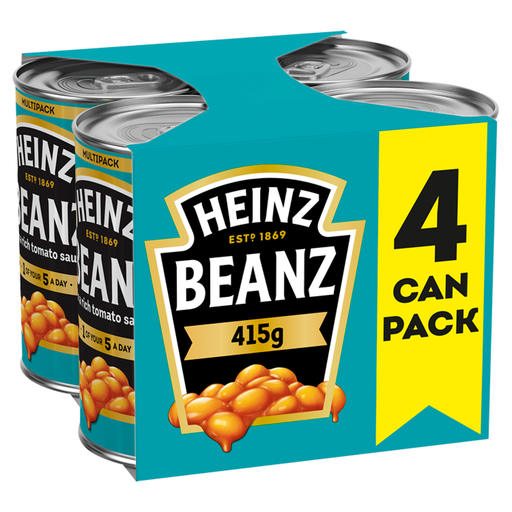
Waitrose & Partners lists Heinz standard beans in 4 x 415g tins and Heinz No Added Sugar beans in 4 x 200g Snap Pots.
M&S lists baked beans in 220g, 400g and 1.6kg formats, alongside a 390g No Added Sugar variant.
Waitrose & Partners is a retailer listing Heinz standard 4 x 415g and 6 x 415g packs, as well as No Added Sugar Snap Pots.
These baked-bean multipacks suit households considering standard tins for recurring meals. They include standard and reduced-sugar-and-salt four-packs, plus a six-tin pack; compare the exact label and the amount your household will use.
 No image available
Four standard-sized tins suit planned household use. This is the reduced-sugar-and-salt Branston variant; read its label for the exact nutrition information. For a baby starting solids, do not assume the family pack is an appropriate routine choice: NHS guidance says babies should not eat much salt.
 No image available
This four-tin standard Heinz pack suits households that regularly use full-sized tins. It is a different variant from Heinz No Added Sugar beans, so check this pack’s own label if the formulation matters. NHS advice on limiting salt for babies still applies when considering family foods.
No image availableFour 410g tins provide a standard-sized multipack for recurring household meals. Consider whether a full tin matches the portions you usually serve, and check the exact label before choosing it for someone with specific dietary requirements.
 No image available
Six 410g tins make this a larger cupboard stock-up than the four-tin options here. It suits a household expecting frequent use, provided there is space to store the tins; check the individual label when planning portions or dietary choices.
Do not assume they are. NHS guidance says a varied diet is introduced from around six months alongside usual breast milk or first infant formula, and that babies should not eat much salt. Check the exact food and your baby’s feeding stage rather than treating a family pack as a default first food.
Choose a four-pack if your household regularly uses full-sized tins; consider 200g pots if smaller individual servings better match what you eat. Check how much is likely to remain after opening either format.
No. The Waitrose & Partners listing for Heinz No Added Sugar beans reports salt in the product, and NHS guidance says babies should not eat much salt. Read the exact nutrition label rather than using the sugar wording to judge suitability.
Some are: Waitrose & Partners describes its listed standard Heinz 4 x 415g pack as suitable for vegetarians and vegans. Check the label of the exact brand and variant you intend to use.