Workers with a microwave
A full-size tin is easier to plan around when you can heat beans in a suitable container and use or refrigerate any leftovers. Check the preparation and storage directions on the tin you take to work.


Choose full-size baked-bean multipacks if you can use a whole tin, share it or refrigerate leftovers according to the label. A smaller single tin can make a one-person office lunch simpler; if sugar or salt matters to your choice, compare the exact products’ per-100g labels rather than relying on the range name.
The useful distinction is how much you will eat at lunch and what you can do with any beans left after opening a tin.
A full-size tin is easier to plan around when you can heat beans in a suitable container and use or refrigerate any leftovers. Check the preparation and storage directions on the tin you take to work.
A smaller tin or pot may avoid opening more beans than you intend to eat, particularly if you cannot refrigerate leftovers. Compare the portion size with what you would actually pack.
Compare ingredients and per-100g nutrition across the exact standard and reduced-sugar-or-salt products you are considering. For an allergy, check the label on the pack you buy rather than relying on an older online listing.
Start with the amount you can use from an opened tin, then check whether your workplace setup and the product label fit the lunch you have planned.
| Priority | What to check | Your needs |
|---|---|---|
| Portion size | Compare the number of tins and grams per tin. Consider whether a full 400–415g tin will be eaten, shared or split between meals. | I’m packing lunch for one and would rather open a smaller tin than have beans left over. |
| Heating at work | Read the tin’s preparation directions. If using a microwave, check that a suitable container and any required cover are available. | A hot lunch only works for me if I can prepare it with the equipment at work. |
| Opened-tin storage | Check the product’s instructions for transferring, refrigerating and using unused contents. For its 400g baked beans, M&S specifies a non-metallic container, refrigeration and use within 3 days; other products may differ. | When I open a full tin, I need a way to store what remains and use it within that tin’s stated period. |
| Nutrition label | Compare sugar and salt per 100g on the exact products. Check what a reduced-content claim is compared with; a no-added-sugar label does not by itself describe the full nutrition profile. | For a lunch I pack regularly, I want to compare the actual labels, not choose by a range name alone. |
| Ingredients | Read the current ingredients and allergen information on the pack. GOV.UK states that any of the 14 regulated allergens present in UK prepacked food must be clearly identified in the ingredients list. | If an ingredient matters to me, I need to check the particular tin I’m buying. |
A 400–415g tin may be more than one person wants at lunch. Storage instructions depend on the product: M&S, for example, directs buyers of its 400g beans to transfer unused contents to a non-metallic container, refrigerate them and eat them within 3 days.
If you cannot store leftovers as the label directs, consider a smaller portion. Otherwise, arrange a suitable container and refrigeration before opening the full-size tin.
A no-added-sugar claim does not mean that a product contains no sugar. Salt, ingredients and nutrition values can also differ between varieties.
Compare the per-100g panels and ingredients on the exact tins you are deciding between, including the standard variety used for any comparison claim.
Product recipes and label information can change. That matters when an ingredient or allergen affects whether a particular tin is suitable.
Check the ingredients and allergen declaration on the pack you buy.
These examples show formats and label differences worth checking; they do not establish that every range has the same ingredients, instructions or pack sizes.
Heinz appears in full-size baked-bean multipacks and smaller serving formats, as well as a No Added Sugar range.
Tesco’s own-label 420g tin offers a full-size format to compare with branded baked-bean packs.
Waitrose lists 420g Essential baked beans in both standard and Reduced Salt & Sugar varieties.
M&S lists a 400g baked-bean tin with product-specific nutrition and storage information.
Branston appears in 410g baked-bean multipacks, including four-tin and six-tin formats.
These options include full-size multipacks for repeated or shared lunches, a reduced-sugar-and-salt multipack, and a smaller single tin for a one-person lunch.
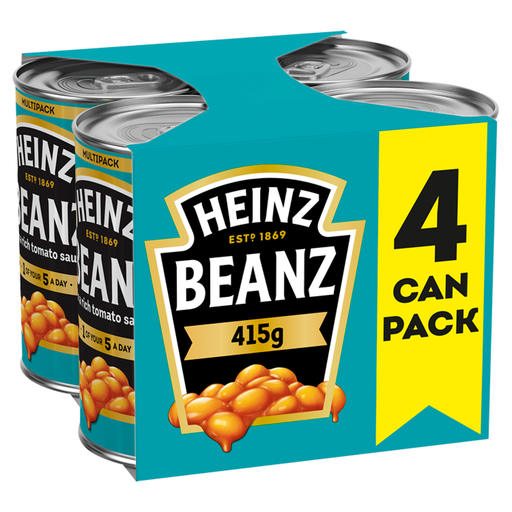 Image unavailable
Four full-size tins may suit lunches spread over several days or a shared lunch. The product directions describe hob heating or heating in a covered microwave-safe container; unused contents should be moved to a non-metallic airtight container, refrigerated and used within 2 days.
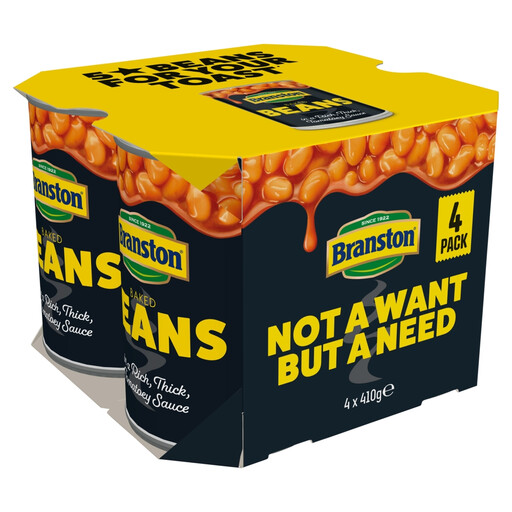 Image unavailable
This four-tin pack is an option when you can use or share a full 410g tin. Its directions describe hob or covered-container microwave heating; opened contents should be transferred to a container, refrigerated and used within 2 days.
 Image unavailable
This four-pack combines 410g tins with a reduced-sugar-and-salt variety. Compare its current per-100g panel and ingredients with the exact standard product that interests you; a reduced-sugar label does not mean sugar-free. The product directions describe hob or covered-container microwave heating and say to refrigerate opened contents and use them within 2 days.
 Image unavailable
Six full-size tins suit a plan to use beans across multiple lunches or share them. Check the tin’s heating directions for your office setup. Its opened-content instructions call for a covered container, refrigeration and use within 2 days.
 Image unavailable
This single 220g tin is a smaller-portion alternative to opening a full-size multipack tin. Check its label for heating directions. If any beans remain, transfer them to a separate container, refrigerate and use within 2 days.
It can be if you will eat the whole tin or can store leftovers as its label directs. Otherwise, a smaller tin may be simpler. For its 400g beans, M&S specifies transferring unused contents to a non-metallic container, refrigerating them and eating them within 3 days; check the directions for the product you choose.
Yes. The NHS says an 80g portion of beans or pulses counts as one of your 5 A Day, but beans and pulses count only once in a day even if you eat more. That rule does not make a larger tin count as several portions.
Read the ingredients and allergen information on the exact pack you buy. GOV.UK states that any of the 14 regulated allergens present in UK prepacked food must be clearly identified in its ingredients list; an older online listing may not reflect the current recipe.
Do not put a metal tin in a microwave. Follow the product’s preparation directions and transfer the beans to a suitable container when microwave heating is specified; the listed Heinz four-pack directs microwave heating in a covered microwave-safe container.