
24/7 Customer Support

Free returns

Same-day & Next-day Delivery

Quality Guaranteed

Unlock Your Welcome Offers: FREE Delivery | Up to 80% OFF | Free 30-day JoyPlus trial
Download the APP
Buying bakeware can seem straightforward until a tray warps, a cake sticks to its tin or a shallow dish spills sauce across the oven. Product descriptions often focus on finishes and appearance, while the details that affect everyday use—dimensions, temperature limits, cleaning instructions and storage—receive less attention.
For UK households, the most common buying pitfalls are:
The right choice depends on what you cook most often, how many people you feed and how much cleaning you are prepared to do.
Aluminised steel and carbon steel are common choices for cake tins, baking trays and roasting tins. Metal generally provides a firm structure and predictable contact with the oven shelf. Thickness also matters: the KitchenAid cake pan and quiche pan listed below use 0.8mm aluminised steel, a specification intended to help the pan retain its shape during normal oven use.
Non-stick bakeware can make release and cleaning easier, but it is not maintenance-free. Check whether the instructions recommend hand washing and avoid metal utensils or abrasive cleaners if the surface is vulnerable to scratching.
Silicone baking moulds are flexible and useful for shaped cakes, loaves and individual portions. They should normally be placed on an oven-safe tray before filling. Always check the stated maximum temperature; the Maison by Premier rectangular silicone mould is listed for use up to 230°C and is not suitable for a hob or open flame.
Foil catering trays are convenient for batch cooking, parties and food transport. Their low weight can reduce washing up, although a baking sheet underneath improves stability when moving a filled tray.
Measure your oven shelf before ordering. Allow space around the bakeware for safe handling and, where appropriate, airflow. Compare the external dimensions rather than relying only on descriptions such as “large” or “family-sized”.
Depth affects practical use:
For parties or meal preparation, packs of two or three can be more practical than buying individual pieces. However, confirm where the products can be used and whether lids are intended for storage rather than heating.
Temperature ratings should be treated as limits, not targets. The Maison by Premier silicone loaf mould is rated up to 230°C, while the KitchenAid quiche pan is listed as oven-safe to 230°C. Follow the product label and recipe instructions and use oven gloves when handling hot metal or foil.
Dishwasher suitability can save time, but hand washing may help preserve a non-stick coating. For coated bakeware, use wooden, silicone or plastic utensils and dry items thoroughly before stacking. Store silicone moulds flat where possible to help maintain their shape.
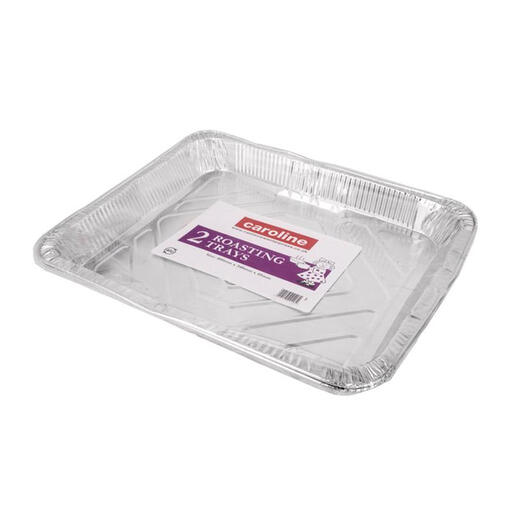
Why This Fits Their Persona: A practical starting point for households that need large roasting tins for family meals, batch cooking or occasional gatherings without adding heavy cookware to the cupboard.
The listed 400 x 340 x 45mm dimensions make capacity clearer than a vague “large” label. It is described as oven-safe and freezer-safe; follow the product guidance and place it on a solid baking sheet for support.
Pack of two aluminium trays; 45mm depth for roasts, vegetables and other larger dishes.
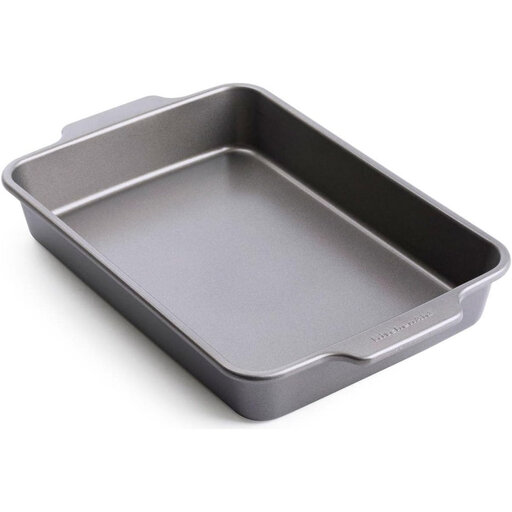
Why This Fits Their Persona: Suits regular home bakers who prefer a structured metal pan for traybakes, sheet cakes and savoury oven dishes.
Its 0.8mm aluminised steel construction provides a clearly stated specification, while the product details specify that it has no non-stick coating—use suitable lining or grease as required by the recipe.
33 x 22cm rectangular format; wide handles; dishwasher-safe according to the listed specifications.
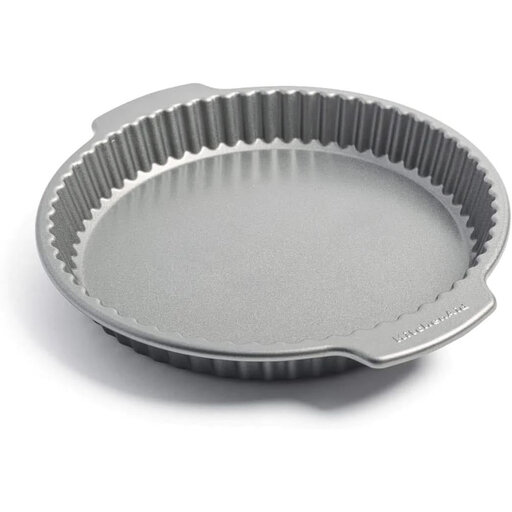
Why This Fits Their Persona: Designed for cooks who regularly make quiches, tarts and shallow pastry dishes and want a defined edge with straightforward cleaning.
The 28cm size and 0.8mm thickness are stated directly, reducing uncertainty around fit and structure. Check the oven shelf dimensions before purchase.
Non-stick finish; sculptured edge; oven-safe to 230°C; dishwasher-safe according to the product details.
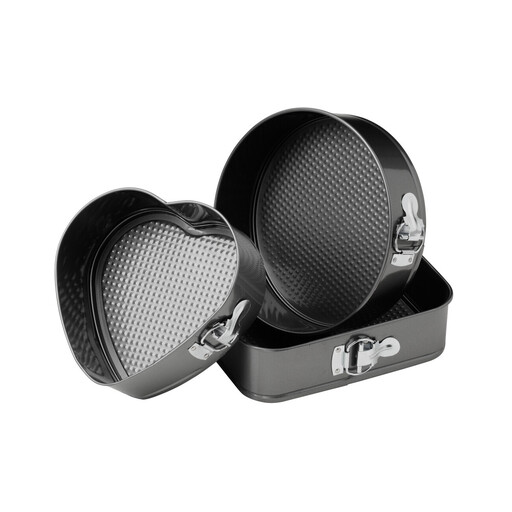
Why This Fits Their Persona: A flexible option for families, birthday bakes and hosts who want round, square and heart-shaped cake tins in one set.
The springform sides and detachable bases address the common problem of damaging delicate cakes during removal. Avoid sharp utensils to protect the coating.
Set of three shapes; carbon steel construction; non-stick coating; dishwasher-safe according to the listing.
We have compiled a complete, real-time list of products that fully satisfy these strict selection criteria and UK safety regulations.
Choose pieces with more than one practical use, such as a rectangular cake pan for traybakes and savoury oven dishes or a roasting tin that can handle vegetables and meat. Nesting foil trays and compact muffin trays can also reduce cupboard space, while a set of springform cake tins provides multiple shapes without buying separate individual tins.
Follow the recipe’s preparation instructions and consider greasing, flouring or using baking parchment where suitable. Even when a tin is described as non-stick, avoid metal utensils and abrasive cleaners. Allow the cake to cool as directed before releasing it; removing it too early can cause delicate edges to break.
Some foil trays are listed as oven-safe and freezer-safe, but always check the product label and usage guidance. Use a baking sheet underneath for stability, particularly with liquid or heavy food. Do not use foil trays on an open flame or direct heating element and allow hot contents to cool before fitting a storage lid.