
24/7 Customer Support

Free returns

Same-day & Next-day Delivery

Quality Guaranteed

Unlock Your Welcome Offers: FREE Delivery | Up to 80% OFF | Free 30-day JoyPlus trial
Download the APP
Choosing baking and roasting trays can seem straightforward until a tray warps, food sticks, or a supposedly suitable dish proves too shallow for a family meal. The right choice depends less on attractive packaging and more on dimensions, material, capacity and intended use.
Whether you are baking biscuits, preparing a Sunday roast, batch-cooking meals or organising food for an event, these checks can help you avoid paying for features that do not match your routine.
A tray measuring 40cm across may not provide 40cm of usable cooking area. Rolled edges, handles and sloping sides reduce the internal surface. Before buying, check the internal dimensions, depth and whether the tray fits comfortably inside your oven.
Also measure the oven shelf rather than relying on the oven’s advertised capacity. A large aluminium roasting tray may be suitable for family portions but awkward to lift when full.
A non-stick baking tray can reduce sticking and washing up, but coatings differ in care requirements. Some product descriptions recommend hand washing and avoiding metal utensils, while others specify dishwasher suitability. Treat these instructions as important rather than optional.
Even a durable coating can be damaged by abrasive scourers, sharp tools and overheating an empty tray. If you want a long service life, use silicone, nylon or wooden utensils unless the manufacturer specifically states otherwise.
Disposable foil trays are lightweight, but their flexibility can make hot food difficult to carry. A filled tray can bend when moved from the worktop to the oven or from the oven to a table.
For disposable foil trays, use a sturdy oven baking sheet underneath during loading, cooking and removal. Matching lids are useful for storage and transport, but allow food to cool before sealing to reduce condensation.
Carbon steel baking trays are commonly chosen for reusable everyday bakeware because the material is rigid and conducts heat efficiently. A heavier gauge may be less prone to flexing, although it can also be heavier to handle.
A coated carbon steel oven baking sheet is suitable for biscuits, biscuits, chips and roasted vegetables when used according to the care instructions. For food that may release juices or fat, a deeper roasting tin offers better containment than a flat biscuit sheet.
Aluminium roasting trays heat efficiently and are convenient for cooking, reheating and serving. Their lightweight construction suits catering and batch preparation, but they still need support when carrying hot food. Confirm whether the product is ovenable, freezer-safe or dishwasher-safe rather than assuming these properties.
A shallow baking sheet supports biscuits, pastry and foods that need airflow around them. A deep roasting tray is more practical for meat, vegetables, pasta bakes and dishes containing sauce.
As a rough guide:
Capacity is particularly important for meal preparation. A 55oz foil tray with a lid can suit individual portions, leftovers and prepared dishes, while a 60oz square option provides additional room for serving or catering portions.
A freezer-to-oven baking tray can simplify meal preparation, but check the manufacturer’s temperature and handling guidance. Sudden temperature changes can stress some materials, and a frozen tray should be placed securely on an oven shelf.
For foil products, check local council guidance before recycling. Foil generally needs to be reasonably clean and may need to be scrunched into a larger ball, depending on local collection rules. Not every council accepts foil, so “recyclable” should be understood as subject to local facilities and instructions.
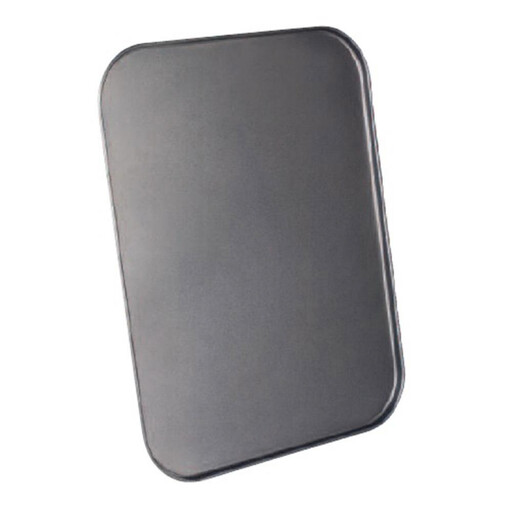
Why This Fits Their Persona: Its 34.5 x 26cm format is practical for first kitchens, everyday biscuits and smaller batches without taking up excessive cupboard space.
The stated non-stick surface and carbon steel construction address sticking and flimsy-tray concerns, while the product is described as dishwasher and freezer-to-oven suitable.
Carbon steel construction; stackable format; suitable for biscuits, shortbread, vegetables and personal pizzas.
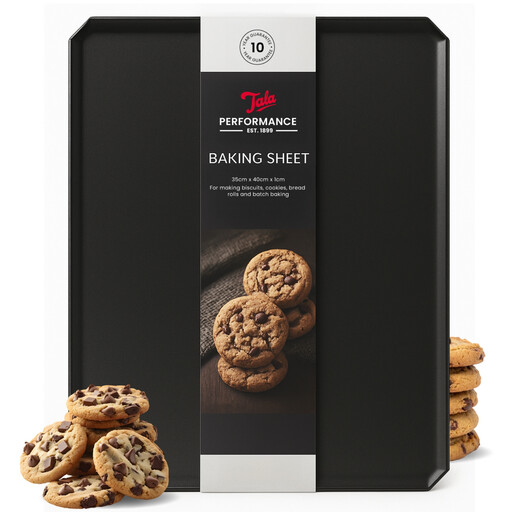
Why This Fits Their Persona: Keen bakers who regularly make larger batches may value the stated professional-gauge carbon steel construction and generous 35.5 x 42cm dimensions.
The specified dimensions and carbon steel material make its capacity clearer than vague “large tray” descriptions, while the coating care guidance should still be followed.
Double-layer non-stick coating; listed oven, fridge, freezer and dishwasher suitability; suitable for baking and roasting.
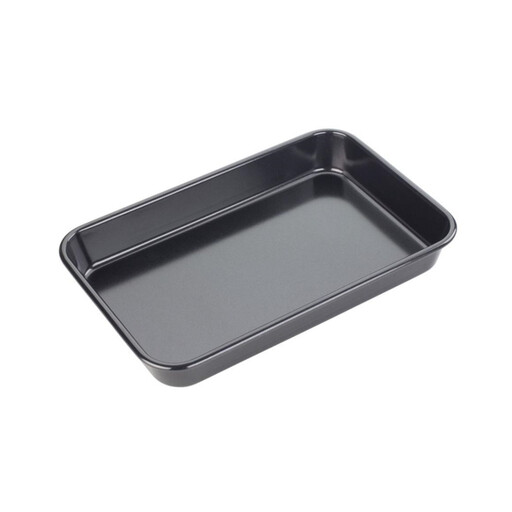
Why This Fits Their Persona: Frequent roast cooks may appreciate the raised base, juice separation and pouring lip for handling meat juices and gravy preparation.
Its listed 4cm depth, carbon steel body and dedicated pouring feature provide more practical information than a generic flat oven baking sheet.
Raised base; pouring lip; double-layer non-stick coating; stated oven, fridge, freezer and dishwasher suitability.
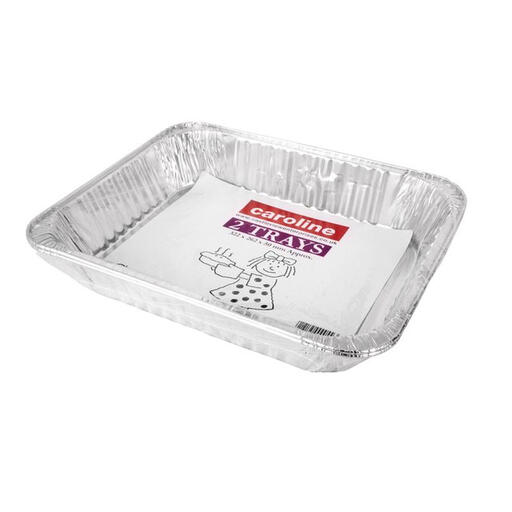
Why This Fits Their Persona: The extra-large footprint and 50mm depth suit family portions, buffet dishes, meal delivery and occasions where quick clearing-up matters.
The stated measurements and pack quantity make capacity and value easier to assess, while using a baking sheet underneath improves stability during handling.
50mm depth; lightweight aluminium; pack of two; suitable for cooking, reheating, serving and transporting food.
We have compiled a complete, real-time list of products that fully satisfy these strict selection criteria and UK safety regulations.
Some reusable trays are listed as dishwasher-safe, but this is not universal. Non-stick products may retain their coating for longer when washed by hand with mild detergent. Disposable foil trays are generally intended for one use; check whether the material and local facilities support recycling after the tray has cooled and been cleaned.
Only do this when the product information specifically states freezer-to-oven suitability. Use the tray on a baking sheet for support, and follow the stated temperature guidance. Avoid placing foil directly on an exposed heating element or open flame.
This depends on the number of portions and the food being cooked. A tray around 30–37cm wide with sides approximately 4–5cm deep can offer useful space for meat and vegetables, but always compare the internal dimensions with your oven shelf. For larger gatherings, a 400 x 340mm aluminium roasting tray may be more practical, provided it can be handled safely when full.