
24/7 Customer Support

Free returns

Same-day & Next-day Delivery

Quality Guaranteed

Unlock Your Welcome Offers: FREE Delivery | Up to 80% OFF | Free 30-day JoyPlus trial
Download the APP
Choosing baking trays can seem straightforward until a tray warps, food sticks, or the dimensions do not fit your oven. UK kitchens often need bakeware that can handle everything from biscuits and traybakes to Sunday roasts, meal preparation and buffet serving.
Marketing descriptions can also make similar products appear interchangeable. Before buying, focus on the details that affect everyday use: dimensions, material, coating, temperature suitability and cleaning instructions.
A tray may fit the oven cavity but still be awkward to slide past the door or remove when hot. Product measurements can also refer to the outer rim rather than the usable cooking area.
Measure the width and depth between your oven’s internal runners. Leave enough room for oven gloves and air circulation. For larger oven trays and roasting trays, check both the tray dimensions and your preferred shelf position before ordering.
The term non-stick describes a coating, not a guaranteed lifespan. Some surfaces require hand washing, soft utensils and protection from abrasive cleaners. Others are listed as dishwasher-safe, although repeated dishwasher cycles may still affect the appearance of certain finishes over time.
Always check:
A deep roasting tin is useful for meat, vegetables, sauces and casseroles, but it may not be the most practical choice for biscuits or delicate pastries. A shallow baking sheet encourages more direct heat exposure, while a muffin tray or cake tin provides moulded support for individual portions.
Buying one tray for every task can be less economical than choosing a small combination of bakeware suited to how you cook.
Dimensions should be compared in millimetres or centimetres, not only by descriptions such as “large” or “family-sized”. For example:
Depth matters particularly when cooking foods that release liquid. Higher sides can help contain gravy, oil and roasting juices, but may make it harder to turn food or slide a spatula underneath.
Carbon steel bakeware is commonly chosen for its strength and heat conduction. Thickness is relevant: the KitchenAid metal cake tin and quicheform are specified at 0.8mm, while the Tala Performance set is listed as 1mm-thick carbon steel.
Aluminised steel can offer a firm structure with even heat distribution, while aluminium foil trays are lightweight and convenient for transporting or serving food. However, foil trays can be less rigid than reusable metal bakeware, so support them from underneath when carrying hot or heavy food.
Do not assume that all metal trays have identical oven limits. Check the product label or supplied instructions for the stated temperature range, and use oven gloves when handling hot cookware.
Non-stick baking trays can reduce sticking and washing up, but care varies between products. The Maison by Premier muffin tray and cake tin recommend avoiding metal utensils and abrasive cleaning products. By contrast, the Chef Aid baking sheet and Tala set are listed as dishwasher-safe.
Consider cupboard space as well. Stackable baking trays are helpful in smaller UK kitchens, while a baking tray set can provide different sizes without requiring several separate purchases.
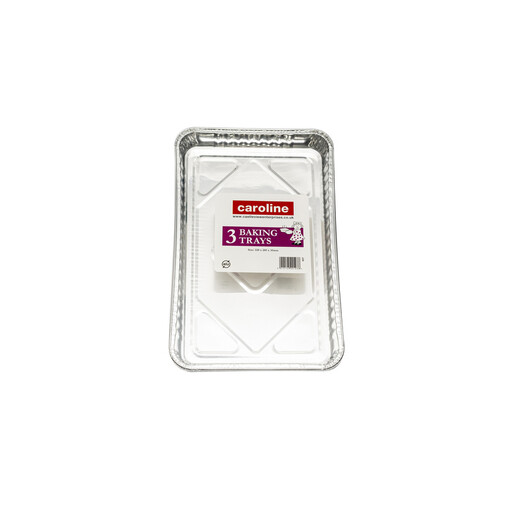
Why This Fits Their Persona: A three-tray pack gives new home cooks several matching trays for batch cooking, family meals and entertaining without buying individual pieces.
The stated 323 × 201mm footprint and 33mm depth make capacity clearer than a vague “large tray” description. The material type is not specified, so buyers should check the packaging for temperature and care guidance.
Pack of three; useful 33mm depth; suitable for baking, serving and food preparation.
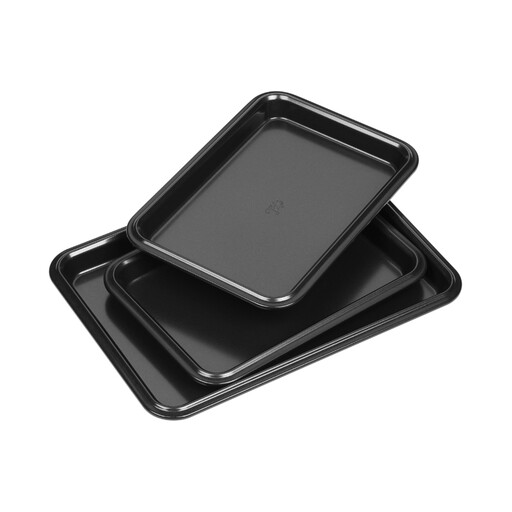
Why This Fits Their Persona: Regular bakers may value a structured set with one larger tray and two smaller trays for different recipes and cupboard organisation.
The listed 1mm carbon steel construction provides a specific thickness to compare with lighter trays. Care instructions and the stated guarantee should still be reviewed before purchase.
Three stackable sizes; double-layer non-stick coating; listed as dishwasher-safe with a 10-year guarantee.
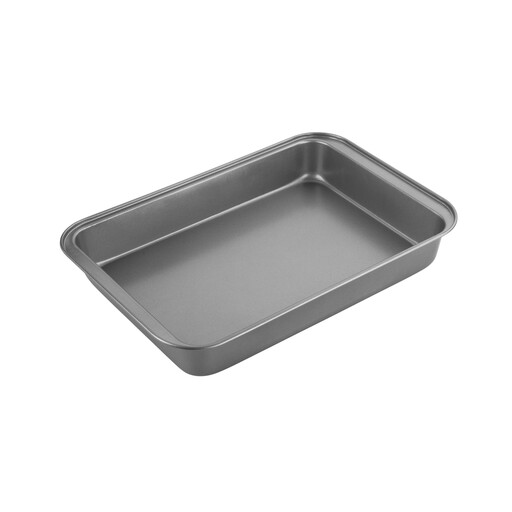
Why This Fits Their Persona: Suitable for households that regularly prepare roasts, vegetables, sides or make-ahead meals requiring a deeper roasting tin.
Its listed approximate 36.5 × 24.5 × 5.5cm size makes the deeper format clear. Fridge and freezer suitability is stated, but users should follow the supplied guidance when moving chilled cookware into a hot oven.
Deep sides; carbon steel construction; non-stick finish; listed as fridge- and freezer-safe.
We have compiled a complete, real-time list of products that fully satisfy these strict selection criteria and UK safety regulations.
To help reusable baking trays retain their finish:
They can be useful when easy food release and reduced washing up are priorities. Their value depends on care requirements, coating durability, dishwasher suitability and how often you bake. For frequent use, compare construction thickness and cleaning instructions rather than relying on the phrase “non-stick” alone.
Only when the product specifically states that it is suitable for this use. Temperature changes can place stress on some materials. Check the manufacturer’s instructions, avoid exceeding the stated temperature limit and use a stable oven shelf or baking sheet where recommended.
There is no universal lifespan. It depends on material thickness, frequency of use, temperature, storage and cleaning habits. A carbon steel or aluminised steel tray may remain useful for regular cooking when handled according to its care instructions, while a damaged or peeling coating is a reason to replace coated bakeware.