
24/7 Customer Support

Free returns

Same-day & Next-day Delivery

Quality Guaranteed

Unlock Your Welcome Offers: FREE Delivery | Up to 80% OFF | Free 30-day JoyPlus trial
Download the APP
Bringing the rich aroma and complex flavours of a café-quality coffee into your own kitchen is an appealing thought. Yet, the journey to find the right barista coffee machine can feel overwhelming. With a vast market of models boasting different features, pressures and price points, it is easy to get lost in the technical details.
This guide is designed to cut through the clutter. As the Joybuy Product Recommendation Officer, my role is to provide clear, practical advice to help you understand what truly matters in a home espresso machine. We will explore the key considerations and highlight a few standout models to help you make a choice that suits your lifestyle, skill level and budget.
Before diving into specific models, let's cover a few fundamental points. Understanding these will help you narrow down your options and identify the features that are most important for your daily coffee ritual.
The type of machine you choose will define your coffee-making experience.
A few technical terms appear frequently, and knowing what they mean is helpful.
Here are three machines that cater to different needs, from the aspiring home barista to the person seeking automated convenience.
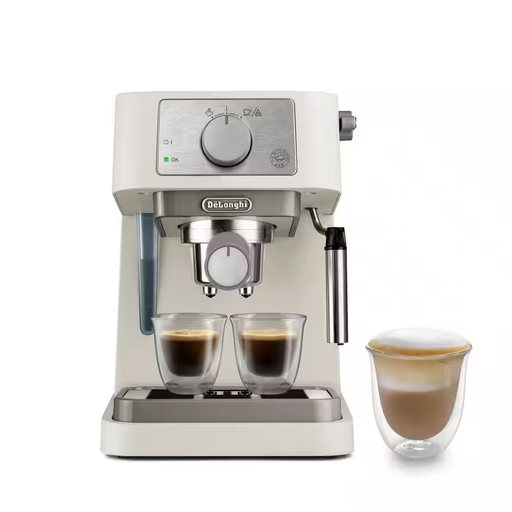
Why It Stands Out: The De'Longhi coffee machine Stilosa is a stylish and straightforward entry into the world of home espresso. It combines a compact footprint with the essential features needed to pull a proper shot of espresso and froth milk. Its 15-bar pump provides the necessary pressure for a rich extraction, and the manual stainless steel steam wand allows you to practise creating foam for classic milky coffees.
Pros:
Who is it for? This is an excellent choice for the coffee enthusiast on a budget, someone taking their first step away from pod machines or anyone with limited counter space who wants a capable manual espresso machine.

Why It Stands Out: The Sage Barista Pro is a high-performance bean to cup coffee machine that delivers on both speed and quality. Its standout feature is the ThermoJet heating system, which is ready for extraction in just three seconds. The integrated conical burr grinder offers 30 grind settings, giving you precise control over your coffee's flavour. The intuitive LCD screen provides feedback on grinding and extracting, helping you to refine your technique.
Pros:
Who is it for? This machine is aimed at the home coffee lover who wants to elevate their craft. If you enjoy the process of making coffee and want a machine that combines a high-quality grinder and espresso maker in one seamless package, the Barista Pro is a compelling option.

Why It Stands Out: The Barista Touch Impress represents the next step in assisted home coffee making. It features a colour touchscreen that provides step-by-step barista guidance. The Impress Puck System simplifies two of the trickiest parts of espresso making: dosing and tamping. It provides intelligent dosing and an assisted 10kg tamp, then checks the dose and auto-corrects if needed. Furthermore, the Auto MilQ system creates silky microfoam automatically and is optimised for dairy, oat, almond and soy milks. It even includes settings for cold brew and cold espresso.
Pros:
Who is it for? This machine is perfect for the user who desires premium, café-quality coffee with maximum convenience and consistency. If you love great coffee but want the machine to handle the more technical variables, the guided experience of the Barista Touch Impress is hard to overlook.
The models featured here represent just a fraction of the possibilities. If your ideal machine isn't listed, or you'd like to compare a wider range of features and price points, we invite you to explore our complete collection.
Explore our full range of home barista machines here.
1. What is the difference between a coffee machine and a barista machine? While the terms are often used interchangeably, a "barista machine" typically refers to an espresso machine designed to replicate the functions of a commercial café machine. This includes using a high-pressure pump (usually 9-15 bars) to force hot water through finely-ground coffee and a steam wand to texture milk. This differs from simpler drip filter or pod coffee makers.
2. Is a bean to cup coffee machine worth it? A bean-to-cup machine can be a worthwhile investment for those who prioritise freshness and convenience. Grinding beans just before brewing unlocks superior flavour and aroma compared to pre-ground coffee. While the initial cost is higher than a manual machine, the all-in-one design saves counter space and streamlines the coffee-making process.
3. Do I need a 15-bar or 9-bar coffee machine? This is a common point of confusion. The ideal pressure for extracting espresso is around 9 bars at the group head (where the water meets the coffee). Most home machines use a 15-bar pump to ensure that they can consistently generate and maintain that 9-bar pressure throughout the extraction process, overcoming the resistance of the tightly packed coffee puck. Therefore, a machine advertised with a 15-bar pump is designed to achieve the 9-bar industry standard for extraction.