Choose by timing and by what the bar contains, not by its fudge flavour. University College London Hospitals NHS Foundation Trust’s exercise-snack guidance for people managing diabetes distinguishes a snack eaten 60–90 minutes before exercise after a missed meal, which includes carbohydrate and protein with minimal fat, from a much closer-to-exercise glucose top-up; an ordinary fudge bar, a protein-led bar and a nutrition bar do not serve those purposes interchangeably.
Who is choosing?
People eating shortly before exercise
If you have only 15–30 minutes, timing and the purpose of the snack matter more than a protein claim. University College London Hospitals NHS Foundation Trust describes this window as a possible glucose top-up in its guidance for people managing diabetes; a bar’s label alone does not establish that it is suitable for that purpose.
People planning a snack before a session
If you missed an earlier meal and have 60–90 minutes before exercise, compare carbohydrate, protein and fat per bar. That follows the snack composition described for this situation in University College London Hospitals NHS Foundation Trust’s diabetes-specific guidance.
Buyers drawn to fudge-flavoured protein bars
If protein is your main reason for buying, compare it with the bar’s carbohydrate, fibre, sweeteners and allergen information. A fudge flavour does not tell you how the bar differs from confectionery or a nutrition bar.
What should you check?
Conventional fudge bar
Consider it when: You want a small confectionery treat rather than a snack chosen for its carbohydrate-and-protein composition.
Trade-off: The Fryer Supplier lists 16g carbohydrate but 0.5g protein for a 22g Cadbury Fudge bar.
Fudge-flavoured nutrition bar
Consider it when: You are planning ahead and want both carbohydrate and protein in one bar.
Trade-off: Tesco lists 7.7g fat and 7.7g fibre in the 55g Huel Chocolate Fudge Brownie bar, so check whether its composition fits your timing and usual tolerance.
Fudge-flavoured protein bar
Consider it when: Protein is the reason for the snack and you are not relying on the bar alone for a pre-session carbohydrate top-up.
Trade-off: Grenade lists 22g protein for Fudged Up, but its maltitol content and warning about excessive consumption deserve attention.
| Priority |
What to check |
Your needs |
| Timing and carbohydrate |
Compare carbohydrate per bar, not just per 100g. Check whether you are choosing a planned snack or considering a much closer-to-exercise top-up; sugar content alone does not establish how a bar should be used for glucose management. |
I have little time before activity and need to distinguish an ordinary snack from a glucose-management decision. University College London Hospitals NHS Foundation Trust’s advice on the latter is specifically for people managing diabetes. |
| Protein and serving size |
Read carbohydrate and protein together for the amount you will eat. Tesco lists 17g carbohydrate and 15g protein per 55g Huel bar; The Fryer Supplier lists 16g carbohydrate and 0.5g protein per 22g Cadbury Fudge bar. |
If I missed a meal and am eating 60–90 minutes before exercise, I want to compare the contents of one bar rather than assume two fudge-flavoured products play the same role. |
| Fibre, fat and sweeteners |
Check fibre, fat and named sweeteners on the current label. Tesco lists 7.7g each of fibre and fat for the Huel bar; Grenade identifies maltitol in Fudged Up and warns that excessive consumption may cause a laxative effect. |
I would rather establish how an unfamiliar bar fits my routine before taking it to a demanding session or a long journey. |
| Ingredients and allergens |
Read the current ingredients and precautionary allergen statement, as well as any vegan label. Tesco lists Huel as vegan while also warning of possible milk, sesame, peanut, nut and mustard traces; The Fryer Supplier lists milk-derived ingredients in Cadbury Fudge. |
When an ingredient or possible trace matters to me, I need the pack’s specific wording rather than a flavour name or dietary label alone. |
Common buying mistakes
-
Assuming all fudge bars serve the same purpose
Similar flavours can conceal different per-bar figures. The Fryer Supplier lists 0.5g protein for a 22g Cadbury Fudge bar, while Tesco lists 15g for a 55g Huel Chocolate Fudge Brownie bar.
Compare carbohydrate, protein, fat and fibre for the portion you will actually eat, then consider how long you have before exercise.
-
Trying an unfamiliar sweetened bar before a demanding session
Grenade identifies maltitol in Fudged Up and warns that excessive consumption may cause a laxative effect.
Check the sweetener information and find out how a bar fits your usual routine before relying on it for an important session or journey.
-
Taking a vegan label as an allergen clearance
Tesco lists Huel Chocolate Fudge Brownie as vegan but also gives precautionary warnings for several allergens. The two labels answer different questions.
Read the current pack’s ingredients and precautionary statement for any allergen that matters to you.
-
Applying school-food rules to an ordinary retail purchase
The Department for Education’s September 2026 school-food guidance applies to England and identifies confectionery, chocolate and chocolate-coated products as restricted across the school day within its school-food scope. It is not a general ban on buying a fudge bar for personal use.
If you are choosing food to provide at a school in England, check the applicable school-food standards. For a personal snack, assess the product and its label for your own use instead.
Relevant brand references
Cadbury
Cadbury identifies its Fudge Chocolate Bar as a 22g chocolate-covered fudge bar.
- The Fryer Supplier lists 16g carbohydrate per 22g bar, giving a clear single-bar figure to compare.
- The same listing gives 0.5g protein and identifies milk-derived ingredients.
Huel
Tesco lists Huel Chocolate Fudge Brownie as a 55g vegan nutrition bar.
- Tesco lists 17g carbohydrate and 15g protein per bar for shoppers comparing both figures.
- The listing also gives 7.7g fat and 7.7g fibre, with precautionary allergen warnings to check.
Grenade
Grenade presents Fudged Up as a chocolate-fudge-flavoured protein bar.
- Grenade lists 22g protein per bar for buyers comparing protein figures.
- It contains maltitol, and Grenade warns that excessive consumption may cause a laxative effect.
M&S
M&S describes its Vanilla Fudge Bar as milk chocolate with a vanilla fudge centre.
- Its stated flavour and format make it a confectionery option to compare with an ordinary fudge bar.
- Check the current pack’s nutrition and allergen information if those details determine your snack choice.
Joybuy fudge bars
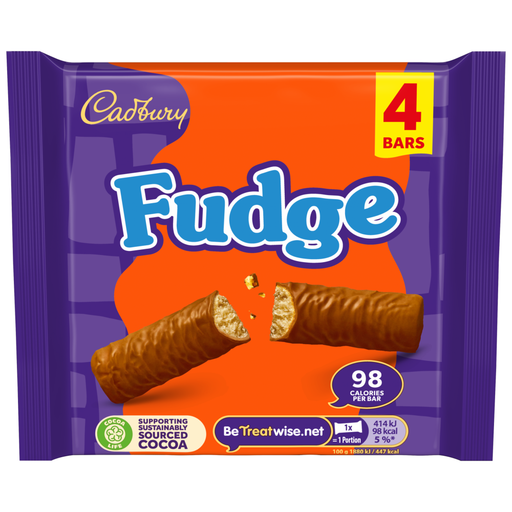
This multipack represents the conventional Cadbury fudge-bar option for shoppers considering a small confectionery snack. It is not a selection of protein or nutrition bars.
 No image available
Cadbury Fudge Bar 4 Pack 88g
Consider this pack if you want conventional chocolate-covered fudge rather than a bar chosen for its carbohydrate-and-protein composition. The listing is for four bars totalling 88g; check the current pack for per-bar nutrition and whether separate wrapping matters to you.
View on Joybuy
Questions about pre-workout bars
Is an ordinary fudge bar the same as a planned pre-workout snack?
No: a conventional fudge bar does not necessarily provide the carbohydrate-and-protein combination described for a snack eaten 60–90 minutes before exercise after a missed meal in University College London Hospitals NHS Foundation Trust’s diabetes-specific guidance. The Fryer Supplier lists 16g carbohydrate but 0.5g protein for a 22g Cadbury Fudge bar.
What changes if I eat only 15–30 minutes before exercise?
The purpose of the snack becomes particularly important. University College London Hospitals NHS Foundation Trust describes that window as a possible glucose top-up for people managing exercise and diabetes; neither a high-protein label nor a fudge bar’s sugar figure establishes that it is suitable for treating low blood glucose.
Does a vegan fudge-flavoured bar settle the allergen question?
No. Tesco lists Huel Chocolate Fudge Brownie as vegan while also warning that it may contain milk, sesame, peanuts, nuts and mustard. Check the current wrapper’s ingredients and precautionary wording for the allergens relevant to you.
Do England’s school-food rules ban buying fudge bars?
No. The Department for Education’s September 2026 guidance concerns food covered by school-food standards in England; it identifies confectionery, chocolate and chocolate-coated products as restricted across the school day in that setting. It does not impose a general ban on ordinary retail purchases for personal use.


