
24/7 Customer Support

Free returns

Same-day & Next-day Delivery

Quality Guaranteed

Unlock Your Welcome Offers: FREE Delivery | Up to 80% OFF | Free 30-day JoyPlus trial
Download the APP
A well-chosen bathroom storage cabinet can make a compact bathroom easier to use, but attractive photos and broad claims do not always reveal whether a unit will fit your space. The main risks are buying a cabinet that blocks doors or pipework, choosing materials unsuitable for regular moisture, or underestimating how much storage everyday toiletries and towels actually require.
This guide explains the practical details to check before buying, then matches several options to different household needs.
A cabinet may appear narrow in a product image but still interfere with a basin, toilet, radiator or doorway. Measure:
A tall bathroom cabinet is useful where floor space is limited, but a 170 cm unit may not suit a low-ceilinged room or a position beneath a wall cupboard.
Most bathroom furniture uses MDF, particleboard, metal or coated materials rather than solid waterproof construction. Repeated splashes, standing water and poor ventilation can affect boards and finishes over time. A bathroom storage unit should be positioned away from frequent splashing, and spills should be wiped promptly.
Check the product instructions for placement restrictions instead of relying on vague moisture-related wording. Even a white bathroom cabinet can show swelling or finish damage if it is regularly exposed to water around a basin or shower.
A large internal volume is not automatically convenient. Deep shelves can hide small bottles, while fixed shelves may not accommodate taller cleaning products. Drawers, adjustable shelves and separate compartments can make a bathroom organiser more practical than one open cupboard.
Also check the stated static load capacity. Toiletries, spare bottles and cleaning products can become surprisingly heavy when stored together.
For a narrow bathroom, compare the cabinet’s external dimensions with your measured space. A slim bathroom cabinet can provide vertical storage without taking much floor area, but depth matters just as much as width.
For example, the JOYFURNOS tall cabinet measures approximately 30 × 30 × 170 cm. Its 30 cm depth may work beside a basin or in a hallway, but buyers should still check skirting, pipe routes and door swing before ordering.
Under-sink furniture requires more detailed measuring. Check the basin width, pedestal position, waste pipe location and available knee clearance. Do not assume that a cabinet described as a universal fit will match every washbasin arrangement.
Look for a combination of shelves, drawers and cupboards when storing different categories. A narrow bathroom cupboard with adjustable shelving can accommodate tall shampoo bottles as well as smaller cosmetics and spare toiletries.
Useful features include:
A bathroom shelf set may be more suitable than a closed cabinet if you need quick access or want to avoid opening doors in a tight space.
MDF and particleboard are common bathroom furniture materials. Their suitability depends on construction, finish, placement and care. Look for clear assembly instructions, labelled parts and an anti-tip kit, particularly for tall or narrow units.
Anchor a freestanding cabinet to a suitable wall in line with the instructions. This is important in homes with children, pets or frequent household use. Also check whether the supplied fixings are suitable for your wall type; plasterboard, masonry and tiled surfaces may require different fixing methods.
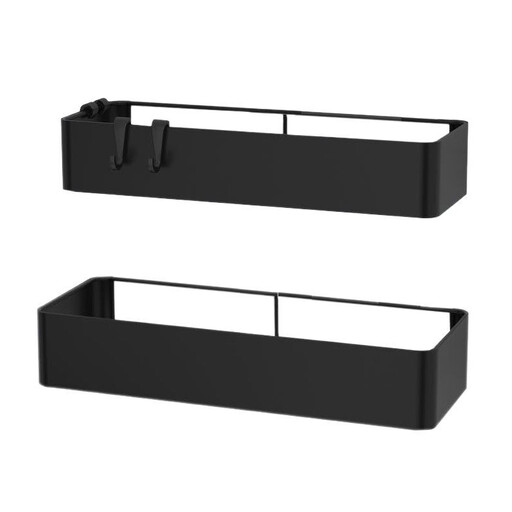
Why This Fits Their Persona: A two-piece bathroom shelf set suits renters, first-time household organisers and shoppers who want visible storage without committing to a freestanding cabinet.
Its stated rust-resistant iron construction addresses the common concern that exposed shelving may deteriorate quickly in a humid room. Check wall fixings and installation space before purchase.
Two shelves are supplied, with stated lengths of 38.6 cm and 40 cm. Open access makes frequently used toiletries easy to reach.
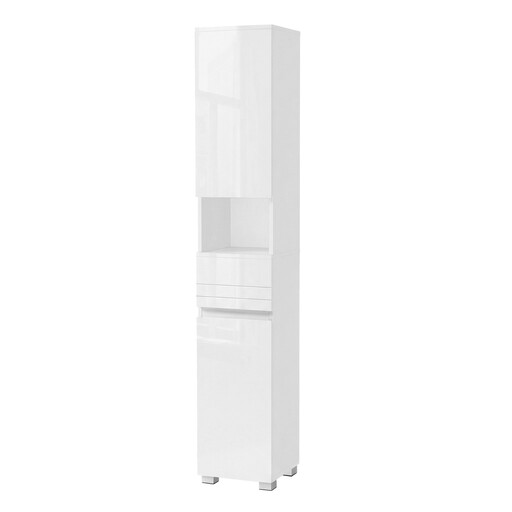
Why This Fits Their Persona: This suits households wanting concealed, categorised storage in a compact footprint, including small bathrooms, guest bathrooms and homes with limited floor space.
The listing specifies six compartments across shelves, drawers and cabinets, rather than relying on one large, difficult-to-organise space. Adjustable shelves help reduce wasted vertical room.
The MDF cabinet measures approximately 30 × 30 × 170 cm and states a 10 kg maximum static load per shelf and drawer. Reversible doors and an anti-tip kit are included.
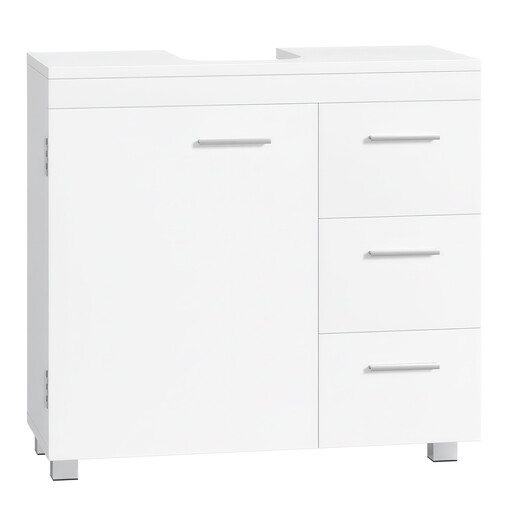
Why This Fits Their Persona: This under-sink bathroom cabinet is intended for households that need to use otherwise wasted space beneath a washbasin for towels, toiletries and cleaning supplies.
The design combines three drawers with two compartments behind a door, helping separate small items from bulkier supplies. Measure the pedestal and waste pipe before ordering.
It measures approximately 30 × 70 × 64 cm, includes an adjustable shelf and states a maximum static capacity of 36.2 kg. An anti-tip kit is included.
We have compiled a complete, real-time list of products that fully satisfy these strict selection criteria and UK safety regulations.
Measure the available width, depth and height rather than choosing by appearance. A slim bathroom cabinet around 30 cm deep may work beside a basin, but door clearance, skirting boards and pipework must also be considered. For very limited wall space, a bathroom shelf set may be more practical.
There is no single lifespan for every cabinet. Durability depends on material, assembly, ventilation, weight, cleaning and exposure to water. A well-installed unit that remains dry and within its stated load limits is less likely to suffer avoidable damage than one placed beside a frequently splashed basin or shower.
Installation is usually manageable when the cabinet has labelled parts and clear instructions, but accurate measuring is essential. Confirm the basin and pedestal dimensions, waste-pipe route and floor level before assembly. Secure the finished unit to the wall where the instructions require it, using fixings appropriate for the wall construction.