BBQ hosts feeding a group
For several salads or fillings, compare pack size with drained quantity so you can plan how much tuna will go into each dish.


Choose standard chunks for tuna that will be mixed into several BBQ salads or fillings, checking the drained quantity to work out how much you can serve. No-drain chunks remove a preparation step when you are assembling food shortly before serving; consider steak-style tins when you want distinct pieces on a platter. Whichever format you choose, check the individual tin for its packing liquid, ingredients, salt, fish allergen declaration, sourcing claims and instructions for leftovers.
For several salads or fillings, compare pack size with drained quantity so you can plan how much tuna will go into each dish.
If you are assembling food shortly before serving, an explicitly labelled no-drain format removes the draining step required for conventional tins in liquid.
Check the individual product for ingredients, salt, fish allergen information and any sourcing credential that matters to your household. Similar-looking tins can differ on these details.
Match the tuna format to the finished dish, then check quantity and the individual product label.
Choose when: The tuna will be mixed through several salads, wraps or sandwich fillings.
Bear in mind: Tins packed in liquid normally need draining; use the drained quantity when planning portions.
Choose when: You will assemble salads or sandwiches shortly before serving and want to skip draining.
Bear in mind: No-drain does not identify the packing medium or salt content; check both on the selected pack.
Choose when: You want to serve visible pieces of tuna in a composed salad or platter.
Bear in mind: Check the tin for draining instructions and any bones warning before preparing the dish.
| Concern | What to check | Who this matters to |
|---|---|---|
| Usable quantity | Compare the stated drained weight and work out how much tuna each dish needs; tin count alone does not give the usable quantity. | When I am making several salads and fillings, I need enough drained tuna to divide between them. About 27% of consumers put usable quantity first. |
| Preparation time | Look for an explicit no-drain description rather than assuming any particular multipack has it. | If food is being assembled as guests arrive, I want to avoid draining tins. For about 20% of consumers, quick, low-mess preparation is the primary concern. |
| Ingredients and salt | Read the fish allergen declaration, ingredients and salt figure on the exact product; compare nutrition figures on the same stated basis. | When I am serving others, I need to know what is in the tuna and be able to check its salt content. That label clarity comes first for about 20% of consumers. |
| Finished texture | Choose between chunks and steak-style pieces according to whether the tuna will be mixed in or served visibly. | For a platter, I want pieces that can remain visible rather than tuna stirred through a filling. About 20% of consumers make presentation and texture their main concern. |
| Sourcing credential | Check the specific tin for an MSC ecolabel or a stated catch method; do not extend one product's claim to a whole range. | If a stated sourcing credential decides which tin I buy, I need to see it on that product. It is the primary concern for about 13% of consumers. |
Sainsbury's lists 0.12g salt per 100g drained for its cited spring-water chunks, while the cited Asda product lists 0.90g on the same basis. The packing liquid alone does not tell you the salt figure.
Compare the nutrition panels on the exact tins, using the same per-100g drained basis where stated.
Different pack sizes and draining requirements can change how much tuna is available for salads and fillings.
Check the net and drained quantities, then plan against the amount your dishes require.
The cited Sainsbury's listing says to use refrigerated leftovers within one day after transferring them to a non-metallic container; the cited Asda and M&S listings give two days.
Follow the selected tin's instructions for transferring, refrigerating and using leftovers.
An MSC label or catch-method statement applies to the product displaying it, not automatically to every tuna format from that retailer or brand.
If the credential matters to you, check the exact tin you intend to serve.
Its No Drain Tuna Chunks in Spring Water MSC product is a branded option for avoiding the draining step.
Its range includes chunks in brine for shoppers comparing packing media and ingredients.
Its spring-water category includes own-label chunks in several pack sizes, alongside steak-style options.
Its cited 4 x 145g spring-water chunks listing includes product-specific sourcing and nutrition information.
Its cited spring-water chunks come in a 4 x 145g pack with an MSC-labelled listing.
Its tuna range includes spring-water chunks and steak-style formats for different serving plans.
These tins cover chunks in spring water or brine for salads and fillings, plus no-drain chunks for quicker assembly. Check each pack's stated quantity and format against the dishes you plan to make.
 No image available
A four-tin chunks pack to consider when making several salads or sandwich fillings. If skipping the draining step matters, check this particular pack's instructions rather than treating it as a no-drain product.
 No image available
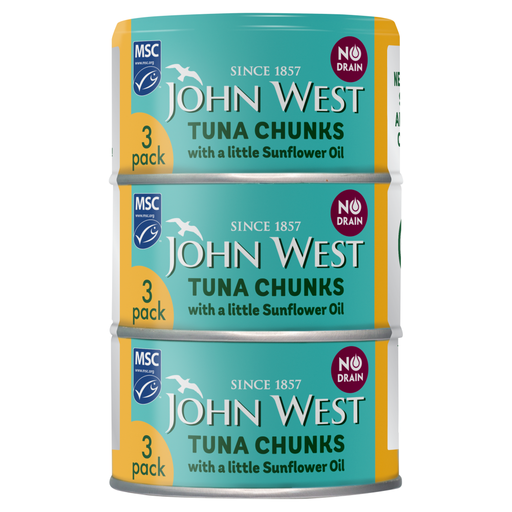
The no-drain format suits salads or sandwiches assembled shortly before serving. This variant is packed in sunflower oil, so check that it fits the dish you are preparing.
 No image available
Consider these no-drain chunks for last-minute salad or sandwich assembly if you prefer a spring-water variant. When comparing usable quantities with conventional tins, check the current can label for the relevant weight basis.
 No image available
This four-tin chunks pack is an option for several salads or sandwich fillings when brine suits your recipe. Check the selected can's drained quantity and nutrition panel when planning servings or comparing salt figures.
 No image available
Spring-water chunks are a format to consider for mixed salads and sandwich fillings. Before planning group portions, confirm how the stated 145g relates to the six-pack description and check the total and drained quantities on the pack.
Choose by the individual tin's ingredients and nutrition panel rather than its packing liquid alone. Sainsbury's lists 0.12g salt per 100g drained for its cited spring-water chunks, Asda lists 0.90g for its cited spring-water chunks, and Princes lists 0.9g for its cited brine chunks. Use the format that suits your salad, then compare the labels on the same stated basis.
Follow the instructions on the tin you opened. The cited Sainsbury's product says to transfer leftovers to a non-metallic container, refrigerate and use within one day; the cited Asda and M&S listings specify transfer and refrigeration with use within two days.
Start with the amount of tuna your recipes require, then check each pack's net and drained quantities. A count of tins cannot, by itself, tell you how much drained tuna will be available for salads, wraps or fillings.