
24/7 Customer Support

Free returns

Same-day & Next-day Delivery

Quality Guaranteed

Unlock Your Welcome Offers: FREE Delivery | Up to 80% OFF | Free 30-day JoyPlus trial
Download the APP
Waking up to the aroma of freshly ground coffee is one of life’s simple pleasures. Moving from pods or pre-ground coffee to a bean to cup coffee machine is a significant upgrade, promising café-quality drinks in your own kitchen. However, the market is flooded with models that look impressive but can lead to buyer's remorse.
As the Joybuy Product Recommendation Officer, my role is to help you navigate the options and avoid common purchasing pitfalls. Many consumers find themselves stuck with a machine that doesn't fit their lifestyle. Before you invest, let's look at three frequent traps to avoid.
To choose wisely, you need to understand what truly matters. Focus on these core components rather than marketing buzzwords.
The main advantage of a bean to cup coffee machine is its integrated espresso machine with grinder. The quality of this component is paramount. Look for machines with hardened steel or ceramic conical burr grinders, which produce a consistent grind size for even extraction. The number of grind settings is also crucial; a machine with 13 or more settings gives you the flexibility to "dial in" different types of coffee beans, from light to dark roasts, to get the flavour just right.
How you enjoy your milk-based drinks will dictate your choice here.
The heating system affects both the warm-up time and the quality of your coffee. Most home machines use a Thermoblock or Thermocoil system, which heats water on demand. They are energy-efficient and fast, often ready in under a minute. More advanced machines may feature dual-boiler systems, allowing you to extract espresso and steam milk simultaneously—a feature prized by those who make multiple milky coffees back-to-back.
Choosing a machine is about matching its features to your daily routine. Here are a few recommendations tailored to different user profiles.

Why This Fits Their Persona: This user wants to move on from pods to fresh beans without a steep learning curve. The Magnifica Start offers one-touch buttons for espresso and coffee, making the transition seamless. It's a reliable workhorse for daily coffee with minimal fuss.
It avoids the cleaning nightmare with a fully removable brewing unit, which can be easily rinsed under the tap. Its compact footprint is also well-suited for smaller UK kitchens.
Intuitive one-touch operation for core coffee drinks. The manual steam wand offers a chance to learn milk frothing without the complexity of a fully integrated system.
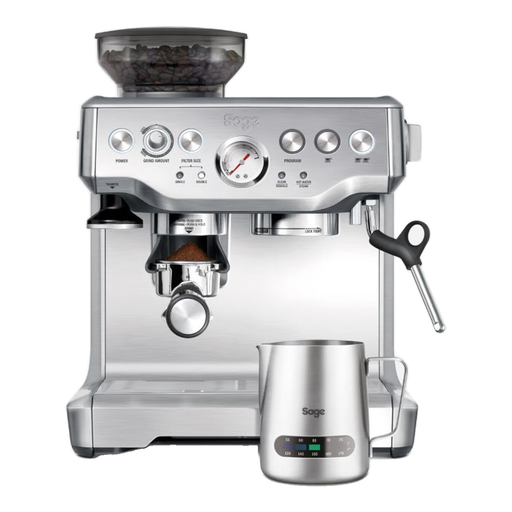
Why This Fits Their Persona: This user enjoys the craft of coffee making. The Barista Express provides the tools for control—an integrated grinder with 16 settings, precise temperature control and a powerful manual steam wand for practising latte art. It's a true home barista coffee machine.
It sidesteps the pressure myth by focusing on what matters: low-pressure pre-infusion followed by a 9-bar extraction process, which is the professional standard for a balanced espresso.
It offers a complete hands-on experience from grind to extraction and milk texturing. The inclusion of a pressure gauge provides real-time feedback to help you perfect your technique.

Why This Fits Their Persona: This user loves technology and wants premium results for both hot and cold drinks. The touchscreen interface provides step-by-step guidance, while the unique cold extraction feature makes it a standout iced coffee machine for creating cold brew and iced lattes at home.
It combines automation with control. The Impress Puck System assists with dosing and tamping to reduce mess and the Auto MilQ system has settings for dairy and alternative milks, avoiding the one-size-fits-all problem.
The innovative cold extraction technology is a unique feature not found on most machines. The ThermoJet heating system is ready in 3 seconds, eliminating the wait for your morning coffee.
We have compiled a complete, real-time list of products that fully satisfy these strict selection criteria and UK safety regulations.
How often do I need to descale a bean to cup coffee machine? This depends heavily on the water hardness in your area of the UK. In hard water areas, you may need to descale every 2-3 months. Most modern machines have an automatic alert that tells you when it's time. Using a water filter in the tank can also reduce the frequency of descaling.
Is a more expensive automatic coffee machine worth the investment? It depends on your priorities. Higher-priced models typically offer more durable construction (stainless steel vs. plastic), faster heat-up times, more precise grind and temperature controls and more sophisticated automatic milk frothing systems. If you drink several cappuccinos or lattes a day, a premium automatic coffee machine with a one-touch milk system can be a significant time-saver and a worthwhile investment.
Can I use oily coffee beans in my machine? It is generally advised to avoid very dark, oily beans in a fully automatic coffee machine. Over time, the oils can build up and clog the internal grinder mechanism, which can be difficult to clean and may affect performance. A medium roast bean is often a safer and more reliable choice for ensuring the longevity of your machine.