Espresso-tonic maker with limited worktop space
You want espresso for tonic without letting an unused milk system dictate the machine's footprint.


Choose a machine that makes espresso and offers the adjustments you will use, then check its full footprint and refill access against your worktop. If espresso tonic and black coffee are your main drinks, a milk system need not drive the choice; it becomes relevant when the machine will also serve milk-drink makers. Allow for cleaning and descaling whichever route you take.
You want espresso for tonic without letting an unused milk system dictate the machine's footprint.
You make espresso tonic, while others also want cappuccino or latte-style drinks. Milk preparation and its clean-up matter alongside espresso.
You want to adjust the espresso used with tonic and may want a pre-ground-coffee option for occasional decaf or a different coffee.
Start with the space the machine can actually occupy and the espresso controls you want. Consider milk preparation and maintenance as separate decisions, rather than assuming more drink functions will improve an espresso tonic.
| Concern | What to check | Who this matters to |
|---|---|---|
| Worktop fit | Measure usable width, depth and overhead space; check how the exact model's water tank and bean container are refilled. | If I have a narrow worktop, the machine must fit where I can still refill it comfortably. Around 31% of consumers put practical footprint first. |
| Espresso control | Confirm an espresso programme and the particular output-length, strength or grind adjustments you want. | When tonic or ice changes how my drink tastes, I want control over the espresso base. For around 31% of consumers, that flexibility is the primary need. |
| Milk drinks | For shared use, compare a manual wand with an automatic milk system and check the cleaning steps for the exact model. | My espresso tonic needs no milk, but other people at home regularly make milk drinks. That shared use comes first for around 23% of consumers. |
| Maintenance | Check the model's cleaning and descaling instructions, water-hardness setting and any compatible filter schedule. | I want to know what cleaning and descaling will involve before making this an everyday machine. Around 15% of consumers prioritise that upkeep. |
Width alone will not tell you whether a machine projects too far across the worktop or can be refilled beneath a cupboard. Melitta lists the Purista at 20 cm wide, while De'Longhi lists the Magnifica Start ECAM220.22.GB at 240 mm wide and 440 mm deep.
Compare the exact model's width, depth, height and refill access with the space where it will sit.
Espresso tonic uses espresso, tonic and ice, so a milk system addresses other drinks rather than the core recipe.
Choose milk capability according to how often the household will actually make milk drinks.
Filter claims have conditions, and cleaning and descaling still follow the machine's instructions. Water hardness can affect when descaling is needed.
Check the exact model's filter compatibility, replacement schedule and descaling instructions.
If you use a compatible filter, replacement cartridges add an ongoing task and consumable.
Changing the beans in a hopper is not the same as selecting a different drink programme. De'Longhi lists a pre-ground-coffee function for the Magnifica Start ECAM220.22.GB, and JURA lists a ground-coffee chute for the ENA 4.
If occasional decaf matters, check whether the exact model offers a pre-ground option and how it is used.
The Purista line is relevant when espresso and black coffee take priority on a narrow worktop.
The Magnifica Start ECAM220.22.GB suits consideration when espresso tonic shares the machine with occasional manually prepared milk drinks.
The ENA 4 is an espresso-and-black-coffee option for someone who wants programmable coffee quantity without choosing a milk-drink machine.
A Philips model with a LatteGo milk system is relevant when household milk drinks are an established need alongside espresso tonic.
These machines offer different approaches to espresso for tonic: fully automatic preparation, models with milk capability, and more hands-on espresso preparation. Compare each one's workflow and worktop fit rather than treating them as interchangeable compact machines.
 No image available
Consider this model if you mainly want espresso for tonic but would also use a manual milk frother. De'Longhi lists customisable coffee length, a pre-ground-coffee function and 240 × 440 × 350 mm dimensions for the ECAM220.22.GB. Check refill access as well as the available worktop space.
 No image available
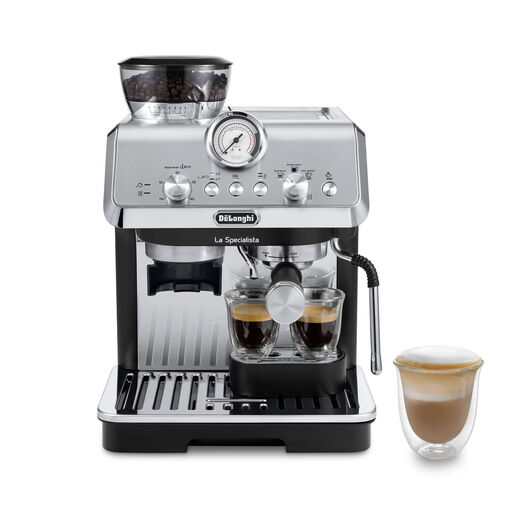
Consider this manual espresso-making route if hands-on preparation appeals to you more than one-touch operation. Grinding, dosing and tamping take your involvement; check the machine's dimensions and refill access against your worktop.
 No image available
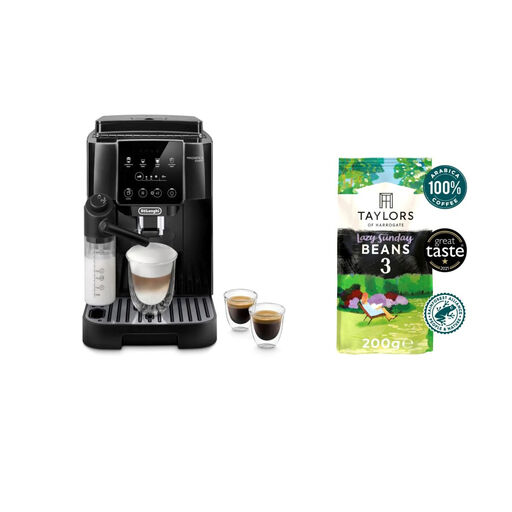
This automatic-milk variant is worth considering when the household makes milk drinks as well as espresso tonic. The bundle includes 200 g of Taylors of Harrogate Lazy Sunday coffee beans. Check worktop and refill space, and confirm the available espresso-length controls if changing shot volume matters to you.
 No image available
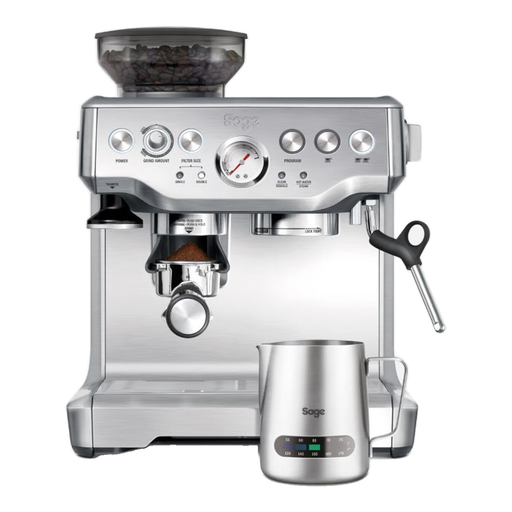
Choose this hands-on route only if you want to take part in preparing each espresso rather than use a fully automatic workflow. Its stated features include 16 grind settings and PID temperature control. Confirm the machine's full dimensions and refill access before assigning it space in a small kitchen.
 No image available
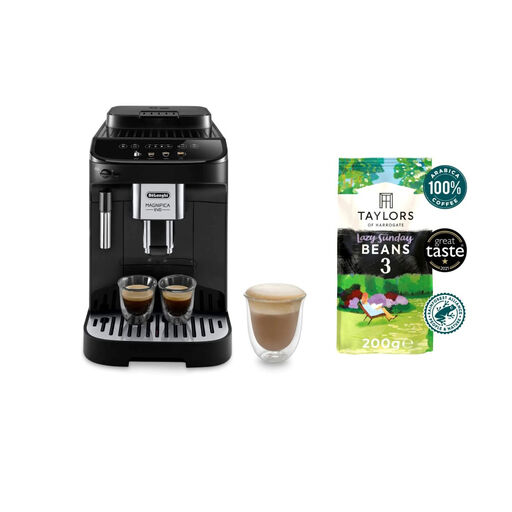
This fully automatic option has a manual milk frother for households that sometimes make milk drinks alongside espresso tonic. The bundle includes 200 g of Taylors of Harrogate Lazy Sunday coffee beans. Check its full footprint and refill access, and confirm espresso-output controls if adjusting shot length is important.
No. Espresso tonic combines espresso, tonic water and ice; consider a milk system only if you will also make milk drinks.
Start with the machine's espresso programme, then adjust the drink to your taste. Artisan Roast Coffee Roasters suggests 35–40 ml of espresso with 100–110 ml of tonic; your preferred balance may change with the coffee and tonic you use.
Prepare the espresso separately and put the tonic and ice in the serving glass. Pour the espresso over them, letting it cool slightly first if you prefer.
Follow the schedule and instructions for your exact model, taking its water-hardness setting and any compatible filter into account. De'Longhi says water hardness affects descaling frequency for its Magnifica Evo models; a filter claim should not be treated as a reason to skip the prescribed maintenance.