
24/7 Customer Support

Free returns

Same-day & Next-day Delivery

Quality Guaranteed

Unlock Your Welcome Offers: FREE Delivery | Up to 80% OFF | Free 30-day JoyPlus trial
Download the APP
Preparing dough by hand can be time-consuming, particularly when you are making bread, steamed buns, pizza bases or pastry for a family. A Bear dough maker such as the Bear Intelligent Dough Maker HMJ-A50N1 is designed to combine kneading and fermentation in one appliance, helping reduce hands-on preparation.
However, capacity figures and “automatic” functions do not always tell the full story. Before buying an automatic dough maker, check the working capacity, bowl material, operating noise and suitability for the recipes you actually make.
A listing may advertise a large bowl, but this does not necessarily mean the machine can safely process the same weight of flour or finished dough. A 5L dough mixer may be suitable for family cooking, but the usable dough limit still matters.
The Bear HMJ-A50N1 has a 5.0L capacity and is specified for up to 2.5kg of dough. Its instructions state that it can handle approximately 400–1,600g of dry flour, depending on the recipe and liquid ratio. This distinction is useful when comparing appliances.
Bread dough, enriched dough, pastry and Chinese-style dough can require different mixing times and moisture levels. A dough maker with only one timed cycle may not offer enough flexibility for different recipes.
The Bear model provides separate options for knead and ferment, knead only and ferment only, with Chinese Dough and Western Bread modes. This gives you more control, although ingredients and recipes still need to follow the appliance instructions.
A low-noise dough mixer will still produce sound from its motor and rotating bowl. Look for a stated decibel figure rather than relying only on phrases such as “silent” or “whisper quiet”.
The HMJ-A50N1 is listed at 61dB. This is an objective specification, but perceived noise can vary according to flooring, worktop stability and the dough quantity being processed.
For regular family baking, consider the amount of dough you usually prepare rather than choosing a machine solely by its bowl size. The Bear dough maker’s stated 2.5kg dough capacity may suit larger bread batches, weekend cooking and small-scale hosting.
Its instructions recommend a flour-to-water ratio of approximately 100:50 to 100:60, with yeast at around 100:1. These are starting guidelines rather than universal rules, as flour type and recipe style affect absorption.
The HMJ-A50N1 uses a 200W DC motor and has a listed rotating speed of 140–170 revolutions per minute. The manufacturer states that a kneading cycle can be completed in around 15 minutes, although actual results can vary with ingredient quantity and dough firmness.
A bread dough kneader should be used within its specified limits. Very stiff dough, excessive flour or repeated heavy batches may place additional demand on the motor.
A 304 stainless steel dough bowl is practical for regular food preparation because it is durable, non-porous and relatively straightforward to wipe clean. The machine also includes a large and small lid arrangement, allowing ingredients such as water or seasoning to be added during the process.
The main unit should not be immersed in water. Use a soft cloth, and avoid steel wool, abrasive cleaners and corrosive liquids. The buckle design is intended to help reduce overflow, while the silicone base pad supports stability during operation.
The supplied range contains one appliance specifically designed for dough kneading and fermentation. Rather than presenting unrelated products as alternatives, the following cards show how the same model fits different household needs.
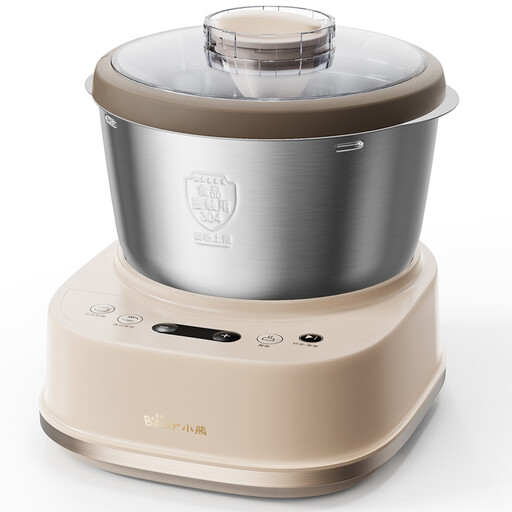
Why This Fits Their Persona: For first-time buyers who want to prepare dough without purchasing separate kneading and fermentation appliances, this model combines both functions in one compact unit measuring 310 × 262 × 283mm.
Its specifications state both bowl capacity and dough limits, helping buyers distinguish between the 5L bowl and the maximum 2.5kg dough output.
Automatic kneading, fermentation functions and a 304 stainless steel bowl.
Why This Fits Their Persona: Buyers prioritising food-contact materials and repeat use may value the specified 304 stainless steel bowl, button controls and automatic process design.
The listed 61dB operating level provides a measurable reference instead of an unqualified “silent” claim.
304 stainless steel bowl, silicone stability pad and lid openings for adding ingredients.
Why This Fits Their Persona: Households making both Western bread and Chinese-style wheaten recipes can select the corresponding programme rather than relying on a single generic cycle.
Separate kneading and fermentation selections make it easier to adapt the process to different dough recipes.
Up to 2.5kg dough output and constant-temperature fermentation function.
We have compiled a complete, real-time list of products that fully satisfy these strict selection criteria and UK safety regulations.
Place the machine on a stable, dry worktop away from high-temperature gas or electric hobs. Add ingredients according to the recipe, secure the lid and select the required mode. A beep indicates that the programmed process has finished.
If the machine stops during operation, the motor’s thermal protection may have activated. Switch it off and allow it to cool for 20–30 minutes before trying again. Do not exceed the recommended ingredient limits, as overloading can affect kneading performance.
For UK homes, check that the appliance specification is compatible with the local supply. This model is listed as 220–240V, 50–60Hz.
The HMJ-A50N1 includes Chinese Dough and Western Bread modes, as well as separate kneading and fermentation functions. It is intended for a range of wheaten dough recipes, but the recipe’s flour, liquid and yeast ratios should remain within the stated guidelines.
The listed maximum dough output is 2.5kg. The instructions specify approximately 400–1,600g of dry flour, depending on the recipe. Do not assume that the full 5L bowl capacity equals a 5kg dough load.
Running cost depends on the appliance’s power rating, programme duration and your electricity tariff. The model is rated at 200W, or 0.2kW. A simple calculation is:
0.2kW × operating hours × your tariff per kWh = approximate electricity cost
Actual usage may be lower if the motor cycles rather than running continuously.