Choose the screen size around where everyone actually sits, then check that each player can read split-screen details and that the TV fits the bedroom. TCL United Kingdom gives 43 inches at about 1.3 m and 55 inches at about 1.7 m as viewing-distance reference points, not fixed limits. Once the size works, check the exact HDMI inputs for any console modes you intend to use, and weigh dark-scene contrast against reflections from the room’s windows and lamps.
Who this choice affects
Players sitting close to the screen
If everyone plays near the TV, split-screen menus need to remain readable without the screen dominating the room. Measure from the usual eye position to the planned screen position. TCL United Kingdom gives about 1.3 m for 43 inches and 1.7 m for 55 inches as starting points.
Console players using supported gaming modes
If you want 4K/120 Hz output, variable refresh rate (VRR) or automatic low-latency mode (ALLM), check the console, game and selected TV input rather than relying on a general gaming label. PlayStation Support says PS5 supports HDMI 2.1 and 4K/120 Hz output; the connected TV must also support the mode you choose.
Players facing windows or lamps
If light reflects in the screen during your usual playing hours, consider placement before choosing a display. Samsung describes a Glare Free feature on its QN90F range, but how reflections affect play depends on the room and screen position.
What matters when choosing
Settle the seating distance and each player’s view before comparing picture technologies or console features. The concerns below reflect different primary needs among consumers choosing a bedroom TV for local co-op.
| Concern | What to check | Who this matters to |
|---|
| Screen size and distance |
Measure from the usual eye position to the screen; use TCL United Kingdom’s 43-inch at about 1.3 m and 55-inch at about 1.7 m references, then check the TV’s full width. |
If split-screen maps and menus are hard to read, I want a larger image, but not one that crowds my usual seat. Around 36% of consumers would put that balance between readability and room fit first. |
| Shared viewing positions |
Mark where each person will sit and check sightlines, screen placement and stand or wall space. |
When we play from different parts of the bedroom, I need everyone to see comfortably, not just the person facing the centre. For around 29% of consumers, shared-viewing comfort would be the primary concern. |
| Console modes |
Check the exact HDMI input for the 4K/120 Hz, VRR or ALLM modes you intend to use, including any required TV setting. |
If I plan to use my console’s supported gaming modes, I do not want the connection or settings to prevent them from working. Console-feature readiness would come first for around 21% of consumers. |
| Reflections |
Look at windows and lamps during normal playing hours; assess any anti-reflection feature against the planned screen position. |
When daylight or a lamp appears in dark scenes, I need a screen position that keeps the game visible to both players. Around 14% of consumers would make reflection handling their first priority. |
Mistakes to avoid
-
Choosing a diagonal from a product photo
A larger image can help with split-screen detail, but a close bedroom seat and limited furniture space may make the set awkward to use or place.
Measure from the normal playing position and check the TV’s full width and stand or mounting clearance. Treat TCL United Kingdom’s viewing-distance figures as reference points, not mandatory sizes.
-
Assuming every HDMI input has the same features
A supported console mode may depend on which input you use and whether the corresponding TV setting is enabled. Sony specifies VRR on HDMI 3 and 4 for the BRAVIA 5 K-55XR5, while ALLM is listed for all four inputs.
Read the exact model’s HDMI specifications before placing the TV or concealing cables. Follow the manufacturer’s instructions for any enhanced-format setting your intended mode requires.
-
Treating an anti-glare claim as a room-wide guarantee
A feature described as Glare Free does not remove the need to consider where a bedroom window or lamp will appear in the screen.
Check likely reflections at the time you normally play, and consider whether moving the screen or light source would improve the layout.
Brands to consider
LG
The C5 range offers a 48-inch OLED option for a bedroom where that size fits the seating distance and the lighting can usually be controlled.
- LG describes the OLED48C54LA as a 4K OLED and attributes pixel-level black levels to its display.
- Check the exact size variant’s HDMI inputs, stand footprint and mounting requirements rather than assuming every C5 configuration is identical.
Samsung
The 43-inch QN90F is a Mini LED option to investigate when reflections are an important part of the bedroom setup.
- Samsung describes the QE43QN90FATXXU as having a Glare Free feature.
- That description is a manufacturer claim, not a guarantee for a particular room; check the exact model’s gaming modes and HDMI ports separately.
Sony
The 55-inch BRAVIA 5 K-55XR5 is an option for a room that accommodates its size and for buyers planning console connections in advance.
- Sony lists a 120 Hz panel, 4K/120 input support, VRR and ALLM for this exact model.
- Sony specifies VRR on HDMI 3 and 4, although ALLM is listed for all four HDMI inputs; plan the console connection accordingly.
Joybuy TVs for bedroom co-op
These TVs offer screen sizes from 42 to 55 inches for different bedroom layouts. Compare each size with your actual seats and check the exact HDMI modes before choosing a set for console play.
 No image available
TCL 50Q6C-UK 50-inch QD-Mini LED 4K HDR TV
Consider this size if a 50-inch screen fits the measured distance from your usual co-op seats. The title identifies a Google TV variant with an ONKYO 2.1 system; check the exact refresh modes and HDMI inputs before relying on a gaming mode.
Joybuy
 No image available
Hisense 55U7Q Pro (55U7QTUK Pro) 55-inch Mini LED 4K TV
Choose a 55-inch screen only if the playing distance, furniture and every player’s sightline accommodate it. This is a VIDAA OS variant; check which HDMI ports and settings support the console modes you intend to use.
Joybuy
 No image available
TCL 55P8K-UK 55-inch QLED 4K HDR Pro TV
If 55 inches suits the room, check the view from each player’s seat before choosing this model. The title lists Google Cast and Miracast; confirm its exact refresh modes and HDMI input support separately for your console.
Joybuy
 No image available
Sony BRAVIA A90 XR42A90K 42-inch OLED 4K HDR TV
A 42-inch screen is worth considering when players sit close, provided split-screen text remains readable from every seat. The title identifies a Google TV variant; check its stand width and the HDMI port requirements for your intended console mode.
Joybuy
 No image available
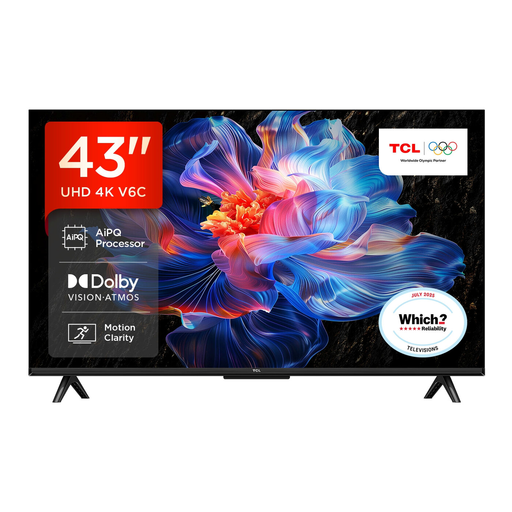
TCL 43V6C 43-inch Direct LED 4K HDR TV
For a close-seated setup, check whether everyone can read split-screen details at 43 inches. The title specifies its 120 Hz Game Accelerator for FHD, so do not assume that means 4K/120 Hz input; confirm the available HDMI modes.
Joybuy
Frequently asked questions
What should I measure before choosing a bedroom co-op TV?
Measure from the players’ usual eye positions to the planned screen location. TCL United Kingdom gives about 1.3 m for 43 inches and 1.7 m for 55 inches as reference points; then check whether everyone can read split-screen details and whether the TV’s full width fits the room.
Do local co-op games require HDMI 2.1?
No, HDMI 2.1 is not a requirement for every local co-op game. If you want a supported 4K/120 Hz or VRR console mode, check the console, game, cable and exact TV input; PlayStation Support says PS5 supports HDMI 2.1 and 4K/120 Hz output, while the TV must support the chosen mode.
Can I use any HDMI input for a console’s gaming features?
Not necessarily: features can vary by input. Sony specifies VRR on HDMI 3 and 4 of the BRAVIA 5 K-55XR5, but ALLM on all four inputs. Check your exact TV model’s port specifications before mounting it or routing cables.
What should I do with an old TV when replacing it?
Use an appropriate electrical recycling collection point rather than household rubbish. GOV.UK advises taking waste electrical products to a household waste recycling centre; when ordering a replacement, ask the retailer how its like-for-like take-back arrangement works.


