Choose a bedroom tower fan around the disturbance that matters most: sound and display light near the bed, airflow across more than one occupied position, or space for safe placement. Compare noise figures only at stated operating settings, and treat timers as a convenience rather than a reason to leave a fan running overnight; Electrical Safety First advises against overnight or unattended use.
Who is a bedroom tower fan for?
Light sleepers who want gentle airflow
If sound, bright controls or a strong breeze would disturb you, check the sound figure at the speed you would use, along with display controls and timer settings. Electrical Safety First advises against leaving an electric fan running overnight.
People sharing a bedroom
When more than one person wants airflow, check whether oscillation reaches both occupied positions and whether the stream can be directed away from anyone who finds it uncomfortable.
People working around a small floor plan
Electrical Safety First describes tower fans as tall and narrow options for smaller rooms. Allow space for a stable position and a cable route that will not obstruct a walkway.
What matters when choosing one?
Start with the fan's position relative to the bed and other occupants, then assess its usable settings and controls. The shares below refer to consumers whose primary need is the concern in that row.
| Concern |
What to check |
Who this matters to |
| Sound, light and breeze |
Check the sound figure at its stated speed, the lowest airflow setting and whether the display can dim. |
If noise, light or a strong breeze would disturb my rest, I need settings I can tolerate near the bed. Around 36% of consumers put sleep comfort first. |
| Shared-room airflow |
Check the oscillation angle and whether airflow can be aimed or narrowed. |
When two people occupy different parts of the room, I want air to reach both without a fixed stream blowing at one face; around 29% of consumers chiefly need shared-room coverage. |
| Floor space and placement |
Check the base dimensions and plan a stable position with a clear cable route. |
With little clear floor around the bed and doorway, I need a fan I can position without creating an obstruction. For around 21% of consumers, fitting the room safely is the main concern. |
| Controls and ownership |
Check the remote and timer functions, the appropriate UK plug and fuse, and product-registration options. |
If I expect to adjust airflow from my seat, I want straightforward controls and a clear way to follow up on product safety. Easy control and ownership checks come first for around 14% of consumers. |
Mistakes to avoid
-
Taking a sleep mode as approval for overnight use
A timer can stop a fan after a chosen period, but Electrical Safety First advises against leaving an electric fan running overnight or while you are out.
Use timed operation while the room is occupied, then switch off and unplug the fan when it is not in use.
-
Comparing sound figures without their operating settings
Dimplex lists 51–59 dB(A) for its Ion Fresh fan, while another listing gives 45 dB(A) for that model. Without matching speed and measurement conditions, those figures cannot establish how it compares with another fan.
Check which setting and measurement method accompany each figure before using it to assess bedroom noise.
-
Treating an ioniser as an air purifier
Dimplex describes the Ion Fresh ioniser as helping to freshen air; that description does not establish independently measured pollutant removal.
If air cleaning is your main aim, assess a dedicated air purifier's filtration and room-coverage information separately from a fan's airflow features.
-
Overlooking the base, cable and product registration
A narrow fan still needs a stable location. Electrical Safety First advises keeping cables away from children and pets and says registration helps manufacturers contact owners about faulty or dangerous products.
Keep the fan out of traffic routes, inspect the cable before use and register the appliance where registration is offered.
Brands to consider for bedroom tower fans
Meaco
The Sefte Smart 36-inch model offers several ways to adjust airflow direction and speed.
- Meaco states a minimum sound figure of 20 dB, 12 speeds and selectable 45°, 90°, 135° or 180° oscillation for this model.
- The minimum figure is Meaco's model-specific claim, not a measurement of sound at higher speeds or an independent comparison with other fans.
Dimplex
The Ion Fresh model combines directional adjustment with a remote and timer.
- Dimplex specifies three speeds, 70° oscillation, 7° tilt and a 12-hour timer for the Ion Fresh.
- Dimplex lists 51–59 dB(A), whereas another listing gives 45 dB(A) for the model. Check the operating conditions before comparing either figure. The ioniser description is not evidence of air-purifier performance.
Honeywell
The HYF260 is a tower-fan option for people considering several speed and timer settings.
- An Amazon listing specifies five speeds, up to 80° oscillation, a remote, auto-dimming lights and 1-, 2-, 4- or 8-hour timer settings for the HYF260.
- Those are retailer-listed features, not independently measured bedroom sound or airflow results.
Joybuy airflow options
These choices cover a heating-and-cooling tower fan with app control and a smaller rechargeable fan for personal airflow. For either one, check the details that matter at its intended bedroom position before relying on it to serve multiple occupants.
 No image available
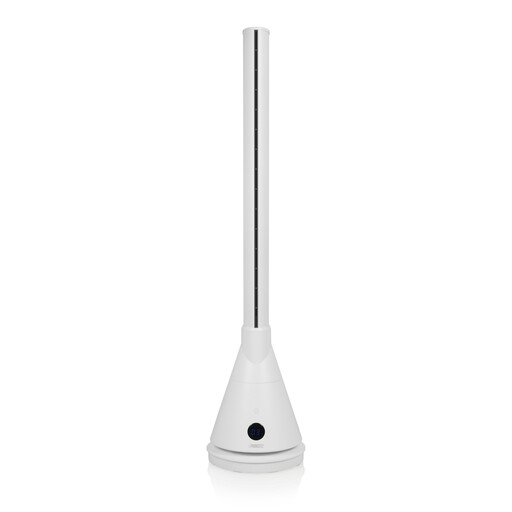
Princess Smart Heating & Cooling Tower Fan, White, 2000W, App Controlled
Consider this model if you want app control and need to assess airflow across more than one bedroom position. Check the oscillation angle and sound at your intended setting, along with the plug and fuse appropriate for UK use.
View on Joybuy
 No image available
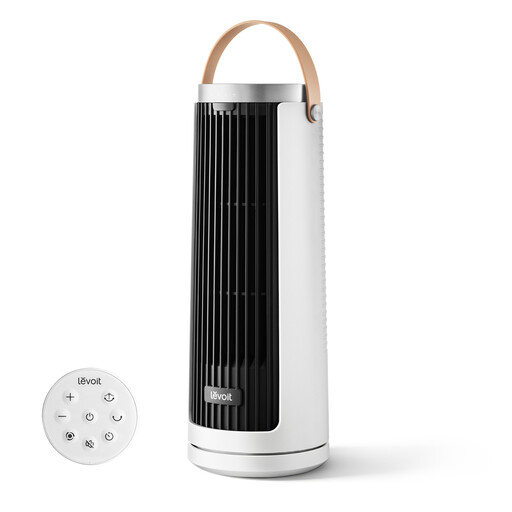
Levoit Windi Mini Plus Portable Tower Fan, USB Type-C Rechargeable
Consider this portable model for personal airflow near a bedside position rather than assuming it will serve everyone in the room. Its title specifies multiple airflow modes; check its coverage, sound information and charging setup against your intended use.
View on Joybuy
Frequently asked questions
Can I leave a tower fan on overnight in a bedroom?
Electrical Safety First advises against leaving an electric fan running overnight or while you are out. A timer does not change that advice; switch off and unplug the fan when it is not in use.
Will a tower fan lower the bedroom temperature?
A fan circulates air rather than lowering the room's actual temperature, as Meaco explains. Choose one for airflow and how that feels to occupants, not as a substitute for equipment intended to reduce room temperature.
What should I check before using an electric fan at home?
Electrical Safety First advises checking for a UK three-pin plug with a fuse and inspecting the fan and cable, particularly after storage. Do not use a damaged fan; unplug it if you notice a burning smell or unusual noise.
Is CE marking acceptable for a tower fan sold in Great Britain?
The Department for Business and Trade states in its August 2026 guidance that Great Britain continues to recognise CE marking alongside or in place of UKCA marking where the relevant product requirements are met. This applies to England, Scotland and Wales; check the applicable route separately for Northern Ireland.
Should I register a new tower fan?
Register it where the manufacturer offers registration. Electrical Safety First says this makes it easier for the manufacturer to contact you if the product turns out to be faulty or dangerous.


