Fast-action rugby viewers
If quick runs, kicks and camera pans make the action hard to follow, check the exact TV’s refresh specification and adjustable motion settings rather than relying on a general smart-TV label.


Choose a bedroom TV for rugby by measuring your viewing distance, then weighing motion handling against the light that reaches the screen. Published guidance gives 1.5–2.7m as a starting range for 43 inches and 1.7–3m for 50 inches; a refresh rate of 120Hz or higher is identified as a sports-focused feature, but you should check the exact TV’s motion controls with your usual broadcast source. OLED is worth considering for predominantly dim viewing, while Mini LED and Full Array LED models are alternatives to compare where daylight or lamps reach the screen.
If quick runs, kicks and camera pans make the action hard to follow, check the exact TV’s refresh specification and adjustable motion settings rather than relying on a general smart-TV label.
Measure from your usual position in bed or in a chair to the proposed screen position, then check that the TV and its stand or mount fit the space.
Consider where windows and lamps sit relative to the screen. Brightness and reflections may matter more to your choice than dark-room contrast alone.
| Concern | What to check | Who this matters to |
|---|---|---|
| Fast rugby action | Confirm the exact model’s refresh specification and adjustable motion controls; assess them with your usual broadcast source where possible. | When the camera pans or a kick sends the ball across the pitch, I want to follow play without distracting blur. Around 42% of consumers put motion clarity first. |
| Screen size and placement | Measure from your usual eye position to the screen. the listed guidance suggests 1.5–2.7m for 43 inches and 1.7–3m for 50 inches as starting ranges. | I want to see the play clearly without a screen that overwhelms my bedroom or obstructs furniture. For around 33% of consumers, fit and viewing distance come first. |
| Daylight and room lighting | Check the screen’s position relative to windows and lamps, then compare the exact models’ brightness and reflection handling. | If I often watch with a lamp on or daylight reaching the TV, I need the picture to remain comfortable to see. Lighting and reflections are the primary concern for around 25% of consumers. |
Your actual eye-to-screen distance determines whether a size is a sensible starting point; the TV also needs space on its furniture or wall.
Measure from your usual pillow or chair position. Compare that distance with the listed starting ranges before checking the model’s physical dimensions and mounting arrangement.
A 144Hz or 165Hz gaming specification does not establish how every live broadcast will look. Motion features and their available settings also vary by model.
Check the exact panel specification and motion controls, then assess the picture with your usual broadcaster, set-top box or streaming device where possible.
A TV that appeals in a dim room may look different when light reaches its screen; display labels alone cannot settle that choice.
Work out where daylight and lamps will fall, and compare brightness and reflection handling on the exact OLED, Mini LED or Full Array LED models you are considering.
TV Licensing says the requirement covers live TV across channels and streaming services, as well as BBC iPlayer, regardless of the device used.
Check whether your household is covered before watching live rugby or using BBC iPlayer; watching through an app does not itself remove the requirement.
A TV Licence may be needed alongside the TV and any viewing subscriptions.
A reference point for comparing a Mini LED TV when bedroom lighting and reflections matter.
A reference point for buyers comparing model-specific motion controls and Full Array LED options.
A reference point for comparing OLED when rugby viewing takes place mainly in a dim bedroom.
A reference point for comparing QD-Mini LED models in sizes that include 50 and 55 inches.
These 42- to 50-inch OLED, QD-Mini LED and Direct LED TVs offer different starting points for a bedroom setup. Measure your viewing distance and check each model’s motion settings for your live-rugby source before choosing.
 No image available
Consider this model if a 50-inch screen fits your measured bedroom viewing distance and you want to compare a QD-Mini LED option.
The listing gives conflicting 120Hz and 144Hz native-refresh figures and describes up to 144Hz variable refresh rate for gaming. Confirm the panel specification and motion settings for live rugby; also check reflections at the intended screen position.
 No image available
Consider this 42-inch OLED if you mainly watch in a dim bedroom and want to compare a smaller screen with the space available.
The listing describes 120Hz input with variable refresh rate and automatic low-latency mode for gaming. Check native refresh and motion settings for your live-rugby source, and assess brightness and reflections if the room is often lit.
 No image available
This 43-inch model is a size to consider if your eye-to-screen distance falls within the listed 1.5–2.7m starting range.
Its listing names Motion Clarity, but specifies the 120Hz Game Accelerator for Full HD gaming. Check native refresh and motion settings for live broadcasts rather than assuming that gaming mode applies to rugby viewing.
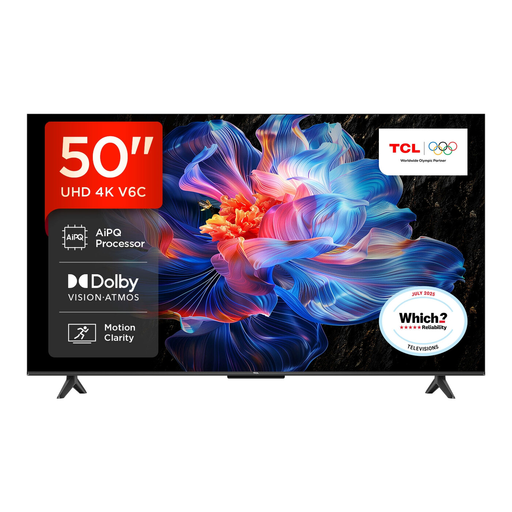 No image available
Consider this 50-inch model where the bedroom has room for the screen and your viewing distance fits the listed 1.7–3m starting range.
The listing names Motion Clarity and specifies its 120Hz Game Accelerator for Full HD gaming. Confirm native refresh and live-broadcast motion controls separately, and check for reflections from windows or lamps.
Start with the distance from your usual eye position to the proposed screen location. the listed guidance gives 1.5–2.7m for a 43-inch TV and 1.7–3m for a 50-inch TV as starting ranges; also check the set’s physical width, stand or mount and nearby furniture.
Yes, it is a useful specification to investigate: a refresh rate of 120Hz or higher is identified as a sports-focused feature. Verify the exact model’s refresh specification and adjustable motion controls, then judge its picture using your normal broadcast source where possible.
Consider OLED if most viewing takes place in a dim room and deep blacks matter to you; compare Mini LED or Full Array LED models if daylight or lamps regularly reach the screen. Brightness and reflection handling depend on the exact TV and its position, not the display label alone.
You need to be covered by a TV Licence to watch live TV on a channel or streaming service, or to use BBC iPlayer, according to TV Licensing. This applies regardless of whether you watch on a TV or another device; check whether your household is already covered.