Night-time fine-print readers
If you check labels, instructions, books or paperwork beside the bed, you need light directed onto the item, not just general room illumination. RNIB recommends positioning task lighting over close work.


Choose a task light you can aim at the page or label, with its light source kept out of your direct line of sight; adjustable brightness helps you set a comfortable level. RNIB guidance also points to magnification and individual assessment when reduced vision makes close reading difficult, rather than relying on a brighter lamp alone.
If you check labels, instructions, books or paperwork beside the bed, you need light directed onto the item, not just general room illumination. RNIB recommends positioning task lighting over close work.
If a visible bulb or reflection makes reading uncomfortable, consider how the shade, dimmer and lamp position work together. Hull University Teaching Hospitals NHS Trust advises keeping home lighting even without causing glare.
If fine print remains difficult under ordinary lighting, a task lamp may be only part of the answer. RNIB discusses lighting alongside magnification and advice tailored to the individual.
Start with where the print will be held and where the lamp can stand or clip on. Then check whether you can direct and adjust its light without putting the source in your eyes.
| Concern | What to check | Who this matters to |
|---|---|---|
| Light on the print | Look for a head, arm or shade you can aim at your usual reading position. If comparing lux figures, check the stated measurement distance. | When I check small instructions beside the bed, I need light on the text rather than elsewhere in the room; around 36% of consumers would put directed illumination first. |
| Glare and shadows | Check whether the source can sit below eye level and outside your direct view. Dimming and a shielded or diffused head give you more ways to adjust the setup. | If the lamp is close to pillow height, I want to read without looking into its light or casting a shadow over the page; roughly 29% of consumers would make glare and shadow control their main concern. |
| Bedside fit | Measure the available surface or attachment edge, and check that the controls are reachable from your reading position. | With little space beside the bed, I need a lamp I can place securely and adjust without moving everything else; around 21% of consumers would prioritise bedside fit. |
| Power setup | For a mains lamp, check the supplied power arrangement and cable reach. For a rechargeable lamp, check charging accessories and the conditions attached to runtime claims. | If a socket is awkward to reach, I need to know how I will charge or power the lamp in daily use; roughly 14% of consumers would put the power arrangement first. |
A decorative lamp can illuminate the room while leaving a label or page in shadow.
Check that its head or shade can direct light onto the place where you actually read, without exposing the source to your eyes. RNIB recommends placing task lighting between you and the task, with the shade below eye level.
Such wording does not tell you how comfortable the lamp will be at your reading distance and angle. Manufacturer lux figures also depend on where they are measured.
Compare the stated measurement distance, brightness controls and head adjustment on the exact model; do not compare lux readings taken under different conditions as though they were equivalent.
A clip saves tabletop space only if the intended edge is compatible and holds the lamp securely. Cordless runtime may also depend on the brightness setting.
Check the clamp range, charging equipment and stated runtime conditions. A Joybuy rechargeable clip-light listing, for example, specifies up to 12 hours only at its lowest brightness setting.
More light may not resolve a need for magnification or assessment. Eye pain, sensitivity to light or a change in vision calls for a different response from shopping for a lamp.
RNIB describes individual low-vision advice as a way to identify suitable aids. NHS guidance advises seeking urgent help for eye pain, light sensitivity or changes in vision.
Lepro offers an integrated-LED desk lamp with a flexible head and arm for reading and study setups.
The FlexiBright is a tabletop task-light option with a pivoting head and selectable colour temperatures.
The Genie e-Reading Desk Lamp is a wider desk-oriented format with manual and automatic adjustment options.
Serious Readers has table and bedside light ranges intended for close reading.
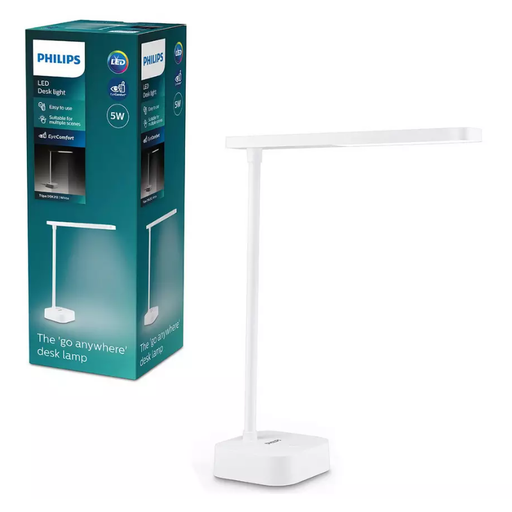
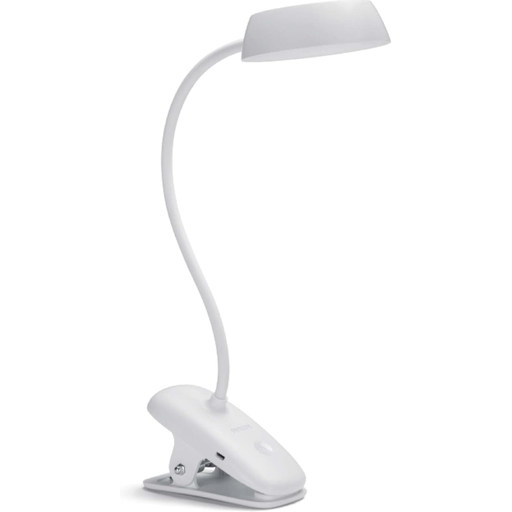
These Philips table and clip-on lamps offer different ways to place a light beside the bed. For either one, check whether its direction and brightness suit the print where you normally hold it.
 No image available
For a bedside table where you want to adjust the local light level, the Tilpa has three brightness settings and USB-rechargeable operation.
A charging adapter is not included. Check whether you can direct its light onto your usual reading position and whether its cordless runtime meets your needs; it is specified for dry indoor use.
 No image available
For a bedside setup with a suitable attachment edge, the Doughnut offers a clip-on alternative to a tabletop lamp.
Check the clip fit and whether you can aim the light at the print without seeing the source directly. Confirm the charging accessories and runtime if cordless use matters; the lamp is specified for dry environments and requires assembly.
Aim it at the print, not your face. RNIB advises placing task lighting between you and the task with the shade below eye level to reduce glare, while keeping general lighting on to help avoid shadows.
Choose by how well you can aim and adjust the light at your reading position, not by either label alone. A published lux value applies to its stated measurement conditions, while a colour-temperature description does not establish glare control.
Check that the exact lamp and its supplied power arrangement suit where you will use them. For Great Britain, GOV.UK guidance updated in August 2026 says CE marking continues to be recognised alongside or in place of UKCA marking for many products; check the applicable requirements for the exact product. Northern Ireland has different arrangements, so do not apply the Great Britain position there without checking its rules.
No: check the terms for the exact model. Lepro describes warranty periods that vary by product, while Serious Readers advertises a five-year guarantee for specified ranges; also check each seller’s return process and any exclusions separately.
If reading remains difficult with suitable lighting, seek advice about vision and possible aids rather than assuming another lamp will resolve it; RNIB discusses low-vision assessment and magnification. NHS guidance advises urgent help for eye pain, light sensitivity or changes in vision.