
24/7 Customer Support

Free returns

Same-day & Next-day Delivery

Quality Guaranteed

Unlock Your Welcome Offers: FREE Delivery | Up to 80% OFF | Free 30-day JoyPlus trial
Download the APP
A bedside table is more than just a place to put your lamp and alarm clock. It’s the command centre of your personal space, a home for your evening read, a charging point for your devices and a crucial piece of storage that helps keep your bedroom a calm, clutter-free sanctuary. But with so many options available, finding the right one can feel overwhelming, especially when you're trying to balance style, function and the dimensions of your room.
This guide is designed to help you navigate the choices. We'll walk through key considerations for selecting a bedside table and share some of our top recommendations that cater to different needs, from compact modern designs to feature-packed solutions for the tech-savvy household.
Before you start browsing, a little planning goes a long way. Keep these three points in mind to narrow down your search and find a nightstand that fits your room and lifestyle perfectly.
The first step is to consider scale. A bedside table that is too large can overwhelm a room, while one that's too small can look out of place and lack utility.
Think about what you need to store. Are you a minimalist who just needs a surface for a book and a phone, or do you have lotions, chargers and other essentials you’d prefer to keep out of sight?
end table with an open shelf offers easy access and a lightweight, airy look.bedside table with drawers is excellent for concealing clutter and keeping your bedroom looking tidy. This is a classic choice for a reason.bedside table with a charging station is a game-changer. Look for models with built-in AC sockets and USB ports to eliminate messy extension cords and keep everything powered up and within reach.Your bedside table should complement your existing bedroom decor. A modern bedside table often features clean lines, neutral colours and minimalist hardware. A classic white bedside table is a versatile choice that fits seamlessly into many different interior styles, from contemporary to traditional. Materials like particleboard and steel offer durability and a sleek finish that is easy to maintain.
Here are a few standout options that balance form, function and value.
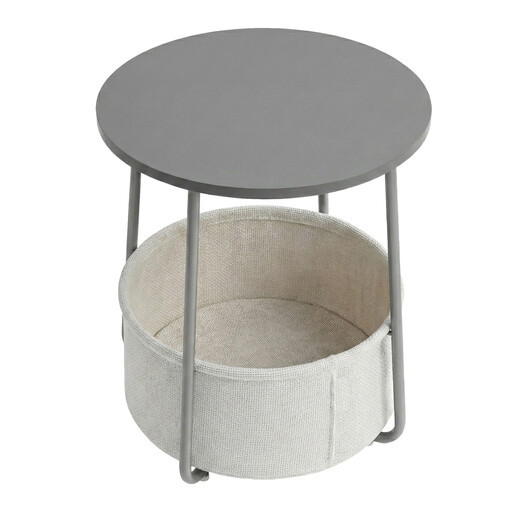
side table with storage solution, perfect for holding books, magazines or a small throw blanket.end table in a living room.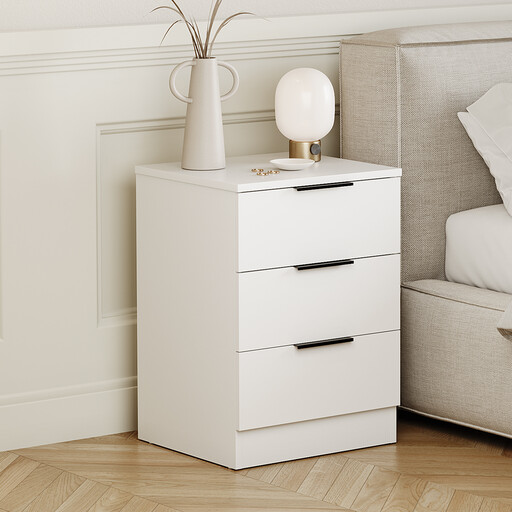
bedside cabinet is a functional hero. Its classic design focuses on maximising storage with three deep drawers, making it easy to keep your bedside area completely clutter-free. The clean white finish and sleek handles give it a timeless appeal.white bedside table suit a wide range of bedroom styles.bedside table with drawers offers a practical and stylish solution for bedrooms, guest rooms or any compact living space.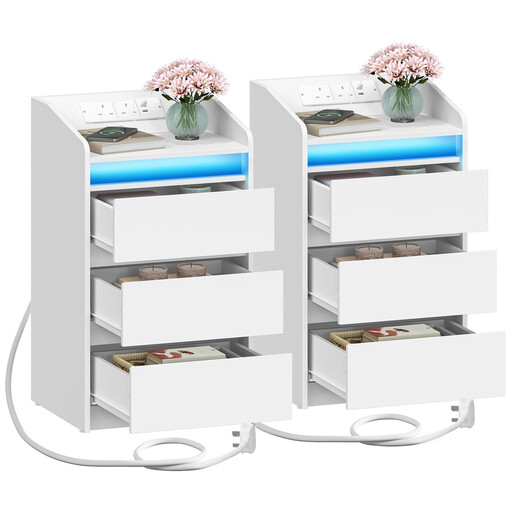
bedside tables set of 2, it's perfect for creating a symmetrical look in a master bedroom. The integrated bedside table with a charging station and customisable LED lighting make it a standout for convenience and ambiance.If your morning routine often starts before you even leave the covers, or you enjoy a relaxed weekend breakfast in bed, a dedicated tray might be what you need. These provide a stable surface for your laptop or meal, adding another layer of comfort to your bedroom.
Explore our range of breakfast bed tables for more convenient solutions.
1. What is the ideal height for a bedside table? As a general rule, the top surface of your bedside table should be about the same height as the top of your mattress, or up to 10 cm higher. This ensures you can comfortably reach for items without having to sit up or stretch awkwardly.
2. What is the difference between a bedside table and a nightstand? In modern usage, especially in the UK, the terms bedside table and nightstand are largely interchangeable. Historically, a nightstand might have been a smaller, more basic table, whereas a bedside cabinet or table could imply a larger piece with drawers. Today, the terms all refer to the small table placed next to a bed.
3. How much space should be between the bed and the bedside table? While there's no strict rule, leaving a small gap of about 5-10 cm is practical. This prevents the space from feeling cramped and makes it much easier to tuck in sheets and duvets when making the bed. The most important factor is that you can access the table and its drawers easily.