
24/7 Customer Support

Free returns

Same-day & Next-day Delivery

Quality Guaranteed

Unlock Your Welcome Offers: FREE Delivery | Up to 80% OFF | Free 30-day JoyPlus trial
Download the APP
A bedside table is more than just a place to put your lamp and alarm clock. It’s a crucial piece of bedroom furniture that helps keep your space organised, reduces clutter and completes your room's overall aesthetic. However, finding the right one can be a challenge. With so many styles, sizes and storage options available, it's easy to feel overwhelmed.
This guide is designed to simplify your search. We'll walk you through the key considerations for choosing a nightstand and share some of our top recommendations that balance style, function and quality craftsmanship.
Before you start browsing, a little planning can ensure you find a piece that you'll be happy with for years to come. Here are a few practical points to consider.
The first step is to measure the available space next to your bed. A common guideline is to choose a bedside table that is roughly the same height as the top of your mattress, give or take a few centimetres. This makes it easy to reach for items without straining. Also, consider the width. You need enough room to walk around comfortably, so ensure there's adequate clearance between the table and any other furniture. If you're furnishing a smaller room, a compact small side table might be a more suitable option than a larger, bulkier unit.
Think about what you need to store. Do you prefer to keep things tucked away out of sight, or do you like having items on display?
Your bedside table should complement your existing decor. Whether your bedroom is a rustic retreat, a modern sanctuary, or has an industrial edge, there's a style to match.
Here are a few standout options that cater to different tastes and functional needs.
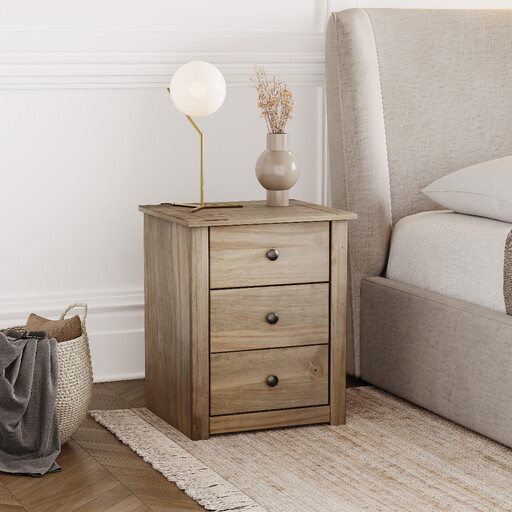
Why It Stands Out: This piece is all about classic craftsmanship and substantial storage. Made from solid pine with a warm oak stain, it brings a timeless, natural feel to a room. The three deep drawers offer generous space to keep your nighttime essentials organised and out of sight.
Pros:
Who is it for? This is an excellent choice for anyone who prioritises storage and appreciates the enduring appeal of solid wood furniture. It’s particularly well-suited for traditional, country or rustic-themed bedrooms where warmth and functionality are key.

Why It Stands Out: The Watson table makes a statement with its mid-century modern design. The combination of grey and white drawer fronts against a natural wood frame creates a striking visual contrast. Its clean lines, handle-free drawers and angled tapered legs are hallmarks of this popular style.
Pros:
Who is it for? This modern bedside table is perfect for those looking to inject some retro flair into their space. Its compact dimensions (H52 x D36 x W42 cm) make it a great fit for smaller bedrooms or flats where style cannot be sacrificed for size.
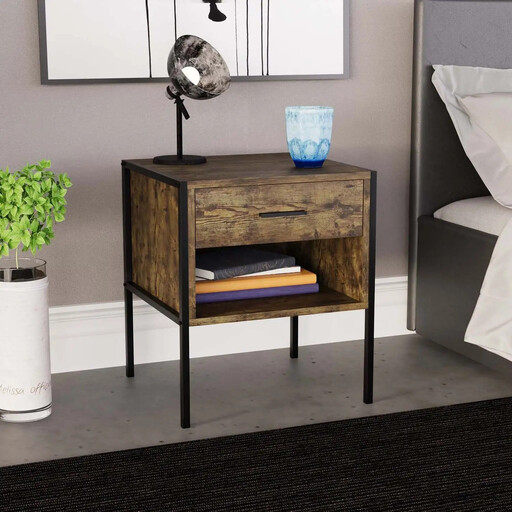
Why It Stands Out: This industrial bedside table captures an urban, contemporary feel by blending a rustic brown wood-effect finish with a sturdy black iron frame. It offers a balanced approach to storage with one drawer for private items and a lower shelf for books or decorative pieces.
Pros:
Who is it for? Ideal for anyone cultivating an industrial, minimalist or modern rustic decor. This nightstand appeals to those who want a blend of concealed storage and open display space in a piece that feels both rugged and refined.
If the warmth and classic appeal of wood furniture resonates with you but you haven't quite found the perfect match, there are many other styles to consider. From dark walnuts to light oaks, the right wooden table can anchor your bedroom's design.
Explore our curated collection of Brown Wood Bedside Tables to discover more designs that might be the perfect fit for your home.
1. What is a good height for a bedside table? A good rule of thumb is to choose a bedside table that is level with or slightly below, the top of your mattress. This typically falls between 50cm and 70cm for most standard UK beds. This height ensures you can comfortably reach for items without having to sit up or stretch awkwardly.
2. What is the difference between a nightstand and a bedside table? In modern usage, especially in the UK, the terms "nightstand" and "bedside table" are used interchangeably. Both refer to a small table or cabinet placed next to a bed. Historically, a nightstand may have been more likely to have a small cupboard, but today the terms describe the same piece of furniture.
3. How much space should be between a bed and a bedside table? You don't need much space at all. Most people place their bedside table directly next to the bed, perhaps leaving a small gap of 5-10cm to make it easier to tuck in sheets and duvets. The more important consideration is ensuring there is enough clear floor space on the other side of the table for easy movement around the room.