
24/7 Customer Support

Free returns

Same-day & Next-day Delivery

Quality Guaranteed
Download the APP
Categories
Choosing a first stunt scooter can feel overwhelming. You want something safe and durable for your child to learn on, but also a model that offers good performance without a hefty price tag. The market is filled with options, making it difficult to distinguish between a solid investment and a toy that will not last.
This guide is designed to help you navigate the key features of a quality beginner stunt scooter. We will break down what to look for and provide a few recommendations to help you find a suitable trick scooter for kids and teens, ensuring they can safely start their journey at the skate park.
Unlike standard kick scooters designed for commuting, a freestyle scooter is built to withstand the impacts of jumps and tricks. Here are a few key components to consider.
The core of any scooter for tricks is its frame. Look for a one-piece, non-folding handlebar and a sturdy deck, often made from lightweight aluminium. This construction provides the rigidity needed for landing tricks. The clamp, which connects the handlebars to the fork, is also crucial. A triple-bolt clamp offers a more secure and stable connection than single or double-bolt versions, which is an important feature for safety and performance as skills progress.
Stunt scooter wheels are typically smaller and harder than those on commuter scooters. Common sizes are 100mm or 110mm, often with a metal core for added durability. The bearings are rated with an ABEC score (e.g., ABEC-7, ABEC-9). A higher number generally indicates a smoother and faster glide, which is beneficial for gaining momentum at a skate park scooter ramp.
A reliable brake is non-negotiable. Most stunt scooters feature a rear fender brake, which is operated by foot. It should be responsive and robust. Additionally, always check that the scooter complies with UK safety standards, such as EN71 testing, to ensure it has been assessed for safety for its intended age group.
Here are a few models that offer a solid starting point for aspiring riders, balancing performance, durability and value.
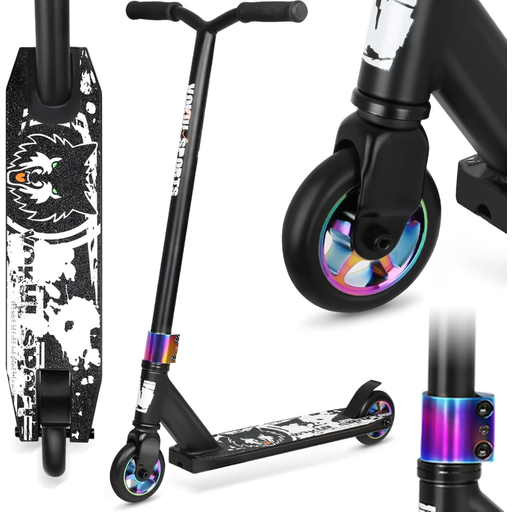
Why It Stands Out: This model is an excellent starting point for younger riders. Its lightweight frame, combining alloy steel and aluminium, makes it easy to handle while being strong enough to support up to 220 lbs. The fixed handlebar and rigid suspension provide a stable platform for learning the basics.
Pros:
Who is it for? This is a great choice for children aged 6 to 12 who are taking their very first steps into the world of stunt scootering. It provides the necessary stability and durability for a beginner to build confidence.
View VOKUL Pro Trick Scooter Details
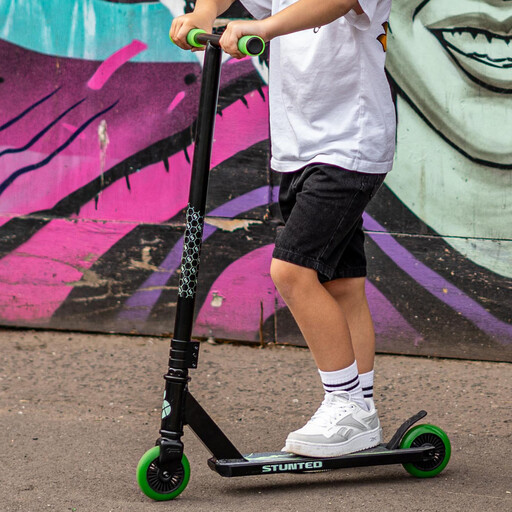
Why It Stands Out: The Glostorm Pro combines eye-catching aesthetics with robust construction. The glow-in-the-dark elements and matte black finish are paired with a steel single-piece handlebar and a pro-grade triple clamp, offering features often found on more advanced models.
Pros:
Who is it for? This scooter is suitable for riders aged 8 and up who want a scooter that looks the part and has the features to back it up. It’s a solid entry level stunt scooter for those ready to start practising tricks.
View Stunted Glostorm Pro Details
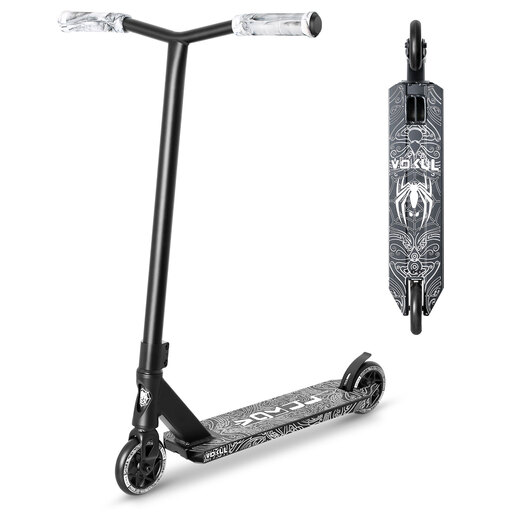
Why It Stands Out: The VOKUL K1 is a step-up model that caters to a wider range of riders, from older children to teens and even adults. It boasts higher-performance components, including larger wheels and superior bearings, making it a capable pro scooter for beginners and intermediate riders.
Pros:
Who is it for? This scooter is an excellent option for riders aged 8 and up, including teens and adults (up to 220 lbs), who are serious about progressing. Its upgraded components provide a platform that will not be quickly outgrown.
If these models are not quite what you are looking for, or if you have a specific colour in mind, there are more choices available.
Explore our full range of black stunt scooter models to find the perfect fit.
1. What is the difference between a stunt scooter and a normal scooter? A stunt scooter is specifically designed for tricks. It has a fixed, one-piece frame and handlebars for maximum strength, whereas normal scooters often fold for portability. Stunt scooters also feature smaller, more durable wheels and a robust deck to handle the impacts from jumps and landings.
2. What age is appropriate for a beginner stunt scooter? Children can start learning on a stunt scooter from around age 6, provided the scooter is appropriately sized and lightweight. Many entry-level models are designed for ages 8 and up, as this is when many children have developed the coordination and strength needed for basic tricks. Always check the manufacturer's recommended age range.
3. Are stunt scooters safe for beginners? When used correctly with appropriate safety gear, stunt scooters are a safe way to get into the sport. It is essential that the rider always wears a certified helmet, knee pads and elbow pads. A well-built scooter that is properly assembled and maintained is also critical for safety. Beginners should start on smooth, flat surfaces away from traffic before moving to a skate park.