
24/7 Customer Support

Free returns

Same-day & Next-day Delivery

Quality Guaranteed

Unlock Your Welcome Offers: FREE Delivery | Up to 80% OFF | Free 30-day JoyPlus trial
Download the APP
Navigating the market for a portable charger can feel overwhelming. You need a reliable power source, but you are met with a wall of technical jargon and ambitious marketing claims. Many shoppers end up with a device that underperforms, fails after a few months or simply doesn't match the promises on the box. This guide is designed to help you sidestep the common purchasing traps and identify the features that truly matter in a high-capacity power bank.
Before you spend your money, be aware of these frequent pitfalls:
To ensure you get a device that is both effective and safe, focus on these non-negotiable specifications.
The single most important factor for speed is the power output, measured in watts (W). For a modern 20000mAh fast charging power bank, a 30W portable charger is an excellent benchmark. This level of power is significant because it can:
Look for support for Power Delivery (PD), the universal standard for fast charging over a USB C power bank port. This ensures the widest compatibility with your current and future devices.
A 20,000mAh capacity offers enough power to charge a typical smartphone 3-4 times, making it ideal for long weekends, business trips or for heavy users who are away from a wall socket all day. However, this capacity comes with a trade-off in size and weight. These are not typically pocket-friendly devices, so consider how you will carry them.
Also, inspect the port selection. A versatile model should offer:
Finally, a power bank with a digital display showing the exact percentage remaining is far more practical than one with four simple LED dots, as it removes all guesswork about when you need to recharge.
We have identified models that align with these practical criteria, matching them to specific user needs.
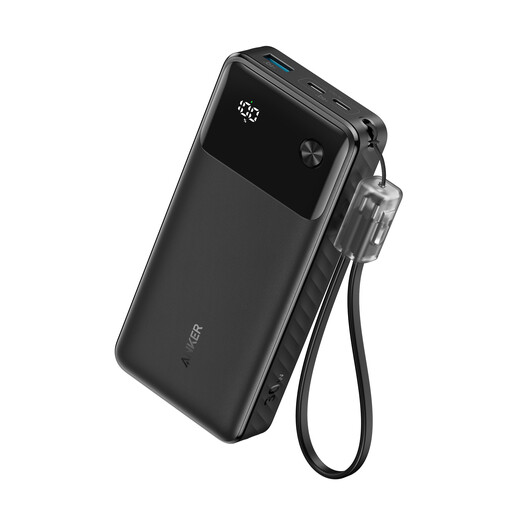
Why This Fits Their Persona: This user juggles a smartphone, tablet and wireless earbuds on daily commutes or during travel. They need a reliable travel power bank that can charge everything quickly without fuss. The combination of high capacity, 30W speed and multiple ports makes this an ideal all-in-one solution.
It delivers a genuine 30W Power Delivery output, avoiding the "fast charging" mirage. The clear digital display provides precise battery status, eliminating the uncertainty of basic LED indicators.
Its main advantage is the ability to charge three devices at once, with one port delivering a full 30W. The Anker PowerCore 20000 also features a trickle-charging mode for low-power items like earbuds.
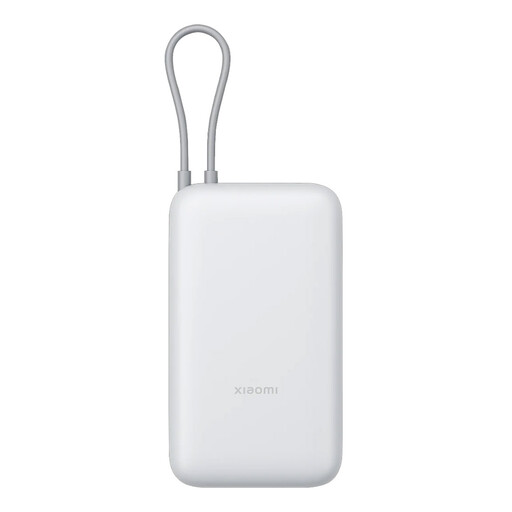
Why This Fits Their Persona: This user needs a large-capacity battery to get through a long day of university or commuting but prioritises convenience and value. The integrated cable means one less thing to remember, making it a practical choice for daily use in a backpack or tote bag.
It offers a substantial 22.5W fast-charging capability, a clear step above basic models. The built-in USB-C cable is a practical feature that solves the common problem of forgetting or losing charging cables.
The primary benefit is the combination of high 20,000mAh capacity and the convenience of an integrated two-way fast-charging USB-C cable, offering great utility for the price.
We have compiled a complete, real-time list of products that fully satisfy these strict selection criteria and UK safety regulations.
As a general rule, a quality 20,000mAh power bank with an effective capacity of around 13,000mAh can charge a modern smartphone (with a battery of ~4,500mAh) approximately 2.5 to 3 times from empty to full. For a smaller phone like an iPhone 14 (~3,200mAh), you could expect around 4 full charges.
Yes, it is completely safe. Modern charging standards like USB Power Delivery (PD) allow the power bank and your device to communicate. The power bank will only supply the maximum amount of power that the device can safely handle. A 30W charger will charge a 15W-capable phone at 15W, not 30W.
Yes. The current global aviation limit for power banks in carry-on luggage is 100 Watt-hours (Wh). A 20,000mAh power bank operating at a standard voltage of 3.7V is equivalent to 74Wh (20,000mAh / 1000 x 3.7V = 74Wh), which is well under the 100Wh limit. You must carry it in your hand luggage, not in checked baggage.