
24/7 Customer Support

Free returns

Same-day & Next-day Delivery

Quality Guaranteed
Download the APP
Categories
Navigating the world of gaming monitors can feel like a mission in itself. With terms like refresh rate, response time and panel type being thrown around, it’s easy to get lost in the technical details. As a competitive or enthusiast gamer, you know that the right display is a critical part of your setup, directly impacting everything from your reaction time in a firefight to your immersion in a vast open world. The goal is to find that perfect balance of speed, clarity and colour without overspending.
This guide is designed to cut through the clutter. As the Joybuy Product Recommendation Officer, my role is to provide clear, practical advice to help you choose a 27 inch 1440p gaming monitor that truly enhances your experience, whether you're a PC purist or a next-gen console player.
Before we look at specific models, let's quickly cover the core features that matter most. Understanding these will help you identify which monitor is the right fit for your gaming style and setup.
For gaming, speed is paramount. A high refresh rate monitor (measured in Hertz, or Hz) displays more frames per second, resulting in smoother motion. While 144Hz has been the standard for years, modern displays pushing 180Hz, 240Hz and even higher offer a tangible advantage in fast-paced games. This is paired with response time (measured in milliseconds, or ms), which dictates how quickly a pixel can change colour. A fast response time monitor (typically 1ms or less) is essential for minimising motion blur and ghosting, ensuring your view remains crisp during rapid movements.
The panel is the heart of the monitor. The two most common types in gaming are:
Additionally, an HDR monitor for gaming (High Dynamic Range) can further enhance visuals by expanding the range of both contrast and colour, making brights brighter and darks more detailed.
Your gaming platform influences your monitor choice. PC gamers using a DisplayPort connection can usually access the highest refresh rates a monitor offers. For console players, it's important to look for a console gaming monitor with HDMI 2.0 or 2.1 ports. This ensures you can take full advantage of the 120Hz performance modes available on the PlayStation 5 and Xbox Series X at 1440p (QHD) resolution.
Here are a few standout models that deliver on the key features gamers are looking for.
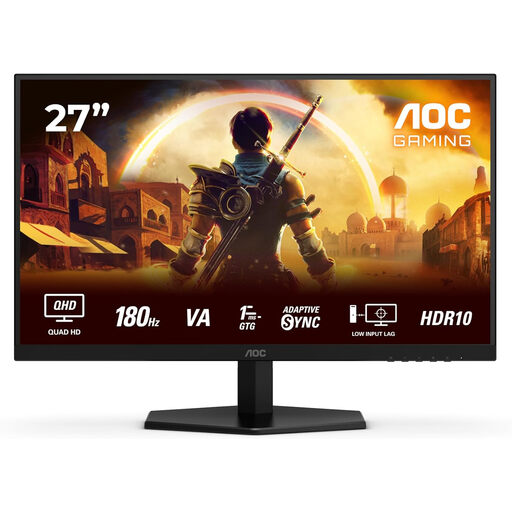
Why It Stands Out: The AOC Q27G42XNE strikes an excellent balance between performance and value. It delivers a significant upgrade over standard 144Hz monitors with its smooth 180Hz refresh rate and an exceptionally fast 0.5ms response time. This combination ensures gameplay is fluid and sharp, while FreeSync Premium technology eliminates screen tearing for a seamless experience. The VA panel provides a strong contrast ratio for deep blacks, making it great for immersive single-player titles and competitive games alike.
Pros:
Who is it for? This monitor is an ideal choice for gamers looking to step into high-refresh-rate gaming at a QHD resolution without a hefty price tag. It's well-suited for both competitive multiplayer and immersive story-driven games.
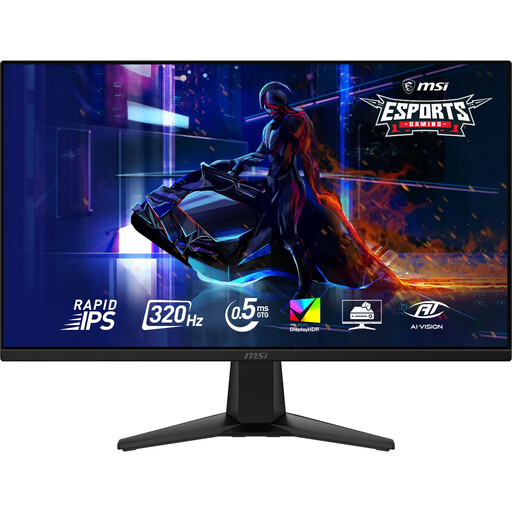
Why It Stands Out: For the truly competitive player, the MAG 275QF X32 offers an incredible speed advantage. Its blazing 320Hz refresh rate on a Rapid IPS panel is built for esports, where every millisecond counts. Paired with a 0.5ms (GtG) response time, it delivers exceptional motion clarity. Beyond speed, it boasts VESA DisplayHDR 400 certification and excellent colour coverage (95% DCI-P3), ensuring that games look not only smooth but also vibrant and detailed. Features like AI Vision, which brightens dark areas, provide a tactical edge.
Pros:
Who is it for? This monitor is aimed squarely at serious esports athletes and competitive gamers who demand the highest possible frame rates and response times to maintain their edge. It's also a great fit for hybrid users who want top-tier speed without compromising on colour quality.
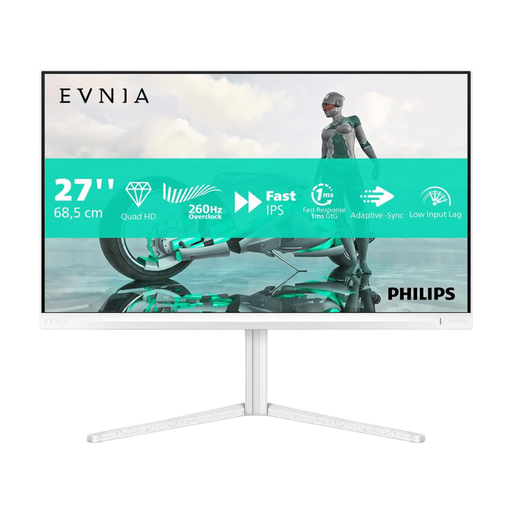
Why It Stands Out: The Philips Evnia 27M2N3501PA is a high-performance all-rounder that combines a fast 240Hz refresh rate with the rich colours of an IPS panel. Its 0.3ms response time (using Smart MBR) ensures motion remains clear and precise, making it a strong contender for competitive play. With excellent colour space coverage (125% sRGB) and HDR10 support, it also excels at displaying vibrant, immersive game worlds. The fully adjustable ergonomic stand is a significant bonus, allowing you to find the perfect viewing position for long gaming sessions.
Pros:
Who is it for? This is an excellent monitor for the enthusiast gamer who does it all. It has the speed for competitive shooters, the colour performance for stunning RPGs, and the ergonomics for long hours of gaming, work or content creation.
These three models represent some of the compelling choices available in the 27-inch QHD category, but the market is full of great options to suit different needs and budgets. If you haven't found your perfect match here, or if you're curious about different sizes and resolutions, we invite you to browse our complete collection.
Explore Our Full Range of Monitors
Absolutely. Many gamers consider the combination of a 27-inch screen and a 1440p (QHD) resolution to be the "sweet spot" for PC gaming. It offers a significant increase in sharpness and detail over 1080p without being as demanding on your graphics card as 4K, allowing you to achieve higher frame rates more easily.
A refresh rate of 144Hz is a fantastic starting point and provides a noticeably smoother experience than older 60Hz displays. For competitive gamers, stepping up to 180Hz or a 240Hz gaming monitor offers a clear advantage in motion clarity. Anything above that is aimed at the highest level of esports competition.
Yes, and it's a great choice. Both the PS5 and Xbox Series X support output at 1440p resolution, and many modern gaming monitors can accept this signal at 120Hz over HDMI. This makes a QHD gaming monitor an excellent, often more affordable, alternative to a 4K TV for achieving high-frame-rate console gaming.