
24/7 Customer Support

Free returns

Same-day & Next-day Delivery

Quality Guaranteed
Download the APP
Categories
As a Joybuy Product Recommendation Officer, my role is to help you navigate the crowded market of gaming hardware. Choosing the right monitor can feel overwhelming, especially when you're trying to balance visual immersion with the raw speed needed for a competitive edge. A split-second of lag or motion blur can be the difference between victory and defeat.
This guide is designed to clarify the key features of a modern 27 inch curved gaming monitor. We will look at the important specifications to consider and highlight a couple of standout options that cater to different gaming priorities, helping you find a display that truly complements your skills.
Before diving into specific models, let's break down the technical jargon into practical considerations. Understanding these points will help you make a more informed decision based on how you actually play.
For competitive gamers, the biggest decision often comes down to balancing visual detail with speed.
A high refresh rate is only part of the equation. To avoid ghosting and motion blur, you need a low response time.
Beyond the core specs, consider features that enhance the overall experience. AI Vision monitor technology, for example, can intelligently brighten dark areas of the screen without overexposing the rest of the image, giving you a clearer view of hidden opponents. For console players, ensure the monitor has HDMI 2.0b ports to support high refresh rates, making it a versatile console gaming monitor as well as a PC display.
Based on a balance of performance, features and intended use, here are two notable options to consider for your gaming setup.
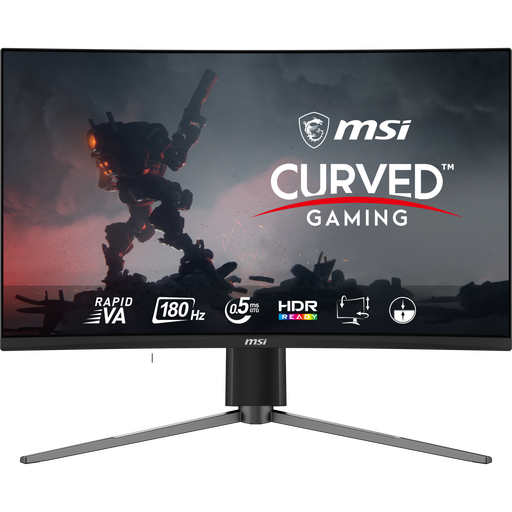
Why It Stands Out: The MSI MAG 27CQ6F strikes an excellent balance between immersive visuals and competitive speed. Its WQHD (2560x1440) resolution on a 27-inch 1500R curved screen creates a stunningly detailed and enveloping view. Paired with a fluid 180Hz refresh rate and a rapid 0.5ms response time, it’s a versatile performer that doesn’t force you to choose between beauty and speed. The inclusion of MSI's AI Vision further enhances gameplay by improving visibility in dark scenes.
Pros:
Who is it for? This monitor is ideal for the all-around gamer who plays a mix of graphically rich AAA titles and competitive multiplayer games. If you want crisp detail for exploring open worlds but still demand high performance for online matches, this is a compelling choice.
View Details for the MSI MAG 27CQ6F
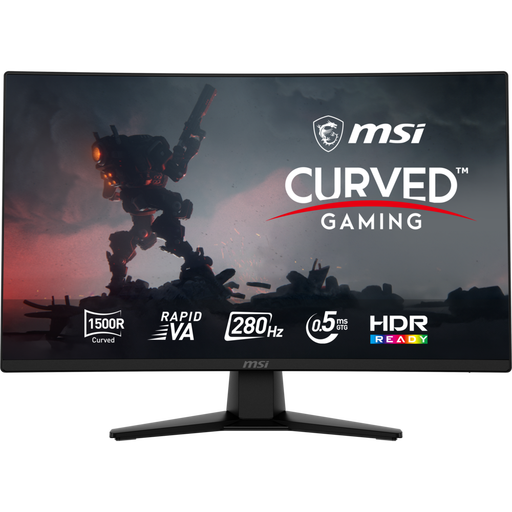
Why It Stands Out: The MSI MAG 274CXF is built for one thing: pure, unadulterated speed. As a dedicated esports monitor, it boasts a blistering 280Hz refresh rate via DisplayPort, giving you the smoothest possible gameplay and the fastest reaction times. While it uses a standard FHD (1920x1080) resolution, this allows your graphics card to push out the extremely high frame rates needed to take full advantage of the display. The combination of a Rapid VA panel and a 0.5ms response time ensures every frame is delivered with precision.
Pros:
Who is it for? This monitor is for the serious competitive player. If your main games are titles like Valorant, Apex Legends or Counter-Strike 2, and your priority is maximising frame rate and minimising input lag, the MAG 274CXF is engineered for you.
View Details for the MSI MAG 274CXF
If the models above aren't quite what you're looking for, or if you'd like to compare them against other specifications, there are many excellent displays available. You can browse a wider selection of panels that balance features, size and performance to find the perfect fit for your desk.
Explore Our Full Range of Curved VA Monitors
Yes, a 27-inch curved monitor is an excellent choice for gaming. The curve, typically 1500R, gently wraps the display around your field of view. This enhances immersion, reduces eye strain by keeping the entire screen at a more uniform distance from your eyes and can improve your peripheral awareness in games.
Absolutely. While professional esports players may seek out the highest refresh rates possible (240Hz+), a 180Hz gaming monitor offers a dramatically smoother and more responsive experience than standard 60Hz or even 144Hz displays. It provides a clear competitive advantage for the vast majority of players in fast-paced games.
The main difference is pixel density, which affects image sharpness. A Full HD (FHD) monitor has a resolution of 1920x1080 pixels. A Quad HD (WQHD) monitor has a resolution of 2560x1440 pixels. On a 27-inch screen, WQHD provides a noticeably crisper, more detailed image. However, rendering games at WQHD is more demanding on your graphics card, which is why ultra-high refresh rate monitors sometimes stick with FHD to ensure players can achieve the target frame rates.