
24/7 Customer Support

Free returns

Same-day & Next-day Delivery

Quality Guaranteed

Unlock Your Welcome Offers: FREE Delivery | Up to 80% OFF | Free 30-day JoyPlus trial
Download the APP
Travelling across the United Kingdom or embarking on weekend road journeys often highlights the challenge of powering household mains equipment away from domestic electrical outlets. While standard 12V car auxiliary sockets are perfectly adequate for low-draw devices such as dedicated sat nav units, they cannot run standard UK 3-pin appliances or support demanding mobile work setups. A quality 300W inverter bridges this everyday gap, converting direct current from your vehicle battery into standard 230V or 240V alternating current. Whether you are navigating a university move-in day, setting up camp in the countryside, or working remotely from your vehicle, having dependable alternating current on hand keeps essential electronics running smoothly.
Finding the right model involves matching your electrical equipment with safe vehicle power delivery limits. Power inverters in this 300W category differ noticeably in their internal waveform generation, port configurations, and high-wattage connection accessories. Understanding how pure sine wave delivery protects delicate microprocessors, alongside verifying vehicle connection methods such as internal lighter plugs and direct battery crocodile clamps, ensures that your portable electronics remain safeguarded throughout every journey.
The nature of the alternating current output dictates which appliances can run smoothly and efficiently without risk of long-term component degradation. Selecting the correct waveform type prevents unwanted electrical hum, unnecessary heat buildup, and power supply disruption.
UK vehicle interior accessory sockets are typically fused between 10A and 15A, which restricts their safe continuous power capacity to around 120W to 150W. Operating a 300W inverter at its full continuous potential requires matching the right connection method to the appliance demand.
Modern vehicle travel involves powering a diverse collection of domestic equipment alongside handheld mobile devices. Choosing an inverter with integrated modern USB standards reduces cabin clutter and keeps the primary 3-pin socket available for high-draw hardware.
Here are three versatile 300W vehicle power adapters tailored to meet various charging, commuting, and holiday travel requirements.
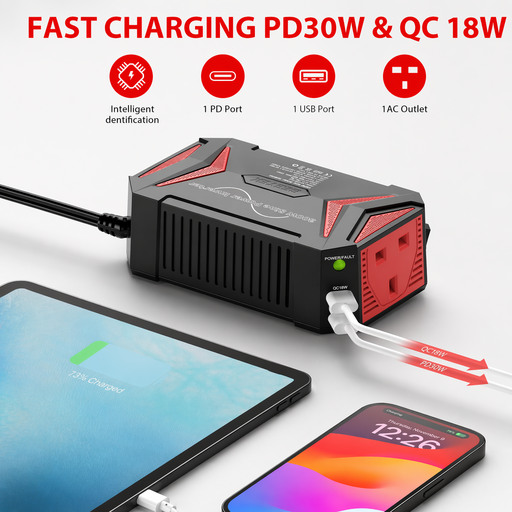
Why It Stands Out: This portable power adapter converts 12V vehicle direct current into clean 230V or 240V pure sine wave output, ensuring sensitive electronic gear operates without electrical interference. It stands out by integrating an onboard PD30W Type-C port alongside a QC3.0 USB port, allowing modern smartphones and compatible laptops to charge rapidly without bulky wall plugs. Designed specifically for vehicle use and outdoor travel, it combines high-grade electrical safety with exceptional charging flexibility.
Pros:
Who is it for? Mobile professionals and outdoor travellers who need clean pure sine wave power and high-speed USB-C charging for modern personal electronics.
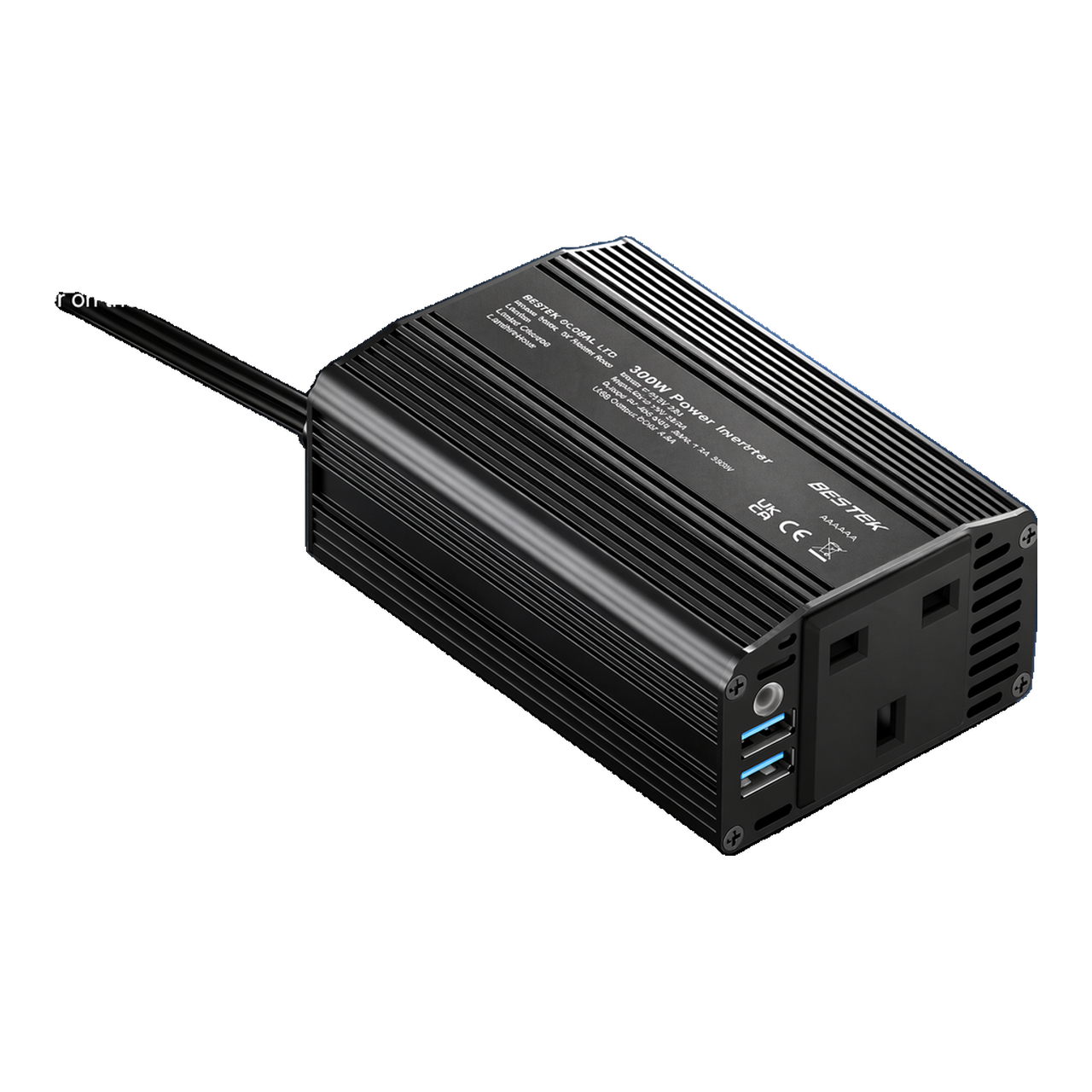
Why It Stands Out: Finished in a clean black casing, model MRI3013BU-UK-BK delivers dependable 230V or 240V AC power from any standard 12V vehicle supply. It is fitted with an authentic UK 3-pin Type G plug socket, allowing domestic appliances to connect directly without awkward travel adapters. Complementing the mains socket, dual USB ports provide steady power to passenger mobile devices during long motorway journeys and student university move-in trips.
Pros:
Who is it for? Students, families, and road trippers looking for an uncomplicated inverter featuring an authentic British 3-pin socket for everyday appliances.
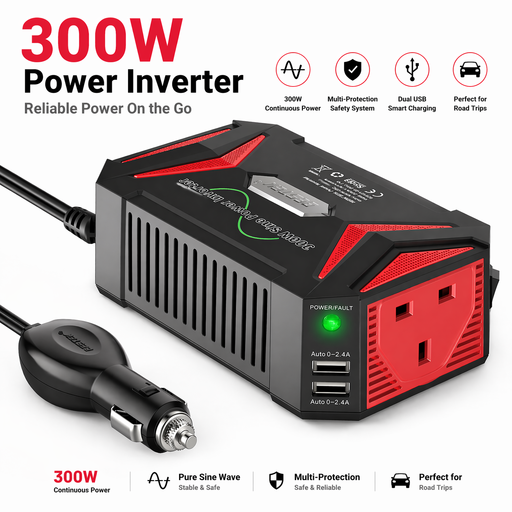
Why It Stands Out: Operating exclusively on 12V vehicle systems, this pure sine wave inverter provides one 220–240V AC socket for mains gear alongside dual USB ports supplying up to 4.8A combined. When your electrical power requirements surpass 150W, the unit operates using battery clamps to draw power directly from the battery without stressing vehicle accessory sockets. It supplies clean, interference-free electricity that makes it well suited for outdoor travel and demanding vehicle journeys.
Pros:
Who is it for? Campers, touring drivers, and holidaymakers who require clean pure sine wave alternating current alongside high-amperage USB distribution for multiple mobile devices.
Most UK vehicle cigarette lighter and auxiliary 12V sockets are protected by 10A or 15A fuses, limiting safe continuous power delivery to between 120W and 150W. While you can power smaller devices such as work laptops or camera chargers through this cabin socket, drawing the full 300W capacity requires connecting directly to the vehicle battery terminals using insulated battery clamps to prevent blowing the vehicle fuse.
A pure sine wave inverter replicates the smooth, continuous alternating current supplied by the UK domestic grid. This waveform is essential for sensitive modern microelectronics, medical equipment, and appliances with precision timing circuits or brushless motors. In contrast, modified sine wave inverters generate a stepped electrical wave that can cause audio buzzing, line interference, or excess component heat in delicate chargers.
Inverters draw a small amount of idle standby current even when no external appliance is connected and drawing load. While this minor drain is harmless during short roadside breaks, leaving an inverter plugged into a vehicle auxiliary socket that remains permanently live with the engine off can slowly deplete the vehicle battery over several days. Disconnecting the unit when parked is always advisable.