
24/7 Customer Support

Free returns

Same-day & Next-day Delivery

Quality Guaranteed

Unlock Your Welcome Offers: FREE Delivery | Up to 80% OFF | Free 30-day JoyPlus trial
Download the APP
Navigating UK roads comes with its own set of challenges, from congested city streets to winding country lanes. For many drivers, the peace of mind that comes from having a reliable witness on board is invaluable. A high-quality 4K dash cam front and rear system provides clear, indisputable evidence in the event of a collision, a hit-and-run in a car park or a disputed insurance claim.
This guide is designed to help you understand the key features to look for in a modern dash cam. We will explore what makes a system truly effective and present a few carefully selected recommendations to help you make an informed choice for your vehicle.
When researching a dual dash cam 4K setup, it is easy to get lost in technical specifications. Here are three practical points to consider that will help you focus on what truly matters for UK drivers.
While 4K resolution (3840x2160 pixels) provides excellent detail, the image sensor is the heart of the camera. A premium sensor, such as those from the Sony STARVIS series, is specifically designed to perform well in low-light conditions. This is crucial for a car camera with night vision, ensuring that number plates and road details are captured clearly after sunset or in poor weather, which is a common scenario on British roads. Look for a wide aperture (e.g., F1.8 or lower) and technologies like Wide Dynamic Range (WDR) or HDR, which balance bright and dark areas of the frame.
A modern dash cam is more than just a recorder; it is a comprehensive safety tool. Key features to look for include:
Getting footage off your dash cam should be simple. A WiFi car camera allows you to connect the device to your smartphone via an app. This makes it easy to view, download and share videos without needing to remove the memory card. Also, ensure the device supports loop recording, which automatically overwrites the oldest files when the memory card is full, and check the maximum supported storage capacity—4K footage requires significant space, so support for 128GB cards or higher is recommended.
Here are our recommendations for 4K front and rear dash cams that offer a strong combination of performance, features and reliability.

The DDPAI Z50 Pro is a feature-rich system that pairs a 4K front camera with a 1080p rear camera. It is built for users who value speed and advanced connectivity.
View Details for DDPAI Z50 Pro
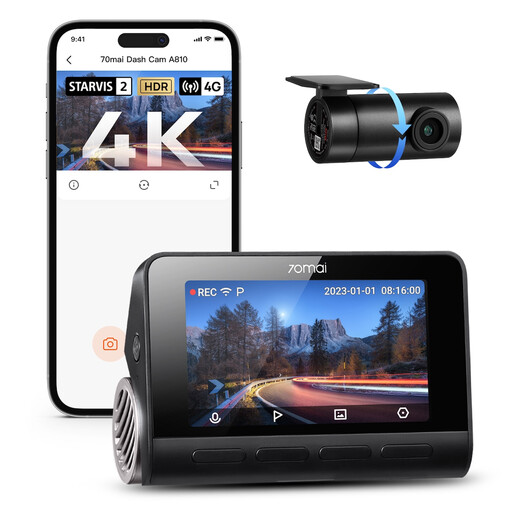
The 70mai A810-2 places its focus squarely on image quality, utilising premium sensor technology for both its front and rear cameras.
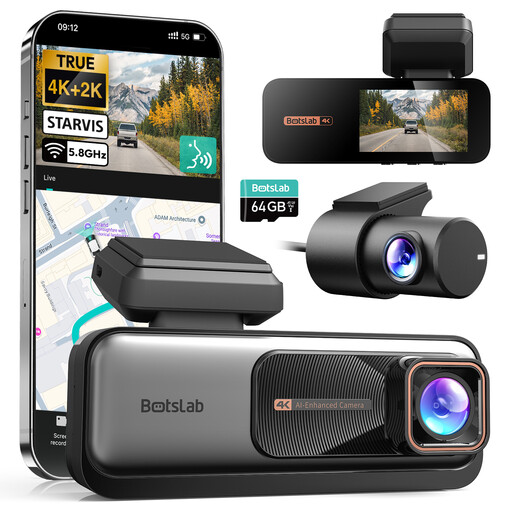
The BOTSLAB G980H offers a compelling package that combines high resolution with an exceptionally wide field of view, ensuring maximum road coverage.
View Details for BOTSLAB G980H
If the models above are not quite what you are looking for, or if you wish to explore a wider range of single-camera systems or different feature sets, we have more to see.
Explore Our Full Range of Car Camera Accessories
Yes, for many drivers, it is a worthwhile investment. The primary benefit of 4K resolution is the increased level of detail. This can be the deciding factor in being able to clearly read a number plate from a distance or identify small but crucial details of an incident, which can be invaluable for an insurance claim.
Yes, in almost all cases, a dedicated hardwire kit is required to enable parking mode. This kit connects the dash cam directly to your car's fuse box, providing constant power while the engine is off. It also includes a voltage cut-off feature to prevent the dash cam from completely draining your car's battery.
Absolutely. Dash cam footage is widely accepted by UK insurance companies and police as evidence. As long as the video is clear, time-stamped and has not been tampered with, it can serve as an impartial witness to support your claim and prove you were not at fault.