
24/7 Customer Support

Free returns

Same-day & Next-day Delivery

Quality Guaranteed

Unlock Your Welcome Offers: FREE Delivery | Up to 80% OFF | Free 30-day JoyPlus trial
Download the APP
Choosing the right cooker hood is a critical step in any kitchen renovation, yet it is often overlooked. A good extractor fan does more than just remove steam; it protects your cabinets from grease, eliminates cooking odours and contributes to a healthier home environment. However, the market is filled with models that promise much but deliver little. As a Joybuy Product Recommendation Officer, my role is to help you see past the marketing jargon and focus on what truly matters.
Before you invest, be aware of these common pitfalls that can lead to disappointment:
quiet cooker hood in name only.recirculating kitchen extractor is a necessity. The trap here is poor filtration. Low-quality carbon filters or inefficient designs can fail to trap grease and odours, simply circulating stale, humid air back into your kitchen.kitchen extractor fan 60cm wide. However, a bulky, low-hanging "chimney" or "canopy" design can feel intrusive in a smaller kitchen, creating a cramped cooking space and becoming a frequent hazard for head bumps.To ensure your new appliance is an asset, not an annoyance, focus on these core specifications.
The extraction rate, measured in cubic metres per hour (m?/h), tells you how much air the fan can move. A higher number means more power. However, this power often comes at the cost of a higher noise level, measured in decibels (dB).
For a typical small to medium-sized UK kitchen, an extraction rate between 300-600 m?/h is generally sufficient. When comparing models, look for the noise level at the maximum or boost setting, not just the minimum. A hood that operates at or below 65 dB at a functional speed offers a good balance between performance and comfort.
This is perhaps the most important decision you will make.
Modern kitchens often feature sleek, integrated appliances. A black glass cooker hood is a popular choice that complements contemporary induction hobs and cabinetry. Beyond aesthetics, an angled cooker hood offers a significant practical advantage. Its slanted profile opens up the space above the hob, improving visibility and preventing you from hitting your head while cooking—a common complaint with traditional T-shaped models.
We have analysed models based on their ability to solve common user problems while delivering on performance and design.
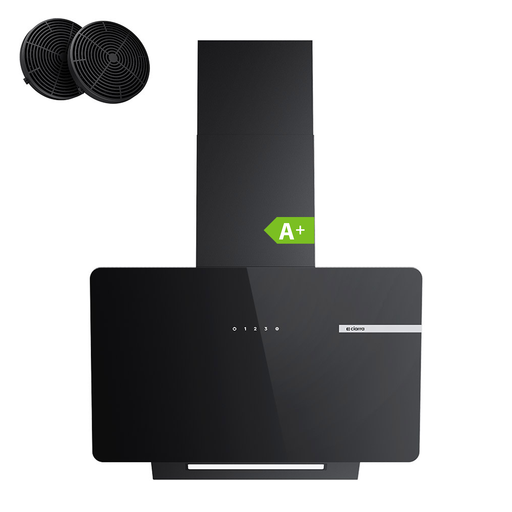
Why This Fits Their Persona: Ideal for those in flats or with compact kitchens who prioritise style and flexibility. The sleek black glass and angled design save space and look modern, while the dual ventilation system means it can be installed as a recirculating or ducted unit, adapting to building restrictions.
Its angled form directly counters the "bulky design" pitfall. It also addresses the "recirculation myth" by being designed for both modes and specifying the correct carbon filter model (CBCF055) for effective odour removal.
Features an A+ Energy Efficiency Class, which helps manage running costs. The SensorTouch controls on the glass panel provide a seamless look that is also easy to wipe clean.
While a great extractor fan handles air quality, the right lighting is essential for completing your kitchen's atmosphere and ensuring your workspace is safe and functional.
We have compiled a complete, real-time list of products that fully satisfy these strict selection criteria and UK safety regulations.
1. How often do I need to change the filters on a recirculating kitchen extractor? This depends on the filter type. The metal grease filters are reusable and should be washed every 2-4 weeks, depending on how much you fry. The carbon filters, which are essential for odour removal in recirculation mode, are disposable and typically require replacement every 3 to 6 months.
2. Is a 60cm cooker hood powerful enough for my kitchen? For a standard 60cm hob in a small or medium-sized kitchen (up to around 60 cubic metres), a 60cm wall mounted cooker hood is perfectly suitable. The key is to check that its extraction rate (m?/h) is sufficient for your room's volume, rather than just matching the hob width.