
24/7 Customer Support

Free returns

Same-day & Next-day Delivery

Quality Guaranteed

Unlock Your Welcome Offers: FREE Delivery | Up to 80% OFF | Free 30-day JoyPlus trial
Download the APP
Acrylic paint offers vibrant colour and versatility, but working with pots, palettes and brushes isn't always practical. For artists and crafters seeking precision and convenience without the mess, acrylic paint pens are an excellent solution. They combine the opaque, rich pigment of acrylic paint with the control of a marker, opening up a world of creative possibilities.
However, with so many options available, choosing the right set can be a challenge. This guide is designed to help you understand the key features to look for and to highlight some of our top recommendations, making it easier to find the perfect acrylic markers for your next project.
Before diving into specific products, consider these factors to ensure you select a set that aligns with your creative needs.
The nib or tip of the pen dictates the kind of marks you can make. There is no single "correct" choice; it depends entirely on your project.
What will you be decorating? While many are sold as multi-surface paint pens, their performance can vary. If you're creating lasting pieces, especially for outdoor display like decorated stones, look for waterproof art markers. These pens use ink that becomes water-resistant once fully cured. This makes them suitable as paint pens for rocks, paint pens for wood, ceramics, fabric and canvas. Always check the product details to confirm surface suitability.
A quality craft pens set should offer vibrant, highly-pigmented colours that provide good coverage, even on dark surfaces. Some sets also include metallic or neon shades for extra flair. Pay attention to the ink system as well. Traditional acrylic markers require vigorous shaking and priming (pressing the tip down) to start the ink flow. Newer models may feature direct-liquid systems that are ready to use immediately, offering a more consistent flow without any pumping.
Here are a few standout options that cater to different artistic needs and preferences.

Why It Stands Out: These Ohuhu paint pens eliminate the most common frustration of acrylic markers: the need for shaking and priming. The direct-liquid ink system ensures the paint is always ready to flow smoothly. A small window on the barrel even lets you see how much ink is left.
Pros:
Who is it for?
View Product Details on Joybuy.co.uk
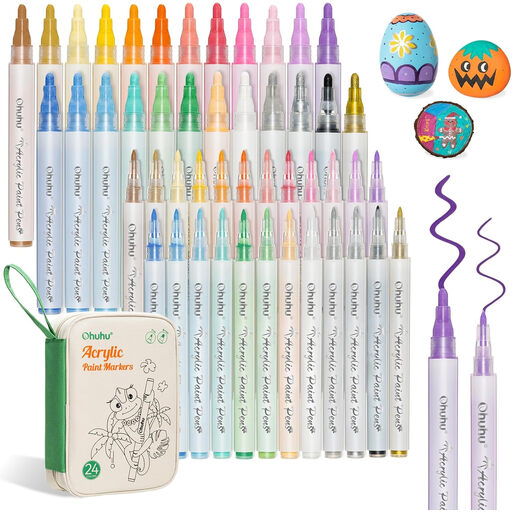
Why It Stands Out: This set is a complete solution for crafters who need both precision and coverage. It’s not a dual-tip pen, but a dual-pack system: 24 pens with a 0.7mm fine tip for intricate work, and another 24 pens with a reversible tip (1.8-2mm round or 4mm chisel) for bold lines and fills. The colours are coordinated across both pen types.
Pros:
Who is it for?
View Product Details on Joybuy.co.uk

Why It Stands Out: For those who want it all in one pen, this set of dual tip acrylic markers is an excellent choice. Each of the 60 pens features a 0.7-2mm fine tip on one end and a 1.7-3mm round tip on the other. The expansive colour selection, which includes 45 regular, 9 metallic and 6 neon shades, makes this a comprehensive toolkit for any artist.
Pros:
Who is it for?
View Product Details on Joybuy.co.uk
If the recommendations above aren't quite what you're looking for, or if you'd like to explore different set sizes and tip combinations, there are many more options to discover.
Explore Our Full Range of Acrylic Markers
1. Are acrylic paint pens waterproof? Most high-quality acrylic markers are water-based but become permanent and waterproof once the ink has fully dried and cured. This makes them ideal for projects on non-porous surfaces like ceramics, rocks and glass. For items that will be washed, like mugs, heat-setting or applying a sealant is often recommended to improve durability. Always refer to the manufacturer's instructions.
2. What surfaces can you use acrylic paint pens on? Their versatility is one of their biggest strengths. These multi-surface paint pens work well on paper, canvas, wood, rock, plastic, fabric, metal and ceramic. The smooth, opaque finish is particularly effective on both light and dark surfaces.
3. How do you activate acrylic paint pens? This depends on the ink system. For many traditional pens, you must first shake the pen well with the cap on to mix the pigment. Then, you press the tip down repeatedly on a scrap piece of paper until the ink begins to flow. However, some newer models, like the Ohuhu Direct Liquid markers mentioned above, have a ready-to-use system that requires no priming.