
24/7 Customer Support

Free returns

Same-day & Next-day Delivery

Quality Guaranteed

Unlock Your Welcome Offers: FREE Delivery | Up to 80% OFF | Free 30-day JoyPlus trial
Download the APP
Finding the right tools can transform a creative idea into a finished masterpiece. Yet, with so many options available, choosing the right acrylic paint pens can feel overwhelming. Whether you are decorating pebbles found on a beach walk, personalising a ceramic mug or adding detail to a canvas, the pen you use makes all the difference. This guide is designed to cut through the clutter, offering clear, practical advice to help you select the ideal paint markers for your next project.
As the Joybuy Product Recommendation Officer, my role is to help you make informed choices. Here, we will explore what to look for in a quality set of paint pens and highlight a few standout options available today.
Before diving into specific products, let's cover a few key factors to consider. Thinking about these points will help you narrow down your search and find the perfect match for your artistic needs.
The first question to ask is: what will you be drawing on? The effectiveness of a paint pen often depends on the surface.
Many multi-surface paint markers are formulated to work on a wide variety of materials, making them a versatile choice for general crafting.
The tip, or nib, of the pen dictates the kind of lines you can create.
The ink itself is crucial. Most acrylic paint pens use water-based ink, which is generally low-odour and non-toxic. Key properties to look for include opacity (how well it covers the surface, especially dark ones), lightfastness (resistance to fading from light exposure) and whether it is permanent or erasable.
Based on features, versatility and user feedback, here are our recommendations for acrylic paint pens to consider for your creative projects this year.

Why It Stands Out: This set from Ohuhu is all about choice and flexibility. With an extensive palette of 90 colours—including regular, metallic and neon shades—it provides a vast creative range. The standout feature is the dual-tip design on every pen, combining a 0.7-2mm fine tip for details and a 1.7-3mm round tip for coverage.
Pros:
Who is it for? This set is ideal for dedicated crafters, hobby artists and families who tackle a wide range of projects. If you value having a huge colour library and the convenience of dual tips, this is an excellent all-in-one solution.

Why It Stands Out: Unlike permanent markers, this Pentel set is designed for non-porous surfaces where you might want to change the design later. The liquid chalk formula is vibrant and opaque but can be wiped away easily with a damp cloth, making it perfect for menu boards, window displays and classroom activities. The reversible nib offers both bullet and chisel options.
Pros:
Who is it for? This is a great choice for small business owners, café managers, teachers and anyone who creates temporary signage or art on non-porous surfaces.
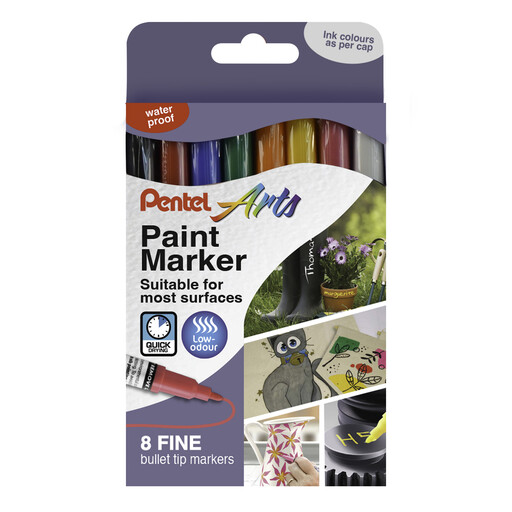
Why It Stands Out: When permanence and durability are paramount, the Pentel Fine Paint Marker delivers. Its pigment-based ink is permanent and opaque, housed in a robust aluminium barrel. This marker is designed to perform on tough surfaces where other pens might fail, including metal, plastic and rubber.
Pros:
Who is it for? Crafters, DIY enthusiasts and trade professionals who need a reliable and permanent marking tool for challenging materials will find this marker to be a workhorse. It is particularly useful for projects that need to withstand handling and time.
While these three selections cover a range of common uses, your project might have unique requirements. If you are looking for different tip sizes, colour palettes or specific ink types, there are many other choices to consider.
For a wider selection of art supplies suitable for various projects, explore our full range of Student-friendly Art Markers.
1. How do you make acrylic paint pens permanent? To ensure your artwork lasts, you often need to seal it. For non-porous surfaces like ceramic or glass, this can sometimes be done by baking the item in an oven (always follow the manufacturer's specific instructions to avoid damage). For porous surfaces like rock, wood or canvas, applying a few coats of a clear acrylic spray sealant after the ink is fully dry will protect it from moisture and fading.
2. Can you use acrylic paint pens on fabric? Yes, many acrylic paint pens work on fabric. For best results, pre-wash the fabric without softener. Once your design is complete and dry, you typically need to heat-set it. Place a cloth over the design and iron it for a few minutes (again, check the pen's instructions for recommended temperature and time). This helps make the design permanent and washable.
3. What is the difference between acrylic markers and alcohol markers? The main difference lies in the ink. Acrylic markers use a water-based, pigmented ink that is opaque, similar to acrylic paint. This means you can layer light colours over dark ones. They are great for a wide range of surfaces. Alcohol markers use a dye-based, translucent ink. They are known for their ability to blend smoothly on special marker paper and are a favourite among illustrators, but they are not as versatile for use on non-paper surfaces.