
24/7 Customer Support

Free returns

Same-day & Next-day Delivery

Quality Guaranteed

Unlock Your Welcome Offers: FREE Delivery | Up to 80% OFF | Free 30-day JoyPlus trial
Download the APP
As a new or expectant parent, preparing for your baby's arrival involves many decisions. Choosing a baby bath might seem straightforward, but the market is filled with options that can be confusing. Many parents find themselves with a tub that is awkward to use, difficult to store or that their baby outgrows in a matter of months.
Before you buy, it's worth understanding the common pitfalls that lead to wasted money and frustrating bath times.
To find a safe baby bath tub that genuinely works for you and your child, focus on these core parameters instead of marketing hype.
The material of the bath is your first checkpoint for safety. Look for tubs made from durable, BPA-free plastic. In the UK and Europe, reputable products should comply with safety standards such as EN 17072:2018. This standard ensures the bath's structural stability, the absence of sharp edges and the security of features like drain plugs, providing a baseline of safety for your child.
A baby's needs change dramatically in the first year. A good bath design acknowledges this.
A bath should make your life easier, not harder. Consider these practical design elements:
We've analysed the market based on these practical criteria. Here are some recommendations matched to different parenting needs.

Why This Fits Their Persona: This parent's primary concern is handling a slippery newborn safely. The Shnuggle bath's design is focused on providing security and confidence during those early months.
It avoids the "one-size-fits-all" trap by excelling as a specialised newborn bath. The 'bum bump' provides dedicated support that a simple large tub lacks, preventing baby from sliding.
The integrated 'bum bump' offers excellent support for newborns. Its compact, water-saving design (uses just 2 litres) keeps baby warm and is economical.

Why This Fits Their Persona: Living in a city flat or a home with limited storage, this parent needs a solution that won't clutter the bathroom. This bath is also ideal for families who travel to visit relatives.
It directly counters the "style over substance" trap by prioritising the ultimate practical feature: storage. It folds completely flat, solving a major pain point for those with limited space.
Its main benefit is the space-saving foldable design for easy storage and travel. It also includes a heat-sensitive plug that changes colour if the water is too hot.
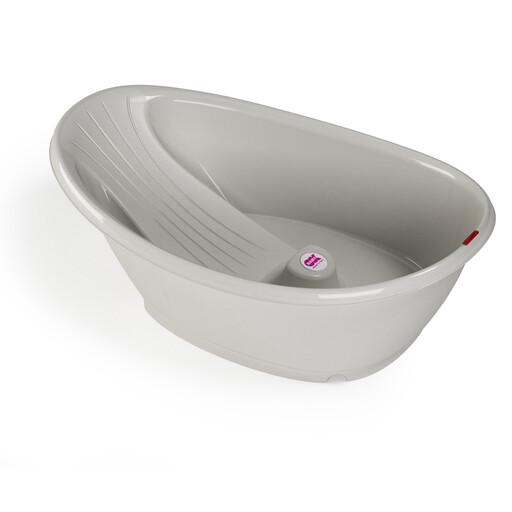
Why This Fits Their Persona: This parent wants a single, versatile product that can adapt as their baby grows through the first year, offering good value and longevity without compromising on stage-specific support.
It tackles the "grows with baby" myth by providing two distinct, dedicated seating positions within the same tub—one for reclining (0-6m) and one for sitting (6-12m)—rather than a single, compromised space.
The dual-position seat offers a genuine two-stage solution. It also includes a built-in thermometer and water level indicator, adding a layer of practical reassurance.
We have compiled a complete, real-time list of products that fully satisfy these strict selection criteria and UK safety regulations.
Most baby baths are designed for use from birth up to around 12 months, or until your baby can confidently sit up unaided and is ready for more space. Some, like the Shnuggle Toddler Bath, are specifically designed as a follow-on tub for children aged 12 months and older who have outgrown their first bath but aren't quite ready for the full-sized family tub. Always check the manufacturer's age and weight recommendations.
The safest place is a flat, stable and level surface. This could be on the floor, inside a dry adult bathtub, or in a large shower tray. Using the floor is often the most secure option as it eliminates any risk of falling. Some baths are compatible with dedicated stands, but you must ensure the bath is correctly fitted and only use the stand for the recommended age range (usually up to 6 months). Never place a baby bath on an unstable or elevated surface like a countertop or chair.
While not strictly essential, a plug is a highly recommended convenience feature. A baby bath filled with water is surprisingly heavy and awkward to lift and tip over, especially when you are also managing a wet baby. A plug allows you to drain the water easily and safely in place, reducing physical strain and mess. For most parents, this simple feature makes the post-bath clean-up significantly easier.