
24/7 Customer Support

Free returns

Same-day & Next-day Delivery

Quality Guaranteed

Unlock Your Welcome Offers: FREE Delivery | Up to 80% OFF | Free 30-day JoyPlus trial
Download the APP
Choosing the best blender for home use depends less on headline wattage and more on how, where and how often you plan to use it. A compact personal blender may suit weekday smoothies, while a hand blender is often more practical for soups, baby food and small portions.
The wrong choice can leave you with an appliance that is difficult to clean, too small for family recipes or unable to handle the ingredients you regularly prepare. This guide explains the key buying checks and highlights suitable options for different UK households.
A high wattage figure can look impressive, but it does not describe the complete blending system. Blade design, container shape, speed control and recommended operating time also affect everyday results.
For example, a powerful kitchen blender may be appropriate for ice and frozen fruit, whereas a 300W smoothie maker may be perfectly adequate for softer fruit and protein shakes. Avoid paying for power you will not use, but do check the manufacturer’s guidance if you regularly process hard or frozen ingredients.
A jug labelled 1.7L may not be intended to hold 1.7L of food during operation. Hot liquids, expanding mixtures and ingredients that need room to circulate require additional space. Check the useful capacity and maximum fill line before choosing a blender for family soups or batch preparation.
Personal blender cups, such as 475ml or 600ml bottles, are convenient for one serving but unsuitable for preparing several portions at once.
Many appliances have a motor base that must only be wiped with a damp cloth. Removable blades, shafts, jugs and lids may be dishwasher-safe, but the precise parts vary by model.
Also check whether blade assemblies can be removed safely and whether narrow areas around the blade guard can be rinsed thoroughly. Food residue left in these areas can become difficult to remove.
If you prepare hot soup, confirm the appliance is designed for hot ingredients. Some personal blenders must not process hot liquids, while a cooking blender may have specific temperature and venting instructions.
Look at the rated motor power alongside the controls. Variable speeds help you start gently to reduce splashing, while pulse and turbo settings provide short bursts for thicker mixtures.
Continuous run limits are particularly important. Several hand blenders in this guide specify operation of no more than one minute at a time, with cooling periods between cycles. This is relevant when making thick hummus, chopping hard ingredients or processing several batches.
For a family countertop blender, a 1.5L to 1.75L useful capacity can be suitable for larger recipes. Glass jugs may resist odour retention, while Tritan or BPA-free plastic containers are lighter and easier to handle.
Prioritise:
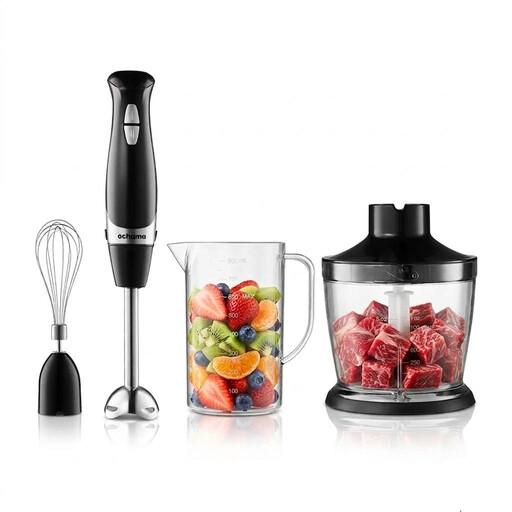
Why This Fits Their Persona: A practical starting point for UK households wanting one appliance for soups, baby food, purées, whisking and small chopping tasks.
The set provides separate 500ml chopper and 800ml beaker capacities, making its intended small-batch use clear rather than suggesting it replaces a large food processor.
600W motor, whisk attachment, two speed settings and detachable accessories for cleaning.
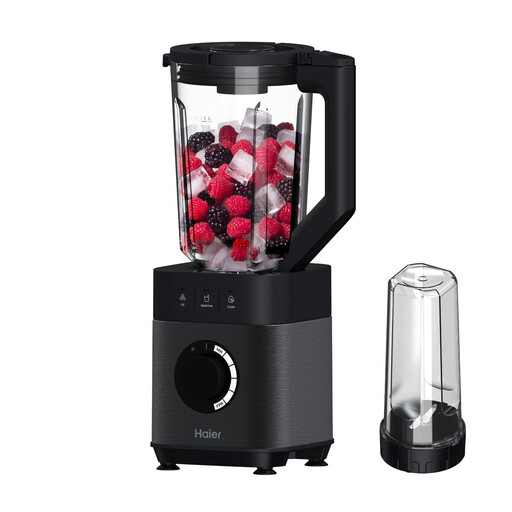
Why This Fits Their Persona: Suitable for households seeking a glass jug, multiple control options and dedicated programmes for regular smoothies, juices and ice-based drinks.
The 1.7L glass jug, five manual speeds, pulse function and safety interlock make capacity and operating controls easy to assess.
1200W motor, six-layer jug blade system, 0.6L Tritan cup and auto-clean programme.
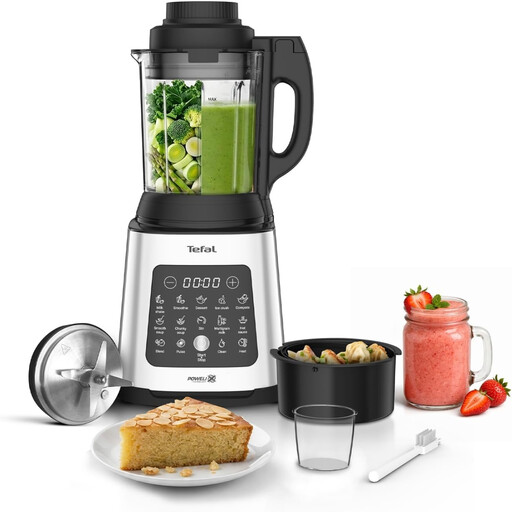
Why This Fits Their Persona: A cooking blender for households preparing soups, sauces, compotes and steamed food while aiming to reduce separate pans and appliances.
Its stated 1.75L useful jug capacity, hot and cold programmes, temperature guidance and cleaning instructions clarify what it is designed to process.
1400W power, ten automatic programmes, steam basket, heatproof glass jug and removable blades.
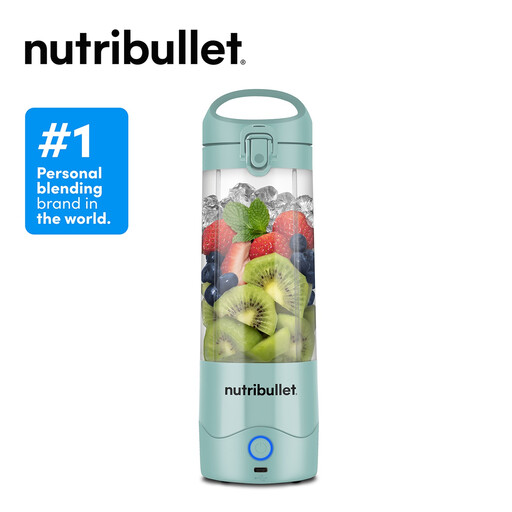
Why This Fits Their Persona: Designed for single drinks at the office, gym or while travelling, without relying on a mains socket during blending.
The 475ml cup clearly establishes its single-serving role, while USB-C charging and a stated 15+ blending cycles per charge explain its portable setup.
Cordless operation, to-go lid, extractor blade and dishwasher-safe cup, lid and blade assembly.
We have compiled a complete, real-time list of products that fully satisfy these strict selection criteria and UK safety regulations.
A hand blender, personal blender or compact smoothie maker usually takes less worktop and cupboard space than a full-size jug blender. A hand blender is particularly flexible because it can be used with a saucepan, beaker or chopper bowl.
Running cost depends on the appliance’s wattage, blending time and electricity tariff. A 1,000W blender operating for one minute uses approximately 0.0167kWh. Actual cost varies with your household tariff, so short blending cycles and sensible batch preparation can help limit consumption.
Lifespan depends on construction, frequency of use, cleaning and whether the motor is overloaded. Follow the stated run-time limits, avoid overfilling and inspect cups, seals and blades regularly. A product with accessible spare parts or a repair commitment may also be worth considering for frequent use.