
24/7 Customer Support

Free returns

Same-day & Next-day Delivery

Quality Guaranteed

Unlock Your Welcome Offers: FREE Delivery | Up to 80% OFF | Free 30-day JoyPlus trial
Download the APP
A good bookcase does more than just hold books. It’s a cornerstone of home organisation, a display for your personality and a vital piece of furniture for decluttering your living room, study or bedroom. Yet, choosing the right one can feel like a gamble. Many of us have been disappointed by a wobbly, impractical shelving unit that looked great online but failed to deliver in reality.
As the Joybuy Product Recommendation Officer, my role is to help you navigate the market and identify the features that truly matter. Before you add any bookcase to your basket, let’s look at the three most common pitfalls that lead to buyer's remorse.
To avoid these issues, focus on a few key specifications. Looking past the marketing photos and checking these details will ensure you get a functional and durable piece of furniture.
The stability of your bookcase depends entirely on its materials and build.
Never estimate dimensions. A few centimetres can be the difference between a perfect fit and a return.
Instead of a one-size-fits-all approach, we match products to specific needs. Here are a few options that address the common pitfalls for different UK households.
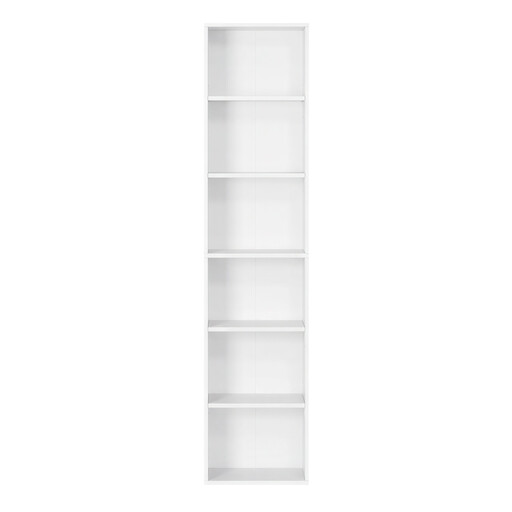
Why This Fits Their Persona: Living in a smaller flat or shared house means every square foot counts. This tall, slim bookshelf maximises vertical storage without a large footprint. Its clean, modern white bookcase design fits easily into most contemporary decor schemes.
It directly solves the 'inflexible design' pitfall with four height-adjustable shelves. It also includes an anti-tip kit to address stability concerns common with tall, narrow units.
Excellent space efficiency for small rooms. The adjustable shelving provides versatility for storing a mix of books, files and decorative objects of various sizes.
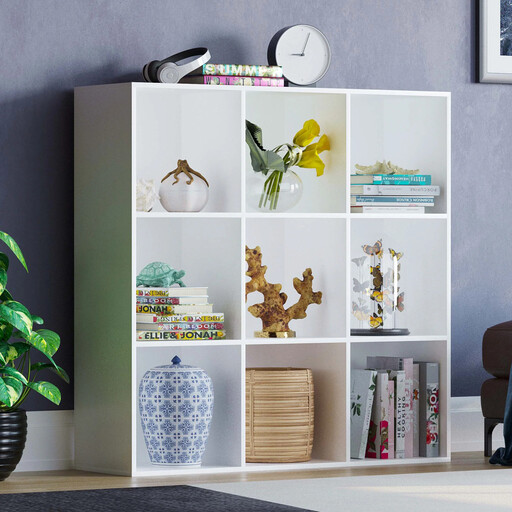
Why This Fits Their Persona: Family life requires versatile storage for books, toys, games and more. A cube storage unit is a practical workhorse for a living room or playroom, offering easy access for everyone and compatibility with common fabric storage bins.
The 3x3 grid structure is inherently stable, avoiding the 'wobble factor'. The melamine and paper veneer finish on engineered wood is more durable and resistant to scratches than cheaper alternatives, standing up better to daily use.
Highly versatile, modular-style storage. The open cubic design is perfect for organising a wide variety of items and helps keep communal spaces tidy.
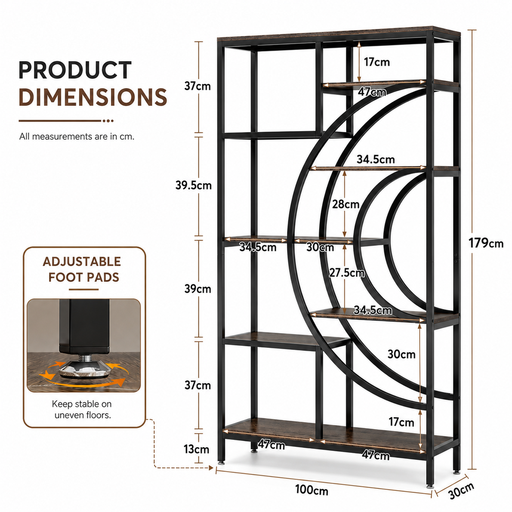
Why This Fits Their Persona: For those furnishing a modern home office or living room, a bookcase should be a statement piece. This industrial bookshelf combines a strong metal frame with a unique geometric design, serving as both functional storage and decor.
The robust, rust-free metal frame provides exceptional stability, completely eliminating the 'wobble factor'. The E1-level manufactured wood shelves are designed for durability and are waterproof and anti-scratch, avoiding the peeling finish issue.
A striking geometric design that elevates a room's aesthetic. The combination of a sturdy metal frame and high-quality shelves ensures both longevity and a high weight capacity.
We have compiled a complete, real-time list of products that fully satisfy these strict selection criteria and UK safety regulations.
1. How do I stop my tall bookcase from wobbling? The most effective method is to use the anti-tip kit that should be included with your purchase to secure it to a wall. Additionally, always place your heaviest items on the bottom shelves to lower the centre of gravity. Finally, ensure the unit is standing on a completely flat and level surface; adjustable feet can help with this if your floor is uneven.
2. What is the difference between a bookcase and a shelving unit? The terms are often used interchangeably. Traditionally, a bookcase has a solid back panel and is primarily designed for storing books. A shelving unit is often open-backed (an 'etagere' style) and can be used more flexibly as a room divider or for displaying a wider variety of decorative objects.
3. How much weight can a standard particleboard bookshelf hold? This varies significantly based on the thickness of the board and the overall construction. Always refer to the manufacturer's specifications for the max. static weight capacity per shelf. For typical flat-pack furniture, this can range from 3 kg to 10 kg per shelf. Overloading the shelves is a primary cause of bowing and long-term damage.