
24/7 Customer Support

Free returns

Same-day & Next-day Delivery

Quality Guaranteed

Unlock Your Welcome Offers: FREE Delivery | Up to 80% OFF | Free 30-day JoyPlus trial
Download the APP
The aroma of a freshly baked cake is one of life’s simple pleasures. Yet, the journey from batter to beautiful bake can be fraught with frustration if your equipment isn’t up to the task. Many of us have been tempted by a promising-looking cake tin, only to be let down by a stuck sponge, a leaky seam or a warped base.
As the Joybuy Product Recommendation Officer, my role is to help you navigate the market and find bakeware that performs reliably. Before you make your next purchase, let’s look at the common pitfalls that can turn a baking project into a kitchen disaster.
To avoid these issues, it pays to understand a few key features. Focusing on these core parameters will ensure you select a tin that lasts, performs consistently and makes baking more enjoyable.
The material of your tin is fundamental to its performance. The two most common options each have distinct advantages:
For delicate cakes that cannot be inverted, a tin with a removable side is essential.
A quality non-stick cake tin can make your life much easier, but not all coatings are created equal. Coatings like Xylan are applied to provide a durable, easy-release surface. However, the longevity of any non-stick surface depends on proper care. To protect the coating and ensure it lasts, always avoid using metal knives or utensils inside the tin. Opt for silicone or wooden tools instead, and wash by hand with a soft sponge, even if the product is listed as dishwasher safe.
To help you choose, we've matched some reliable options to different types of bakers.
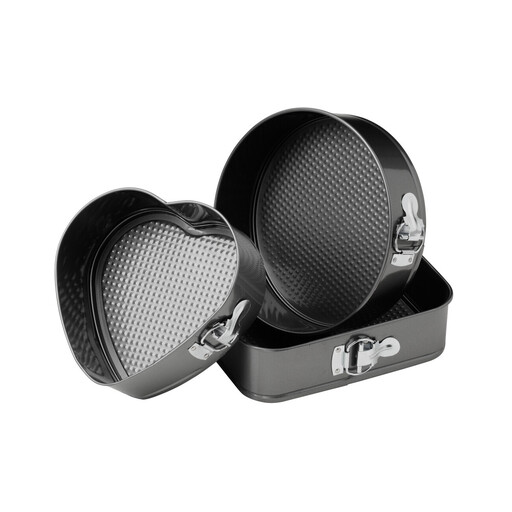
Why This Fits Their Persona: For those who enjoy baking for family gatherings or special occasions, this bakeware set offers great versatility. With a round cake tin, a square cake tin and a heart-shaped tin, you are equipped for birthdays, anniversaries and weekend treats without needing to buy multiple individual tins.
The springform mechanism is designed for simple, effective release, directly countering the "leaky seam" pitfall with a detachable base that allows for easy removal of delicate bakes.
Includes three popular shapes in one set. The non-stick coating and dishwasher-safe design simplify cleanup.
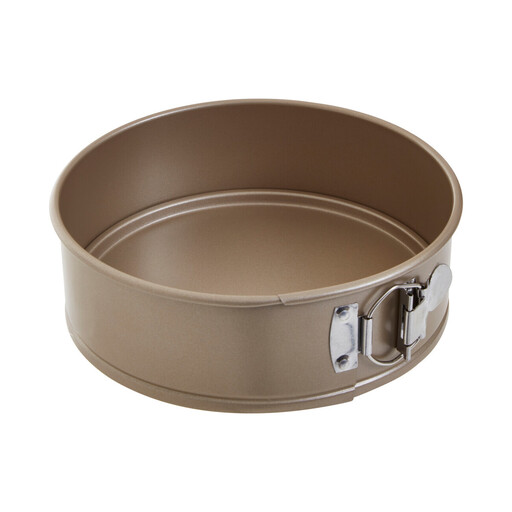
Why This Fits Their Persona: For the baker who is focused on presentation, a reliable, classic round cake tin is the canvas. This tin is ideal for creating layered cakes that require a perfect shape and clean release before decorating. Its stylish champagne finish also adds a touch of class to your bakeware collection. It's the perfect foundation piece to pair with a cake decorating kit.
The durable carbon steel construction resists warping under heat, ensuring an even bake. The reliable springform mechanism provides a clean release without damaging the cake's structure, which is crucial for decorating.
Made from BPA-free materials for safe baking. The effective non-stick coating and springform clip make it ideal for delicate bakes that need to be handled carefully.
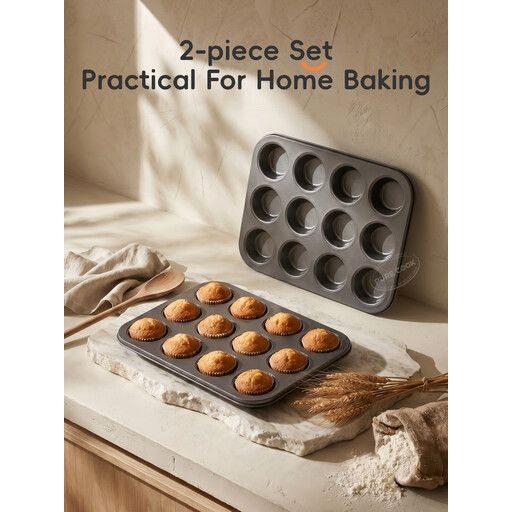
Why This Fits Their Persona: Perfect for small dessert shops, baking classes or anyone preparing for a party. This pan allows you to bake 12 uniform mini cakes, muffins or brownies at once. It streamlines production, ensuring consistency across a large batch, and is also great for portion control. It functions similarly to traditional cupcake cases but in a reusable, structured format.
The carbon steel construction provides excellent and even heat distribution across all 12 cavities, avoiding the "warping woes" and ensuring every single cake is baked uniformly without burnt spots.
High-efficiency baking for multiple portions. The food-grade non-stick coating ensures easy release without needing paper liners, making it a beginner-friendly and low-waste option.
We have compiled a complete, real-time list of products that fully satisfy these strict selection criteria and UK safety regulations.
Even with a good quality tin, very thin batters can sometimes find a way through the seam. A simple and effective trick is to wrap the outside base of the tin in a layer or two of heavy-duty aluminium foil before filling it. This creates a waterproof barrier, which is especially important if you are baking the cake in a water bath (bain-marie).
Both are designed to help you remove delicate cakes easily. A springform tin has a removable collar that unclips from the side. A loose base tin has a solid ring and a separate bottom disc that you push upwards from below to release the cake. Loose base tins are often considered more durable and less prone to leaking, while springform tins are the traditional choice for cheesecakes.
It is not recommended. Because silicone is flexible, a mould filled with batter can become unstable and difficult to handle. It may bend or tip when you move it. For safety and to ensure an even bake, always place your silicone cake moulds on a rigid, flat baking sheet before filling them and placing them in the oven.