
24/7 Customer Support

Free returns

Same-day & Next-day Delivery

Quality Guaranteed

Unlock Your Welcome Offers: FREE Delivery | Up to 80% OFF | Free 30-day JoyPlus trial
Download the APP
Finding a mains socket when you are on the road can be a challenge. Whether you are a remote worker needing to charge a laptop between meetings, a family on a long road trip with tablets to keep powered or a camper wanting some home comforts, a reliable in-car power supply is essential. A car power inverter is a simple and effective solution, converting your vehicle's 12V DC power into the 230V AC power you get from a wall socket at home.
This guide is designed to help you understand what to look for in a car inverter UK models offer and to highlight some practical options. We will focus on the features that matter, helping you find the right device to keep your electronics running smoothly, wherever your journey takes you.
Choosing the right inverter involves more than just finding a car charger with a plug socket. Here are a few key considerations to ensure you get a device that is safe, efficient and suited to your needs.
The most important specification is the inverter's power output, measured in watts (W). This tells you how much power it can supply continuously. A 300W car inverter is a popular choice as it provides enough power for common devices like laptops (typically 60-90W), camera battery chargers and small fans.
It is important to note that most vehicle 12V cigarette lighter sockets are protected by a 15A fuse, which limits them to delivering around 150W-180W of continuous power. For devices drawing more than this, or for sustained use of a 300W inverter at its maximum capacity, you may need to connect the inverter directly to the car battery using clamps. Always check your vehicle's manual and the inverter's instructions.
A 12v to 230v inverter produces AC power in one of two forms: modified sine wave (MSW) or pure sine wave (PSW).
A modern inverter should offer flexibility. Look for a model that includes at least one standard UK 3-pin AC outlet and a car inverter with usb ports for charging phones and tablets directly. Newer models may even feature USB-C Power Delivery (PD) and Quick Charge (QC) ports for rapid charging of compatible devices.
Safety should never be an afterthought. Essential safety features include protection against:
Here are a few recommended models that offer a great balance of performance, features and reliability for different user needs.
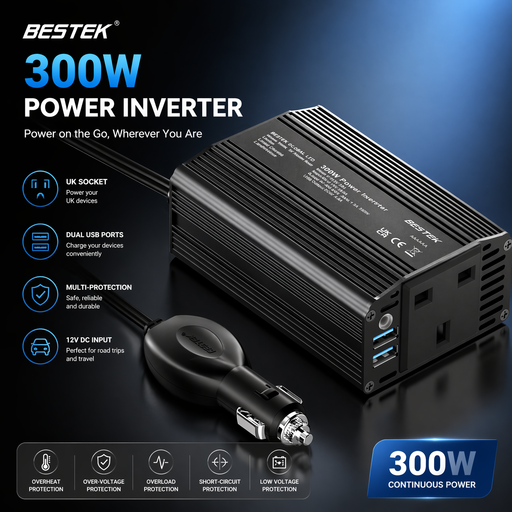
Why It Stands Out: This inverter is a versatile and highly portable all-rounder. Its smartphone-sized design makes it easy to store in a glove box or centre console, while its combination of an AC socket and dual USB ports covers most everyday power needs.
Pros:
Who is it for?: Ideal for daily commuters, families on road trips and casual users who need a reliable way to power a laptop or charge multiple USB devices simultaneously.
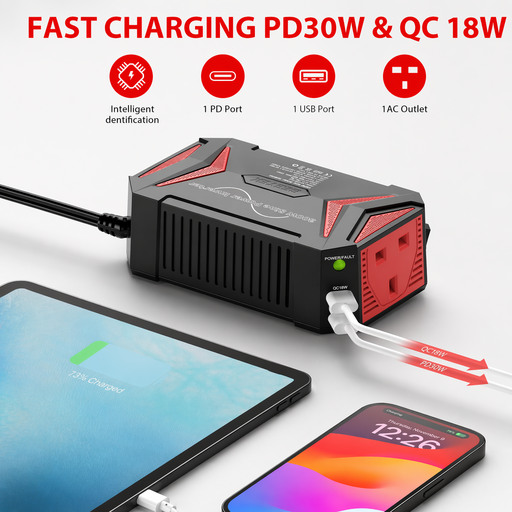
Why It Stands Out: This model combines the stability of a pure sine wave inverter 12v with modern, high-speed charging technology. The inclusion of a PD 30W Type-C port and a QC 18W USB-A port makes it an excellent choice for users with the latest smartphones, tablets and even some ultrabooks.
Pros:
Who is it for?: Tech-savvy professionals, content creators and anyone who needs to fast-charge modern devices and safely power sensitive electronics on the move.
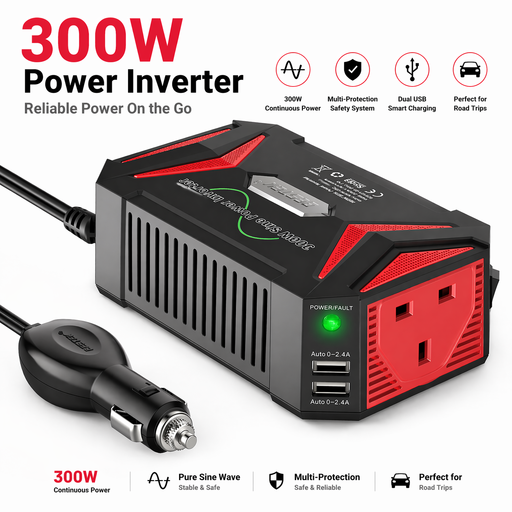
Why It Stands Out: This inverter focuses on delivering clean, reliable power for a wide range of devices. It provides the safety of pure sine wave output and features two powerful smart USB ports that automatically optimise charging speed for connected devices, making it a dependable workhorse.
Pros:
Who is it for?: Campers, boat owners and remote workers who prioritise stable power for sensitive equipment and need reliable USB charging without requiring the latest PD or QC standards.
If the models above do not quite match your specific requirements, whether you need more power or different features, there are many other solutions available.
Explore our full range of battery inverters to find the perfect fit for your vehicle and devices.
1. Can a 300W car inverter run a laptop? Yes, absolutely. Most laptops require between 60W and 90W of power to operate and charge, so a 300w car inverter provides more than enough capacity. It allows you to power your laptop and charge other devices like a phone at the same time.
2. Will a car power inverter drain my car battery? An inverter does draw power from your car's battery. To avoid draining it, it is best practice to only use the inverter while the vehicle's engine is running. Reputable inverters also include a low-voltage shutdown feature, which automatically turns the unit off if it detects the car battery's voltage has dropped to a critical level, preserving enough power to start the engine.
3. Do I really need a pure sine wave inverter? It depends entirely on what you plan to power. For charging phones, running simple fans or powering devices with basic external power bricks, a more affordable modified sine wave inverter is usually sufficient. However, for laptops, camera equipment, drones, audio systems or any sensitive electronics, a pure sine wave inverter 12v is highly recommended to prevent potential damage, noise or operational issues.