
24/7 全天候客户支持

免费退货

当日/次日达

品质保障

开启新人专享福利: 全场免邮 | 低至 2 折 | 免费试用 30 天 JoyPlus 会员
下载 Joybuy
Whether you're a remote worker finishing a presentation on the way to a meeting, a family on a long road trip or a camper needing to power small appliances, a dead battery is a common frustration. Your vehicle's standard 12V socket is fine for basic chargers, but what happens when you need to plug in a laptop, a camera battery charger or even a small fan? This is where a car power inverter becomes an essential piece of kit.
These handy devices convert your car's 12V DC power into the 230-240V AC power you get from a wall socket at home. But with so many options available, choosing the right one can be confusing. This guide will walk you through the key features to consider and present our top recommendations to help you find the right car power inverter UK drivers can rely on.
Before you buy, it's important to understand what you need. Focusing on these three points will help you select a device that matches your requirements.
The most critical factor is how much power the inverter can supply, measured in watts (W). A small inverter might offer 150W, which is sufficient for charging a phone or a tablet. However, for a car laptop charger, you'll likely need something in the 300W range. Always check the power requirements of the devices you intend to use and choose an inverter with a continuous power rating that comfortably exceeds that total. Most inverters plug directly into the cigarette lighter power adapter socket, which is typically fused at 10-15 amps, limiting you to around 150-300W.
Modern electronics demand a variety of connections. Look for an inverter that offers a combination of ports to suit your needs.
This is a more technical point, but it's crucial for certain electronics.
Here are our recommendations for car power inverters that cater to different needs, from simple device charging to powering more demanding electronics.
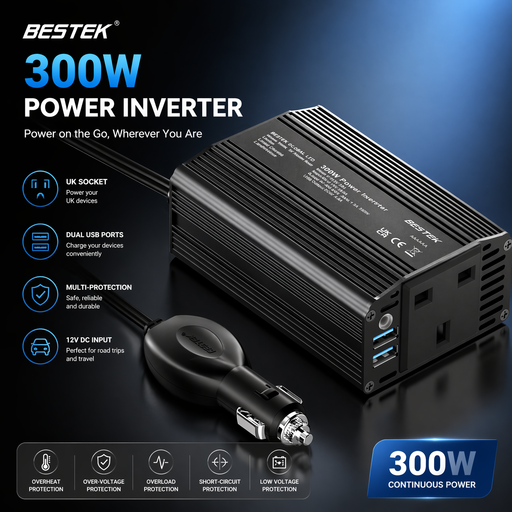
Why It Stands Out: This model from BESTEK is a practical and powerful 12v to 240v converter that balances performance with portability. Its 300W continuous output is ample for most travel and commuting needs, while its compact, smartphone-sized design makes it easy to store.
Pros:
Who is it for? This is an ideal choice for road trippers, commuters and families who need a reliable way to power a laptop and charge a couple of phones or tablets at the same time.
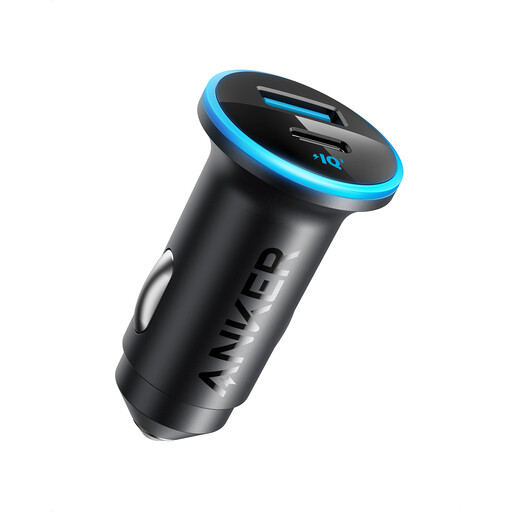
Why It Stands Out: If you don't need a full AC plug socket and your priority is fast-charging modern devices, this compact charger from Anker is a strong contender. It focuses purely on providing high-speed power through its USB-C and USB-A ports.
Pros:
Who is it for? This is perfect for individuals who primarily need to charge a modern smartphone, tablet or other USB-C powered device as quickly as possible while driving.
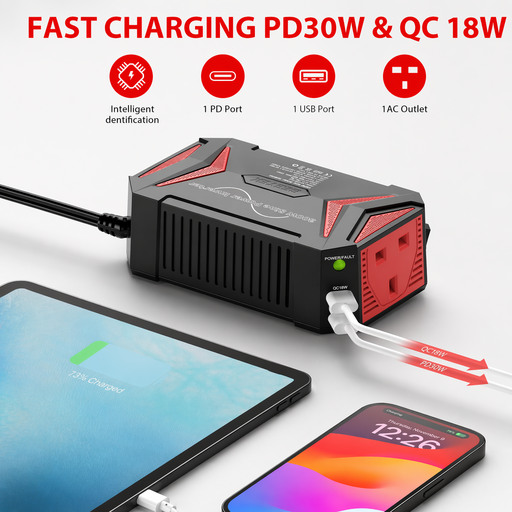
Why It Stands Out: For those powering sensitive or expensive equipment, the quality of the electricity matters. This BESTEK model provides a Pure Sine Wave output, delivering clean and stable power that is safe for modern laptops, cameras, drones and other delicate electronics. It also includes modern fast-charging USB ports.
Pros:
Who is it for? This is the go-to option for mobile professionals, photographers and anyone who needs to reliably run or charge expensive electronics like high-end laptops or camera gear without risking damage.
If these recommendations don't quite fit your needs, or if you're looking for a simpler charging solution, there are many other products to explore. For a wider selection of dedicated chargers, browse our full range of products.
[Explore our collection of USB adapter plugs here](https://www.joybuy.co.uk/explore/usb-to-plug-adapter/CvkhO17s)
Yes, if used for an extended period while the engine is off, a car power inverter can drain your vehicle's battery. Many inverters, including the ones recommended above, have a low-voltage shutdown feature to prevent this from completely draining the battery. For prolonged use, it is always advisable to run the vehicle's engine.
A 300W inverter is suitable for a wide range of devices. You can comfortably power or charge laptops, tablets, smartphones, camera batteries, portable game consoles and small corded tools. It is not suitable for high-power appliances like hair dryers, microwaves or kettles, which require significantly more wattage.
While many laptops will run on a modified sine wave inverter, it is not always ideal. The power brick can get hotter and may wear out faster. For expensive or sensitive laptops, a pure sine wave inverter is the safer choice as it provides clean power that mimics a household outlet, reducing the risk of damage to the power supply and internal components.