
24/7 全天候客户支持

免费退货

当日/次日达

品质保障

开启新人专享福利: 全场免邮 | 低至 2 折 | 免费试用 30 天 JoyPlus 会员
下载 Joybuy
Staying productive and connected on the move is no longer a luxury; it's a necessity. Whether you're a professional finalising a presentation from the passenger seat, a photographer backing up files on a road trip or a caravan enthusiast needing to power small comforts, your vehicle's standard 12V socket often falls short. Charging a phone is one thing, but what about your laptop, camera battery charger or other mains-powered devices?
This is where a car power inverter becomes an essential piece of kit. It converts your car's 12V DC electricity into 230V AC, just like the sockets at home. However, the market is filled with technical specifications that can be confusing. This guide is designed to help you understand the key features to look for and to present our recommendations for reliable power solutions for your vehicle.
Before you buy, consider these three key factors to ensure you select a device that is safe, efficient and perfectly suited to your needs.
An inverter's power is measured in watts (W). This tells you how much power it can supply. Most inverters list two figures: continuous power (the stable output for ongoing use) and peak power (a short burst for starting up devices). For powering items like laptops, drone battery chargers and digital cameras, a 300W pure sine wave inverter is often the ideal balance of power and safety for use with a standard vehicle cigarette lighter inverter socket. Always check the wattage requirements of the devices you plan to use to ensure the inverter can handle the load.
This is arguably the most important technical specification. There are two main types of inverters: modified sine wave and pure sine wave.
A modern 12v to 230v converter should offer more than just a single three-pin AC socket. To maximise versatility, look for models that include built-in USB ports. A car inverter with USB C featuring Power Delivery (PD) is particularly valuable, as it can fast-charge compatible smartphones, tablets and even some laptops directly, often serving as an all-in-one laptop car charger adapter. This reduces the number of separate plugs and adapters you need to carry.
Based on functionality, safety and user-centric design, here are our standout choices for keeping your devices powered up on the road.
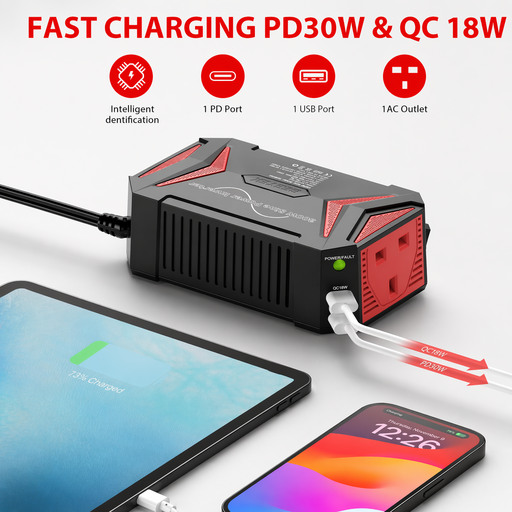
Why It Stands Out: This inverter from BESTEK is a complete power solution. It delivers 300W of continuous pure sine wave power, making it safe for all your sensitive electronics. Its main advantage is the combination of a standard UK 3-pin AC outlet with modern, fast-charging USB ports. The 30W USB-C PD port and a Quick Charge 3.0 USB-A port allow you to power a laptop via the AC socket while simultaneously fast-charging a phone and another device. Safety is also a clear priority, with a built-in 40A fuse, an intelligent silent cooling fan and protection against over-voltage, under-voltage and overheating.
Pros:
Who is it for? This is an excellent choice for road warriors, families on holiday and any power inverter for caravan or motorhome owner who needs a reliable and versatile hub to power multiple devices, from laptops to camera gear.
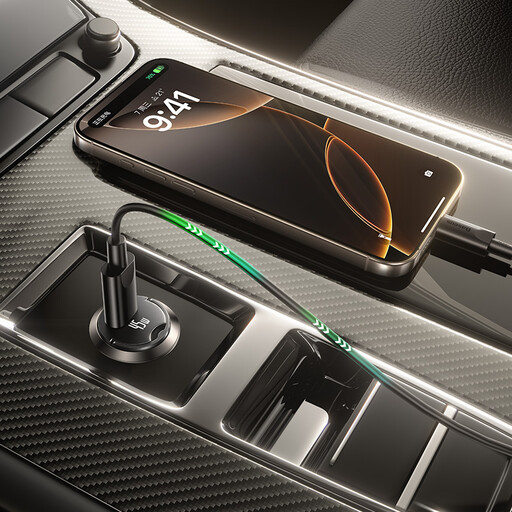
Why It Stands Out: If you don't need a full AC socket and your primary goal is to fast-charge modern USB-C devices, this compact charger from Baseus is a superb option. It plugs directly into your 12V socket and delivers a powerful 45W output from its single USB-C port. This is enough power to charge many modern laptops (like a MacBook Air or Dell XPS 13), tablets and flagship smartphones at their maximum speed. Its small footprint and premium matte finish blend seamlessly into any car interior, and it even includes a 60W USB-C to USB-C cable.
Pros:
Who is it for? The minimalist who values speed and simplicity. It's perfect for commuters and professionals who primarily use USB-C powered devices and want a dedicated, high-speed laptop car charger adapter without the bulk of a full inverter.
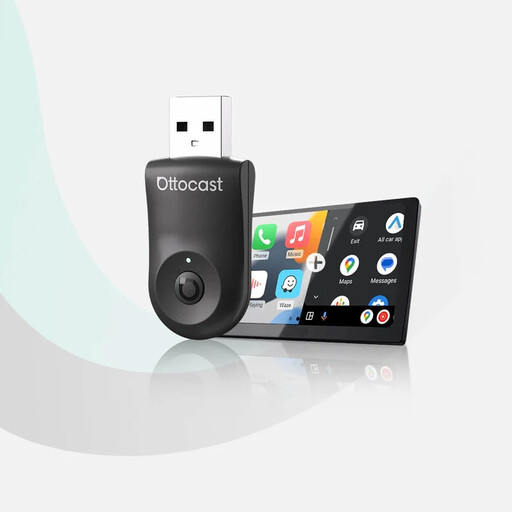
Why It Stands Out: While you're upgrading your car's power setup, consider streamlining your dashboard. If your car has factory-wired Apple CarPlay or Android Auto, the OTTOCAST Mini adapter lets you cut the cord for good. It plugs into your car's USB port and creates a wireless link to your phone. After a simple initial setup, your phone will connect automatically every time you start the car, giving you wireless access to maps, music and messages. It's a simple upgrade that makes the driving experience significantly more convenient.
Pros:
Who is it for? Any driver whose vehicle is equipped with factory-wired CarPlay or Android Auto and who wants to enjoy a seamless, cable-free connection for a cleaner and more modern in-car experience.
If your main goal is charging modern devices and you're exploring different connection types, you might find the perfect solution in our wider range of adapters. From simple plugs to multi-port hubs, there are many ways to keep your tech powered up.
Explore our full collection of USB to C adapters to find the right fit for your needs.
1. Can a 300W inverter run a laptop? Yes, in almost all cases. Most laptops require between 60W and 90W of power to operate and charge, so a 300W inverter provides more than enough capacity. For the safety and longevity of your laptop's power supply, it is highly recommended to use a pure sine wave model.
2. Will a car power inverter drain my battery? A car power inverter draws power from your vehicle's battery. If used for an extended period while the engine is off, it can drain the battery. Most quality inverters include a low-voltage protection feature that automatically shuts the unit off before the battery is fully depleted. For prolonged use, it is always best to have the vehicle's engine running.
3. What is the difference between a car inverter and a car charger? A car power inverter (also known as a 12v to 230v converter) is a device that transforms your car's 12V DC power into 230V AC power. This allows you to plug in devices that have a standard three-pin UK plug. A car charger, on the other hand, plugs into the 12V socket and provides low-voltage DC power (e.g., 5V, 9V, 12V) through USB ports (like USB-A or USB-C) to charge mobile devices directly. Some inverters, like the BESTEK model, combine both functions.