
24/7 Customer Support

Free returns

Same-day & Next-day Delivery

Quality Guaranteed

Unlock Your Welcome Offers: FREE Delivery | Up to 80% OFF | Free 30-day JoyPlus trial
Download the APP
The subtle, mesmerising glow of a starry sky inside a car cabin was once a hallmark of ultra-luxury vehicles. Today, achieving that premium 'galaxy roof' aesthetic is more accessible than ever for UK car enthusiasts. With a quality DIY car starlight headliner kit, you can transform your vehicle's interior into a personalised celestial display.
However, the market is filled with options, and choosing the right one can feel complex. This guide is designed to cut through the clutter, helping you understand the key features to look for and providing clear, practical recommendations to suit your car and your vision.
Before you add a kit to your basket, consider a few key factors. Getting these right will be the difference between a good result and a stunning one.
The number of fibre optic strands in a kit directly impacts the density and realism of your starfield. For a smaller car like a coupe or hot hatch, a kit with 400-600 fibres can provide excellent coverage. For larger vehicles such as saloons, estates or SUVs, opting for a kit with 800, 1000 or more fibres will create a much richer and more immersive effect. Also, check the fibre length. Ensure the strands are long enough to run from your planned light engine location (often in the boot or behind a pillar trim) to the furthest corners of your headliner.
The light engine is the heart of your fibre optic headliner kit. The features it offers will define the final look.
Most modern kits offer dual control methods. A physical RF remote is useful for quick adjustments, but the real customisation comes from app controlled star lights. A dedicated smartphone app typically unlocks a full colour wheel with millions of shades, pre-set dynamic modes (like fade and jump) and brightness/speed control. Many also feature a music sync mode, where the lights pulse and change colour in time with your music via a built-in microphone.
Based on features, versatility and user feedback, here are our recommendations for transforming your car's interior.
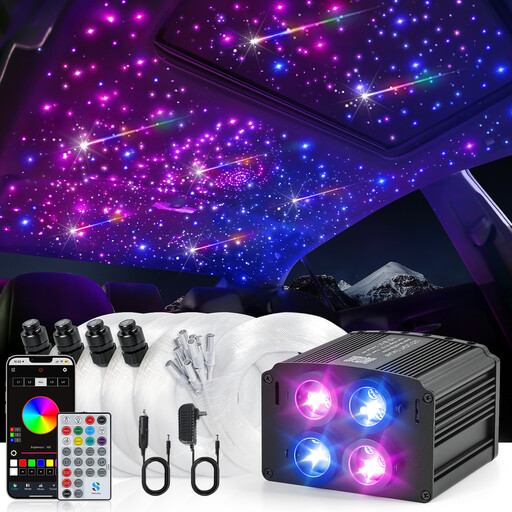
Why It Stands Out: This is a comprehensive, all-in-one solution for those who want the most dramatic effect possible. It combines a powerful 32W RGBW light engine with a very high fibre count and dedicated shooting star functionality. The 4-port engine design also allows for creating distinct colour zones across the headliner for a truly custom look.
Pros:
Who is it for: Car enthusiasts with larger vehicles (SUVs, estates, vans) who are aiming for a professional-grade, maximum-impact finish and want the full suite of dynamic effects.

Why It Stands Out: This kit’s innovative "split" design separates the light sources from the main control box. It uses four compact, individual RGBW light heads, which can make routing cables and hiding components much easier in tight spaces. It maintains a high fibre count for a detailed star pattern.
Pros:
Who is it for: The DIY installer who values a more adaptable setup and wants to create distinct multi-colour zones. It's an excellent choice for medium-sized cars like saloons and hatchbacks where space for a single large engine might be limited.

Why It Stands Out: This kit provides a fantastic balance of power and simplicity. It features the same high-output 32W RGBW light engine found in the premium meteor kit, ensuring exceptionally bright stars and a pure white colour. It focuses on delivering a high-quality twinkle starlight headliner effect, making it a strong contender for those who prioritise brightness over shooting stars.
Pros:
Who is it for: Owners of small to medium-sized cars who want the brightest possible stars and a quality twinkle effect, but don't require the added complexity or cost of a shooting star function.
If these specific kits don't quite match your project's needs, or if you're curious about different fibre counts, lengths or features, there are many other choices available. Explore our full collection to find the perfect fit for your vehicle and budget.
Browse our complete range of Fibre Optic Light kits.
Installation is a significant DIY project that requires patience and attention to detail, typically taking between 6 and 12 hours. The process involves removing the vehicle's headliner, carefully drilling hundreds of small holes, inserting each fibre, securing them and wiring the light engine to a 12V power source. While it is achievable for a confident DIYer, many people opt for professional installation to guarantee a flawless finish.
Yes, interior ambient lighting like a fibre optic headliner kit is generally legal for road use in the UK. The crucial rule is that the lighting must not distract the driver or be visible from the outside in a manner that could be mistaken for emergency service lights (e.g., flashing blue or red). As long as the effect is contained within the cabin and does not impair your forward vision, it is permissible.
Most modern vehicles with a removable, fabric-covered headliner are suitable candidates. This includes the vast majority of saloons, SUVs, coupes and estates. Cars with panoramic sunroofs present more of a challenge due to the reduced surface area, but installation is often still possible in the fabric sections surrounding the glass. It is always a good idea to inspect your car's headliner construction before committing to a purchase.