
24/7 Customer Support

Free returns

Same-day & Next-day Delivery

Quality Guaranteed

Unlock Your Welcome Offers: FREE Delivery | Up to 80% OFF | Free 30-day JoyPlus trial
Download the APP
Driving a car from before 2016 can feel like a step back in time. While it might be mechanically sound, the lack of a modern infotainment system means fumbling with phone mounts for navigation and missing out on hands-free calls and music streaming. A plug and play carplay screen seems like the perfect solution, but the market is filled with devices that promise much and deliver little.
As a Joybuy Product Recommendation Officer, my role is to help you see past the marketing jargon. Many UK drivers invest in these upgrades only to be disappointed. Before you buy, be aware of three common pitfalls that lead to buyer's remorse:
To ensure you get a reliable and genuinely useful car infotainment upgrade, focus on these core specifications. They are the true indicators of quality and performance.
For a smooth and stable wireless CarPlay or Android Auto experience, a device must have Dual-Band Wi-Fi (2.4GHz/5GHz). The 5GHz band offers a faster, less congested connection, which is critical for streaming high-quality audio and receiving real-time map data without lag. A unit with only 2.4GHz Wi-Fi is more susceptible to interference, leading to the frustrating dropouts mentioned earlier. Paired with Bluetooth 5.0 or higher, this ensures your phone and screen stay reliably connected.
When it comes to a car screen with front and rear camera, the details matter more than the marketing terms.
The main appeal of a portable carplay screen is the ability to add carplay to an older car without complex wiring or permanent modifications. A genuine plug-and-play system should draw power directly from your vehicle's 12V-24V cigarette lighter socket. This makes it universally compatible with cars, lorries and vans, and allows for installation in minutes. Be wary of models that require tapping into your car's fuse box, as this is not a simple DIY task.
Based on these practical criteria, here are some recommended options tailored to different driver needs.
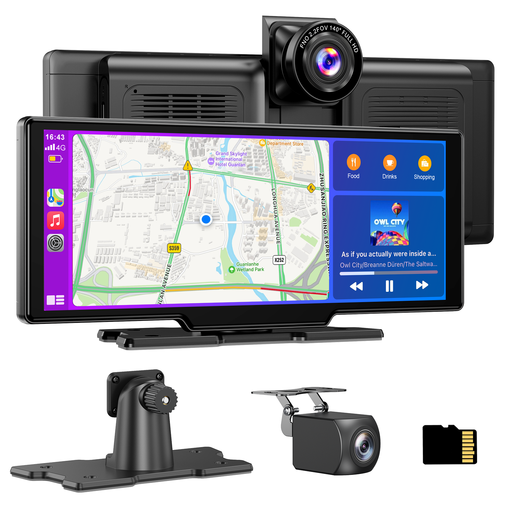
Why This Fits Their Persona: This is for the driver who wants a single, comprehensive device to handle navigation, media and journey recording. It's ideal for family cars, company vans or anyone seeking a complete tech overhaul without permanent installation.
It directly addresses all three pitfalls. It features Dual-Band Wi-Fi for a stable connection, a sharp 1600x600 screen and comes with the 1080P rear camera and a 64GB TF card included in the box, eliminating hidden costs.
A true 2-in-1 system with an integrated 4K front dash cam and a 1080p rear camera. The inclusion of a 64GB memory card means it's ready to record straight out of the box.
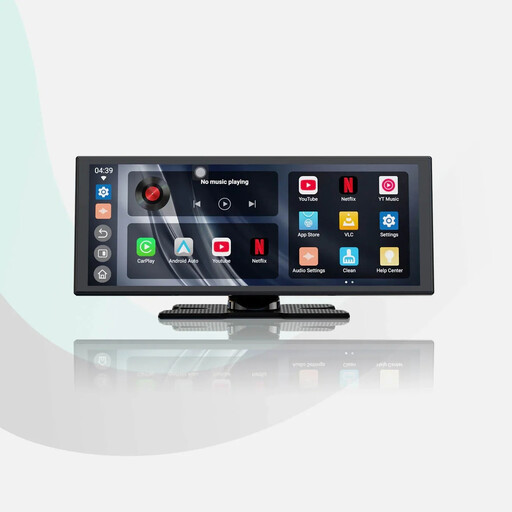
Why This Fits Their Persona: For professional drivers (lorry, delivery, rideshare) or anyone who spends significant downtime in their vehicle. The ability to watch YouTube or Netflix on a large screen during a break is a major benefit beyond standard CarPlay.
This unit features robust dual Wi-Fi and dual Bluetooth for stable connections. Its large 11.4-inch screen has an impressive 1920x720 resolution, providing an exceptionally clear picture that avoids the "HD illusion" trap entirely.
It runs on Android 13 and comes with streaming apps like Netflix and YouTube pre-installed. It functions as a mini-theatre for your car, in addition to providing wireless CarPlay and Android Auto. Includes a 1080P rear camera.
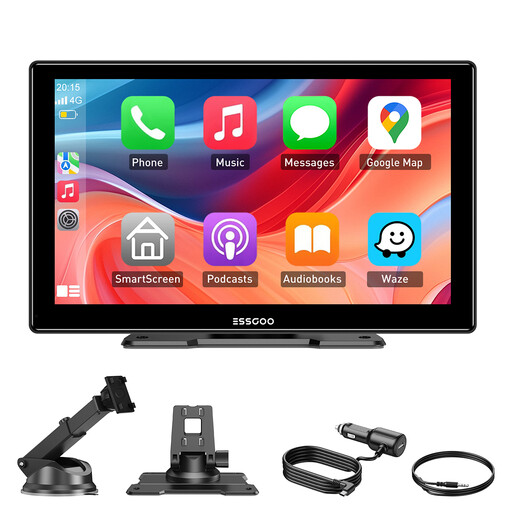
Why This Fits Their Persona: Perfect for students, new drivers or anyone who wants the core benefits of a modern infotainment system—navigation, music and hands-free calls—without the added expense of an integrated dash cam system.
This model prioritises a quality core experience. It includes Dual-Band Wi-Fi and Bluetooth 5.3 for a solid connection and has a clear 1024x600 9-inch screen. It is transparent about not including a dash cam, avoiding the "hidden costs" trap.
An affordable and reliable way to get a wireless portable carplay screen. It focuses on doing one job well: providing a stable, modern interface for navigation and media.
We have compiled a complete, real-time list of products that fully satisfy these strict selection criteria and UK safety regulations.
Yes, almost any vehicle is compatible. The primary requirement is a 12V-24V cigarette lighter socket to provide power to the unit. For audio, these screens offer multiple options: you can use the built-in speaker, transmit the sound to your car's radio via an FM frequency, connect directly with an AUX cable if your car has an input, or pair via Bluetooth to your car's existing system.
The main screen unit is a simple plug-and-play setup. Installing the included rear camera requires a bit more effort but is designed to be a DIY task. It usually involves mounting the camera near your rear number plate and running a single wire from the camera, through the car's interior trim, to the main display unit. While it doesn't require special tools, it does take some patience to conceal the wire neatly.
Yes. Integrated android auto dash cam systems are designed for convenience and safety. They feature loop recording, which means the device starts recording automatically when you start the car. When the memory card is full, it will automatically overwrite the oldest, non-essential footage. If an incident occurs, you can typically lock the current video file with a single touch to prevent it from being overwritten.