
24/7 Customer Support

Free returns

Same-day & Next-day Delivery

Quality Guaranteed

Unlock Your Welcome Offers: FREE Delivery | Up to 80% OFF | Free 30-day JoyPlus trial
Download the APP
As a Joybuy Product Recommendation Officer, I often hear from cat owners facing a common dilemma: the standard cat tree simply isn't built for their larger feline companions. Whether you have a majestic Maine Coon, a fluffy Ragdoll or a household of multiple cats, you know the sight of a wobbly, undersized tower is a cause for concern. A flimsy structure is not only a waste of money but also a safety hazard for the pets you adore.
This guide is designed to help you navigate the market and identify a cat tree for large cats that offers the stability, space and enrichment your pet needs. We will explore the key features to look for and present a few recommendations that are built to handle more substantial weight and activity levels, ensuring your cat has a safe and enjoyable space to climb, scratch and nap.
Choosing the right large cat tower goes beyond just its height. For bigger breeds or multi-cat homes, stability and size are paramount. Here are a few practical points to consider during your search.
The most critical feature of a heavy duty cat tree is its base. A wide, weighted base is the first line of defence against tipping, especially when a large cat leaps on or off. Look for models with a substantial footprint and reinforced support posts. Many reliable options also include an anti-tip kit, which allows you to securely anchor the tree to a wall. This is a simple but highly effective safety measure that provides peace of mind.
A common failing of standard cat trees is the size of the resting spots. A large cat needs a perch or bed that allows them to stretch out comfortably, not teeter on the edge. Check the dimensions of the top platforms and internal condos. An XL cat tree should feature oversized perches, ideally with raised, padded edges for comfort and security. Similarly, a cat condo for large cats should be spacious enough for them to turn around and settle in without being cramped.
The longevity of a cat tree depends on its construction materials. The frame is often made from particleboard or chipboard; look for thicker, denser boards for added strength. The scratching surfaces are equally important. A good cat tree with scratching post will use durable, natural sisal rope, which satisfies a cat's instinct to scratch while being robust enough to withstand vigorous use. The plush covering should be well-secured and easy to clean, ensuring the tree remains a hygienic and inviting spot for your pet.
Based on features that prioritise stability and space, here are our recommendations for cat trees suitable for larger cats or multiple-cat households.
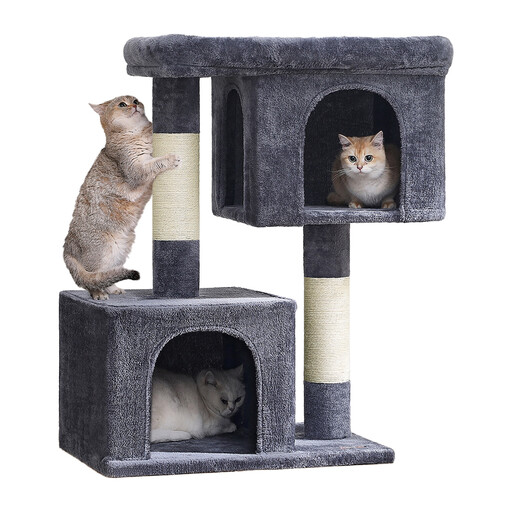
Why It Stands Out: This model is specifically designed with larger cats in mind, with a stated capacity for pets up to 20 kg. Its multi-level structure incorporates two separate cat caves, making it an excellent choice for a cat tree for multiple cats. The combination of a spacious top lounger and dual hideouts provides various options for rest and play.
Pros:
Who is it for? This is a practical option for owners of large cat breeds or those with two or more cats who need a structure that can accommodate shared use without compromising on stability or comfort.
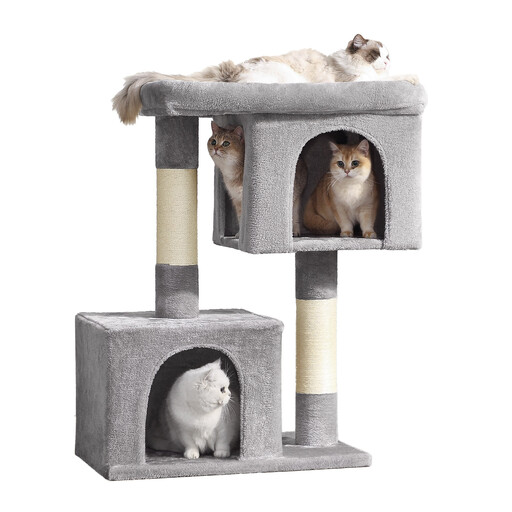
Why It Stands Out: Offering the same robust features as the dark grey version, this light grey model provides an alternative colour to better suit different home interiors. It maintains the generous perch size, dual hideouts and reliable structure needed for larger felines, ensuring you don't have to sacrifice aesthetics for function.
Pros:
Who is it for? Ideal for cat owners seeking a sturdy cat tree with a lighter colour palette to match their home decor, while still providing the necessary space and support for a large or multi-cat household.

Why It Stands Out: This Feandrea model also supports cats up to 20 kg and features a particularly large top perch measuring 68 x 48 cm. Its two caves are designed differently: an upper two-door cave offers a wide view, while a lower single-door cave provides a more secluded napping spot, catering to cats with different preferences or mobility levels.
Pros:
Who is it for? A great fit for households with cats of varying ages, sizes or personalities. The lower, more accessible cave is particularly useful for older cats or kittens, while the upper perch and cave appeal to more adventurous climbers.
While the focus here is on larger structures, we understand that every cat's needs are unique. If you are welcoming a new kitten or require a more compact scratching solution with a small footprint, you may find other suitable options.
Explore our collection of kitten scratch posts for a wider range of sizes and designs.
Check for three key features: a wide and heavy base, thick support posts and the inclusion of an anti-tip kit to secure it to a wall. Product descriptions that specify a higher weight capacity, such as up to 20 kg, are also a reliable indicator.
For a large breed like a Maine Coon, focus on the dimensions of the perches and condos, not just the overall height. Look for perches that are at least 45-50 cm wide to allow them to lounge comfortably. The overall structure should be robust enough to handle their weight and energy.
Yes, provided the cat tree is designed for it. A good cat tree for multiple cats will have several large perches, platforms or condos, allowing each cat to have its own space. This prevents competition and ensures the structure can safely support the combined weight and activity of both cats.