Choose a compact ceramic fan heater for warmth around one seated person; consider an upright or tower model when you want warm air distributed more broadly through a small room. Check the controls and protective shut-offs, but leave enough clearance for safe placement and turn the heater off when leaving the room or going to bed.
Who is it for?
People needing warmth at a desk or while seated
If warmth around one person matters more than heating the whole room, a compact ceramic fan heater with adjustable heat is the relevant format. Check that its position leaves clear space around it, especially near a bed.
People warming a small room
If several parts of a bedroom, home office or living area need warmth, compare upright and tower models with thermostat control. Oscillation may help direct airflow across more of the room, but a wattage or room-size claim alone cannot establish how well a model will heat your space.
Households with children, pets or clutter
Look for tip-over and overheat protection, then assess where the heater can stand without being knocked or placed near combustible items. Protective shut-offs do not replace supervision and safe clearance.
What matters when choosing?
Start with where the warmth needs to reach: one seated person or more of the room. Then check whether the heater can be positioned safely and whether its controls suit the time you will spend there.
| Concern | What to check | Who this matters to |
|---|
| Safe placement |
Look for tip-over and overheat protection, a UK 3-pin plug and space to keep the heater at least one metre from combustible items, as Hertfordshire County Council advises. |
In a room with pets, people moving about or nearby soft furnishings, I need a stable position and safeguards without relying on them alone. Around 42% of consumers put safe placement first. |
| Where warmth reaches |
Compare a compact personal format with upright or oscillating models; read any room-size claim for the exact model and its stated conditions. |
If I want warmth beyond my chair, I need to consider how air moves through the room, not just the maximum wattage. About 33% of consumers make where warmth reaches their primary concern. |
| Control and electricity use |
Compare heat settings and thermostat controls; check model-specific noise information if the fan will run near work or conversation. |
While I remain in the room, I want to adjust the heat without running at maximum output unnecessarily, and fan noise may matter nearby. Roughly 25% of consumers prioritise control and electricity use. |
Buying pitfalls
-
Assuming a protective shut-off makes unattended use safe
Tip-over and overheat protection address particular hazards; they do not make blocked vents, clothing over the heater or nearby combustible items safe.
Use a flat, stable position and keep the heater at least one metre from anything that can burn. GOV.UK advises unplugging electric heaters when you go out or go to bed.
-
Choosing solely by wattage or a room-size claim
A maximum power rating does not promise the same warmth in rooms with different insulation, draughts or starting temperatures.
Choose the format for the area you want to warm, and treat a stated room size as guidance for that particular model rather than a universal rule.
-
Assuming a thermostat keeps electricity use low
A thermostat may cycle the heater after the selected temperature is reached, but it does not change the power drawn while the heater runs at a given setting.
Compare the rated wattage of each setting and consider how long you expect to use it while the room is occupied.
One hour of continuous operation at 2 kW uses 2 kWh of electricity; cycling changes the actual total.
-
Overlooking basic electrical checks
A heater’s protective features do not address a damaged cable or unsuitable plug. Electrical Safety First advises buying portable heaters from a reputable retailer and cautions against second-hand heaters.
Check for a UK 3-pin plug, inspect the heater and cable on arrival, keep its vents clear and register it for recall information.
Relevant brands for reference
Dimplex
Dimplex has compact ceramic fan heaters as well as larger portable fan-heater formats to consider for supplementary warmth.
- Dimplex lists three settings, an adjustable thermostat, fan-only mode, tip-over protection and overheat safety for its compact DXUC2BS ceramic model.
- Dimplex describes its 2 kW letterbox fan-heater range as suitable only for well-insulated spaces or occasional use; check the conditions of the exact model you choose.
De'Longhi
De'Longhi’s ceramic tower range is relevant when adjustable settings and operation from across an occupied room matter.
- De'Longhi lists 1,200 W and 2,000 W settings, a safety thermostat, tip-over auto-off, a dust filter and a remote control for the HFX65V20.
- Check noise information and room suitability for the exact model rather than assuming that its tower shape establishes either.
Bush
The Bush NT20-20AR is a compact digital ceramic fan-heater option with thermostat and timer controls.
- This model is listed with a 2 kW output, three heat settings, a thermostat, a timer and a safety cut-out.
- It is stated as suitable for rooms up to 15 m² and labelled only for well-insulated spaces or occasional use; the room-size figure is a product claim, not a promise of comfort in every room.
Ceramic heaters on Joybuy
These models cover personal-zone warmth and options for directing warm airflow more broadly while a small room is occupied. Choose by the area you need to warm, then check the exact model’s controls, plug and safe placement requirements.
 No image available
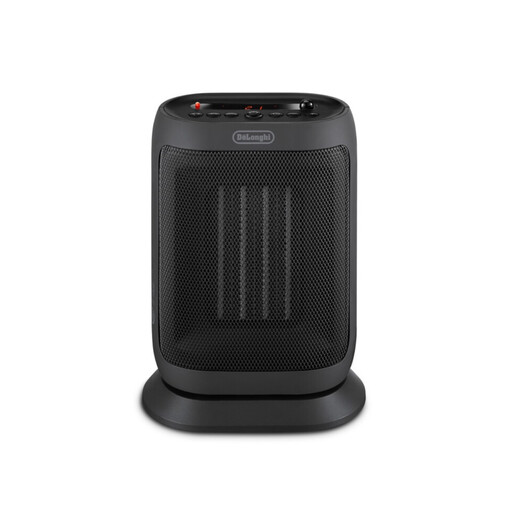
De'Longhi Capsule You & Me ceramic fan heater, 2000 W, dark grey
Consider this model when you want to direct warmth beyond one seated position during occupied use. Its product name specifies an oscillating base, remote control, 24-hour timer and ECO function; a timer is not permission to leave a heater running unattended.
Check the UK plug and model-specific noise information before choosing it.
View on Joybuy
 No image available
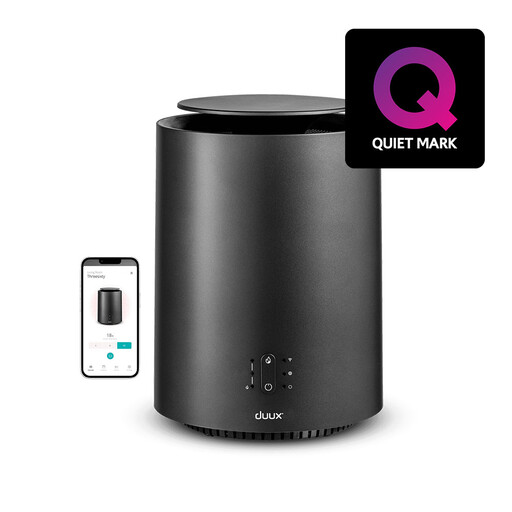
Duux ThreeSixty 2 DXCH09UK ceramic fan heater, 1800 W, black
Consider this model if directing airflow around an occupied room matters more than keeping warmth close to one seat. Its product name specifies 360° oscillation; assess where it can stand with unobstructed clearance.
Check the UK plug, model-specific noise information and suitability for your room.
View on Joybuy
 No image available
Russell Hobbs RHFH1006B portable ceramic heater, 1.5 kW, black
Consider this portable model for warmth around a seated person rather than assuming it will heat an entire room. If temperature adjustment matters, check the controls against your intended use.
Confirm the UK plug and check noise information if the heater will run near a desk.
View on Joybuy
 No image available
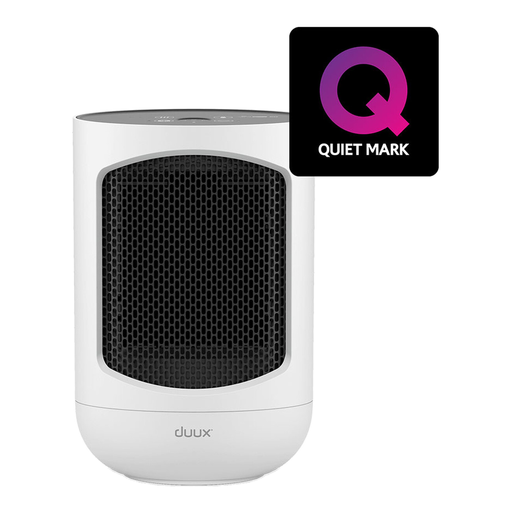
Duux Zone DXCH43UK personal ceramic fan heater, 1500 W, white
Consider this model for warmth around a desk or another seated position. Its product name specifies 60° oscillation; check the controls if maintaining a selected room temperature matters to you.
Confirm the UK plug and check noise information for close-range use.
View on Joybuy
Common questions
Can I leave a portable ceramic heater on overnight?
Turn it off before going to bed. GOV.UK advises unplugging electric heaters at bedtime; a timer or protective shut-off does not replace that precaution.
How far should the heater be from curtains and bedding?
Keep a portable heater at least one metre from anything that can burn, including curtains and bedding, as Hertfordshire County Council advises. Do not use it to dry clothes or towels.
Is a compact heater enough to warm the whole room?
Choose a compact ceramic heater chiefly for warmth around one person, not on the assumption that it will warm every part of the room. If broader warmth matters, compare upright or oscillating models and check any room-size claim against your room’s conditions.
Can a portable ceramic heater replace central heating?
Treat it as supplementary or occasional heat for this occupied-room scenario, not a whole-home replacement. Dimplex identifies relevant portable models as suitable only for well-insulated spaces or occasional use.


