
24/7 Customer Support

Free returns

Same-day & Next-day Delivery

Quality Guaranteed

Unlock Your Welcome Offers: FREE Delivery | Up to 80% OFF | Free 30-day JoyPlus trial
Download the APP
Fresh citrus juice sounds simple, but choosing the wrong appliance can leave you with a crowded worktop, difficult cleaning and less usable juice than expected. The right option depends on whether you want an occasional lemon squeezer, a convenient electric citrus juicer or a larger fruit juicer for oranges, apples and vegetables.
Before buying, look beyond power ratings and polished marketing descriptions. These are the common pitfalls that can make a citrus juicer disappointing in everyday UK use.
A higher wattage does not automatically make a citrus appliance more suitable for lemons or oranges. A manual citrus juicer may be perfectly adequate for a few lemons, while an electric model is more convenient for several glasses of juice. If you want to process hard fruit and vegetables, a dedicated centrifugal fruit juicer is more appropriate than a small citrus press.
Consider your usual quantity, preparation time and available storage space rather than focusing on motor power alone.
Juice residue and citrus oils can collect around filters, reamers and spouts. Check exactly which parts can go in the dishwasher. The motor base should never be immersed in water; it normally requires wiping with a damp cloth.
A detachable filter and jug can make a meaningful difference if you plan to use your fresh juice maker frequently.
Some people prefer smooth, pulp-free juice, while others like some texture. A filter that catches seeds and larger pulp is useful for serving juice directly, but it may require rinsing after each use. Also check whether the reamer or feed chute accommodates the fruit you actually buy, from small limes to large grapefruit.
A manual lemon squeezer is compact, quiet and does not need a plug socket. It suits occasional use, cocktails, baking and recipes requiring a small amount of juice. Clip-style squeezers can be particularly portable, although you will need to apply pressure yourself.
An electric citrus juicer is more convenient for repeated batches. Look for a simple on/off control, a stable base and a jug that can be lifted and poured without spills.
For one or two drinks, a small reservoir is usually sufficient. Families may prefer a jug around 1 litre, reducing the need to empty it repeatedly. Measure your cupboard or worktop before ordering, especially if the appliance will stay assembled.
A compact model can be more useful than a larger appliance if storage is limited in a flat or smaller UK kitchen.
For smoother juice, look for a stainless steel or integrated straining filter that separates seeds and pulp. Food-contact components should be clearly described, and BPA-free plastic is a useful specification to check where stated.
Dishwasher-safe removable parts can simplify maintenance, but always follow the supplied instructions. Rinse citrus residue soon after use to reduce build-up and odours.
Corded appliances must be suitable for the UK power supply. Check the stated voltage and frequency before use. The Kenwood model below is specified for 220–240V, 50–60Hz. Some imported appliances may list different regional variants, so confirm the product details and plug requirements before connecting one to a UK socket.

Why This Fits Their Persona: A practical choice for occasional lemon, lime or orange juice without adding another powered appliance to a smaller kitchen.
It does not rely on an oversized motor for simple citrus tasks. The integrated strainer addresses seeds and pulp, while the non-slip base helps reduce movement during pressing.
Manual operation, built-in strainer, pour spout and dishwasher-safe construction. The stated weight is approximately 0.113kg.
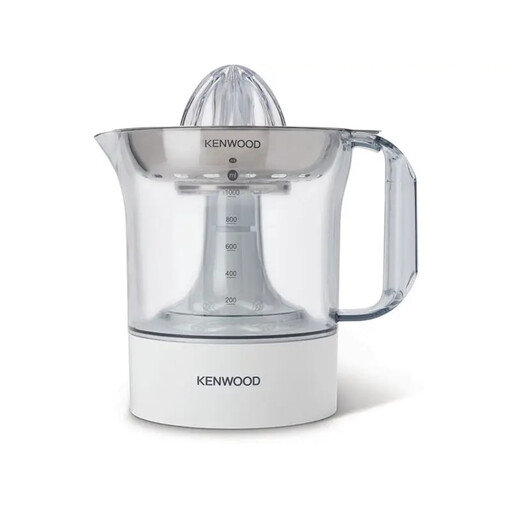
Why This Fits Their Persona: Suitable for households wanting powered extraction, a one-litre serving jug and straightforward operation for regular citrus drinks.
The universal reamer is specified for citrus sizes ranging from limes to grapefruits, while the stainless steel filter helps separate seeds and pulp rather than leaving them in the jug.
40W motor with two-way rotation, 1L transparent jug, cord storage and detachable dishwasher-safe parts. It measures approximately 21.2cm × 16cm × 21.9cm.

Why This Fits Their Persona: Designed for frequent juicing of mixed produce, including citrus, apples, berries, carrots and leafy greens, making it more suitable for family batches than a dedicated orange juicer.
Its 1.5L pulp basin reduces interruptions during larger sessions, while two speed settings allow adjustment for softer and harder ingredients. The feed chute is specified at 3 inches.
800W motor, 800ml juice pitcher, no-drip spout and dishwasher-safe sieve, pulp basin and pitcher. Check the listed voltage variant before use in the UK.
For a manual or electric citrus juicer, wash fruit before cutting it in half. Press the cut side against the reamer and avoid forcing the peel into the filter. Empty and rinse the strainer promptly, particularly after grapefruit or lemon juice, which can leave a strong residue.
For a centrifugal model, remove rinds, stones and unsuitable stems as instructed. Use only the supplied food pusher, never your fingers or kitchen utensils. Unplug the appliance before dismantling it, and wipe the motor base rather than placing it near running water.
A small electric citrus juicer generally uses less power per short session than a higher-powered fruit juicer, but actual cost depends on usage time and your electricity tariff. Manual presses use no electricity at all. For occasional lemon or lime juice, manual operation may be sufficient; frequent family batches may make powered convenience more valuable.
Many models include a filter designed to catch seeds and some pulp. However, “pulp-free” results can vary according to fruit, filter design and how finely the juice is strained. If you prefer a very clear drink, pour the juice through a separate fine sieve after extraction.
Lifespan depends on frequency of use, cleaning and storage. Avoid overloading the reamer or feed chute, allow the motor to cool where instructions require it, and replace damaged components before use. A dishwasher-safe juicer can be easier to maintain, but removable parts should still be handled according to the manufacturer’s care guidance.
We have compiled a complete, real-time list of products that fully satisfy these strict selection criteria and UK safety regulations.