
24/7 Customer Support

Free returns

Same-day & Next-day Delivery

Quality Guaranteed

Unlock Your Welcome Offers: FREE Delivery | Up to 80% OFF | Free 30-day JoyPlus trial
Download the APP
A bursting wardrobe, a mountain of laundry with nowhere to hang or the sudden need for guest coat storage—these are common household dilemmas. A clothes rail with wheels seems like the perfect, flexible solution. However, the market is flooded with options, and it's easy to end up with a wobbly, impractical rack that collapses under the weight of a few winter coats.
Before you buy, it's crucial to see past the marketing claims. Many shoppers fall into common traps that lead to disappointment and wasted money. Here are the key pitfalls to watch for:
To choose a reliable freestanding clothes rail that serves you well for years, focus on its core construction rather than just the advertised features.
The durability of a clothing rack on wheels is determined by its materials. While most use metal tubes for the rails, the critical component is the joints. A true heavy duty clothes rail will often feature all-metal construction or be made with reinforced, high-density plastic connectors designed for load-bearing. When inspecting a product, look for details on the joint material. A simple metal clothes rail with robust connectors will almost always outperform one with flimsy plastic parts, regardless of claims.
A portable rail is only useful if it moves when you want it to and stays put when you don't. Look for two key features:
Consider how you'll use the rail. For sorting laundry or organising a large seasonal wardrobe, a double clothes rail can be invaluable. It offers twice the hanging space without doubling the floor footprint, allowing for better organisation and weight distribution. Furthermore, check the height range of an adjustable clothes rail. For hanging long coats or dresses, you'll want a maximum height of at least 150cm to ensure garments don't drag on the floor or the base shelf. This turns a simple rack into a functional portable wardrobe.
To help you choose, we've matched some well-regarded options to common user needs, focusing on how they address the pitfalls we've discussed.
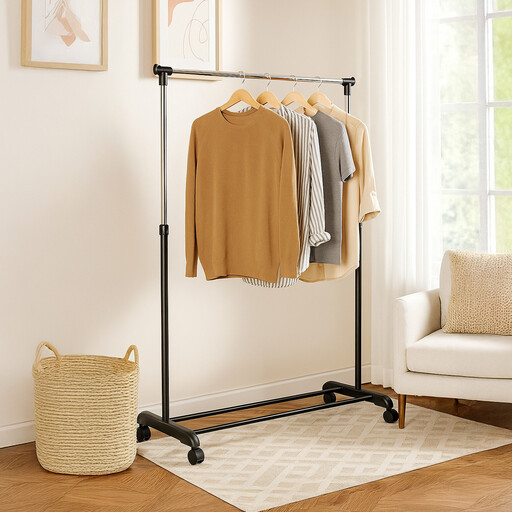
Why This Fits Their Persona: Ideal for students in dorms, renters in small flats or anyone needing a simple, temporary storage solution. Its lightweight frame and tool-free assembly make it easy to set up, move and store away when not needed.
It has a clearly stated, realistic weight capacity of 10kg. This manages expectations and discourages the overloading that causes flimsier rails to fail.
Effortless, tool-free assembly and a highly portable, lightweight design. The adjustable height (up to 160cm) is suitable for longer garments.
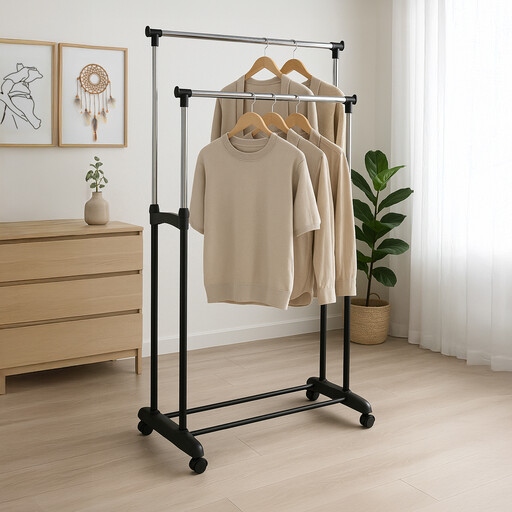
Why This Fits Their Persona: Perfect for families needing an overflow for seasonal wardrobe swaps, a drying rack for laundry day or a temporary closet for a guest room. The dual rails provide excellent organisational capacity.
The double rail design encourages better weight distribution, reducing the focused strain that causes single rails to buckle. The 15kg capacity is more robust for household use.
It doubles the available hanging space on the same floor footprint, making it highly efficient for sorting and storing clothes.
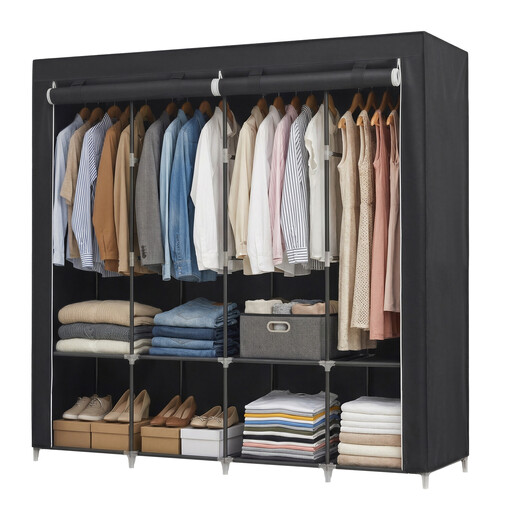
Why This Fits Their Persona: For those who need a complete wardrobe replacement or a large-scale storage unit without committing to permanent furniture. It's a full-featured portable closet with space for hanging clothes, folded items, shoes and accessories.
As a large, high-capacity unit, it directly addresses the stability risk by including an anti-tip kit to secure it to a wall, acknowledging that freestanding stability has its limits.
It offers a massive, organised storage system with four hanging rails, shelves and side pockets, providing a comprehensive solution far beyond a simple rail.
We have compiled a complete, real-time list of products that fully satisfy these strict selection criteria and UK safety regulations.
The stated weight capacity (e.g., 10kg, 15kg) is typically the maximum static load, meaning the weight it can hold when stationary and evenly distributed. For safe, real-world use, it's wise to stay below this limit. Avoid hanging all your heavy items, like winter coats, on one end of the rail. Distributing the weight evenly is the best way to prevent buckling and tipping.
Most modern clothes rails designed for home use are straightforward to assemble. Many feature simple click-and-lock systems or require only basic tools. The products recommended here, for instance, are designed for simple self-assembly with clear, easy-to-follow instructions included.
Yes, a metal clothes rail can be an excellent tool for air-drying laundry, especially for items you don't want to put in a tumble dryer. However, ensure the rail is made from a rust-resistant material like stainless steel or has a protective powder coating. Remember that wet clothes are significantly heavier than dry ones, so be careful not to exceed the rail's weight capacity.